Pepsi drip: what the name means, and what to buy
Pepsi drip is the trade name for flat drip tape. What it costs per metre, how it differs from round inline pipe, and when the thin wall is the right buy.
5 September 2026 · 4 min read · REDYPLAST
Ask for pepsi drip at an irrigation counter anywhere in Telangana and the shopkeeper knows exactly what you mean. Type pepsi drip into Google and almost nothing useful comes back — because the catalogues call the same product flat drip tape, or inline flat drip pipe, and never use the name the market actually speaks.
This page closes that gap: what the name refers to, what it costs per metre against ordinary round drip pipe, and when each is the right money.
Where the name comes from
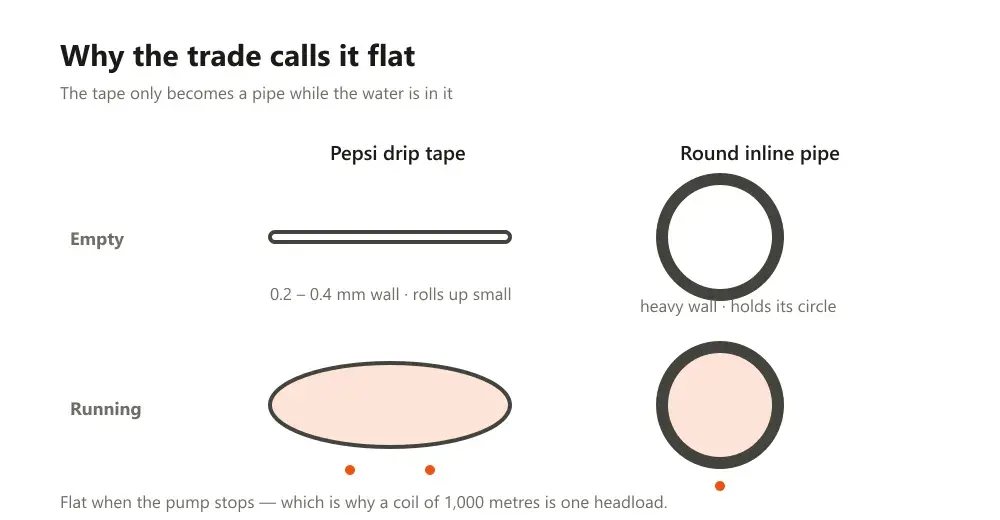
Pepsi drip is flat drip tape: a 16 mm drip lateral extruded as a thin-walled flat tube, with the emitters built in at fixed spacing. Empty, it lies completely flat, like a ribbon. Charged with water, it rounds out and drips exactly like any other lateral.
The name has nothing to do with the cola company. It comes from the flat plastic tubes that ice candy is sold in across rural India — everyone calls those pepsi, the flat rolled tape looks just like a giant version of one, and the name stuck. Dealers, mechanics and farmers all say pepsi; printed price lists almost never do. Knowing both names is the difference between finding the product and not.
What pepsi drip is not
So a farmer who asks for "pepsi pipe" meaning delivery hose, or for "flat pipe" meaning drip tape, can ride home with the wrong coil entirely. The one-word check that prevents it: ask whether the pipe has drippers. If the answer is no, it is conveyance, not irrigation.
The name causes real ordering mistakes, because several flat products live on the same counter. Pepsi drip has emitters built into it — that is the whole point. Flat pipe without emitters is a different product doing a different job: LDPE lapeta hose and lay flat tube move water from the pump to the field, and neither drips a drop on the way.
Pepsi drip against round inline pipe
Both are 16 mm laterals with factory-fitted emitters, both run at low drip pressure, and both carry 5% GST as micro-irrigation. The difference is the wall.
Tape walls are 0.2 mm or 0.4 mm — thin enough to flatten, light enough that a 1,000 metre coil is one person's headload. Round inline pipe carries several times that wall, holds its shape empty, and shrugs off the dragging, treading and sun that would finish a tape.
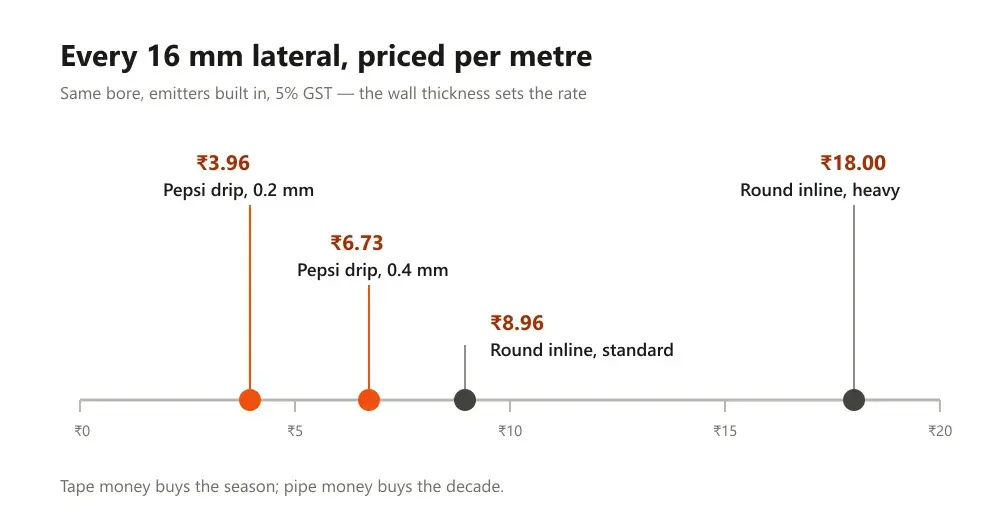
The wall difference is the price difference, per metre at our published MRP:
So the cheapest tape lays an acre's laterals for less than half of what standard round pipe would, and the fittings are shared either way — the 16 mm takeups, joiners and end caps are ₹6 apiece across the whole drip irrigation range.
- Flat tape, 0.2 mm wall — ₹3,960 for a 1,000 m coil, about ₹3.96 a metre. A 700 m coil is ₹2,862.
- Flat tape, 0.4 mm wall — ₹3,366 for 500 m, about ₹6.73 a metre.
- Round inline, standard wall — ₹4,482 for 500 m (₹2,689 for 300 m), about ₹8.96 a metre.
- Round inline, heavy wall — ₹7,200 for 400 m, ₹18 a metre.
When the tape is the right buy
Pepsi drip earns its place wherever the lateral comes out of the field every few months. On vegetables replanted two or three times a year, the line is laid, used for ninety days, rolled up and relaid — the 0.2 mm tape is built for exactly that life, and at ₹3.96 a metre, replacing a damaged stretch is a small event rather than a loss.
Choose round pipe instead when the system is meant to stay: orchards, banana, sugarcane, any layout you intend to leave in place for years. The heavy-wall round lateral at ₹18 a metre costs more than four times the thin tape, and over a decade of not being replaced it is the cheaper pipe.
The 0.4 mm tape is the same idea with one more season of toughness, and it is what our one-acre cotton costing puts on a full-length crop: still tape money, but a wall that stands being walked past and baked for the months cotton sits in the ground.
What thin walls demand in return
- Filtration is not optional. A 0.2 mm emitter path blocks on the same grit a thicker lateral shrugs off — we do not stock filters, so plan that purchase separately, and read [why drip lines block](/blog/why-your-drip-line-keeps-blocking) before the first season, not after it.
- Rats, stubble and rough handling eat tape first. Roll it up promptly at season's end and store it shaded — an afternoon of care buys the next crop's lateral.
- Lay it with the emitters up and stake the ends. A flat tape twists more easily than a round pipe, and a twisted run waters nothing past the twist.
- Do not judge tape by the coil price. A ₹3,960 coil sounds dearer than a ₹2,862 one, but one is 1,000 metres and the other 700 — divide by the metres before comparing anything.
Ordering it by its real name
On our listings the product appears as inline flat drip pipe — Aquaflow for the 0.2 mm tape, Ultraflow for the 0.4 mm — all 16 mm, all with emitters in. That is the pepsi drip you asked the counter for, in catalogue language.
One note on how it ships: tape coils are packed five to a bundle, but the bundle is packaging, not a minimum — one coil is orderable, and the listed price is the price of one. The same goes for the ₹6 fittings, which are boxed in hundreds; count what your rows need and order that number.
Work out the metres your field needs from rows and spacing with the system estimator, then order coils by length, not by count. And if you are weighing tape against round pipe for a specific crop and holding, send us the details — we sell both, so the honest answer costs us nothing.
Keep reading
Drip for vegetables: tape, joiners and the relay year
Vegetable plots replant two or three times a year, and drip for vegetables has to keep up: thin tape, a box of joiners, and what the spine costs.
GuidesHow to size a drip irrigation system in two numbers
Our estimator sizes a drip system from just crop and acres. Here is what it assumes, which numbers to check on your own field, and when to trust the result.
GuidesWhat one acre of drip actually costs, itemised
A real bill of materials for one acre of cotton drip, at our own published MRP. The total is ₹29,133, and one decision inside it moves that by ₹7,722.