How to size a drip irrigation system in two numbers
Our estimator sizes a drip system from just crop and acres. Here is what it assumes, which numbers to check on your own field, and when to trust the result.
7 September 2026 · 3 min read · REDYPLAST
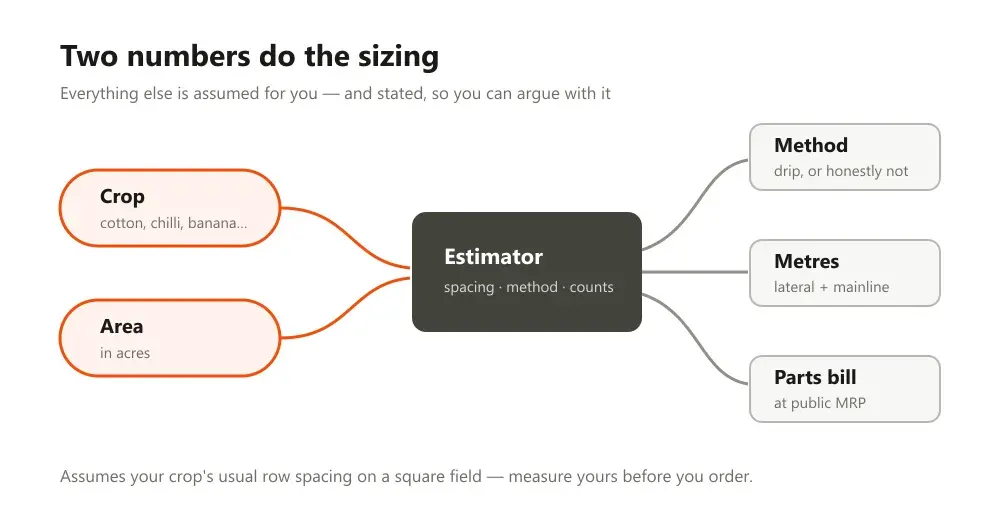
This page is the manual the form deliberately does not carry: what those two numbers stand for, what the tool assumes on your behalf, and which of its assumptions are worth checking against your actual field before you spend.
Working out how to size a drip irrigation system sounds like a job for an engineer, and for a large farm it genuinely is. For everyone else, our system estimator collapses the arithmetic to two questions — which crop, how many acres — and returns the method that suits it, the metres of pipe it takes, and a parts bill at our published MRP with GST already inside.
What the estimator does with so little
From there it counts the rest — takeoffs, joiners, end caps — and prices every line from the live catalogue. Nothing is quoted that is not stocked, and each price can be checked on the listing it came from. The agronomic assumptions behind the plans follow the published ICAR and BIS guidance, and the tool says so at the bottom of the page.
Pick the crop and it picks the method — drip for the spaced, long-season crops, and it will honestly say rain pipe where that fits better, for the same reasons our method-by-crop guide spells out. The crop also brings its typical row spacing, and spacing times area is what turns acres into metres of lateral.
One number it produces deserves respect before any shopping happens: the metres. Pipe is the bulk of the money in a real one-acre costing, so whatever sharpens the metres sharpens the whole estimate.
Measure your rows before you trust the metres
The estimate works on the crop's usual row spacing and a square field. Your field is neither usual nor square, and row spacing is the single strongest lever on the answer — plant the same acre of cotton at 0.9 m instead of 1.2 m and it needs roughly a third more lateral, because every extra row is a whole extra run of pipe.
So measure, once, properly:
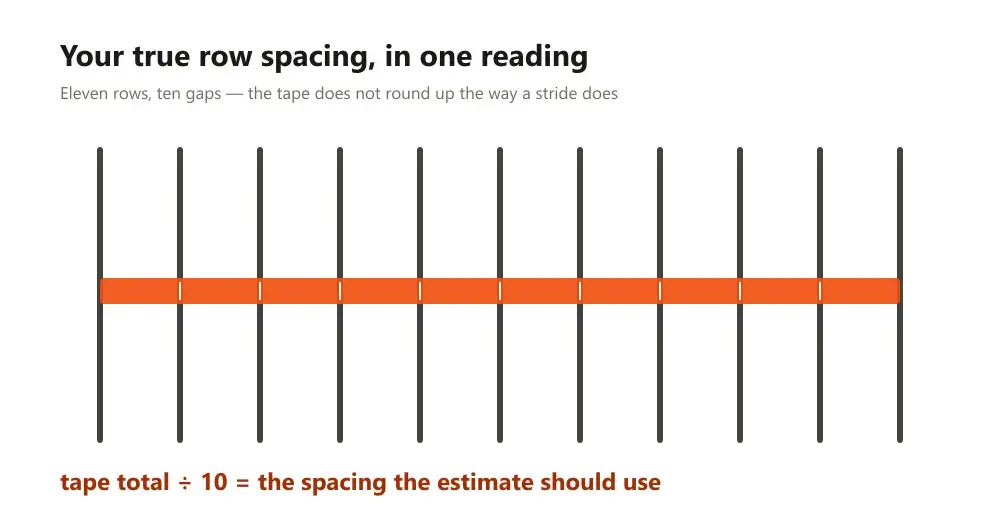
- Lay a tape across ten row gaps, read the total, divide by ten. That is your true spacing — pacing it out is how a third of an acre of pipe goes missing.
- Measure the length and breadth of the block you will actually irrigate, not the patta area. Bunds, paths and the pump corner do not need laterals.
- Note which way the rows run. Laterals run along the rows; the mainline runs across their ends — a long, narrow field needs different lengths of each than a square one.
The numbers the form never asks for
A form this short earns its simplicity by leaving three things to you.
Your water quality decides the filtration. Drip emitters block on silt, iron and algae, and the estimator cannot see your source. We say it plainly everywhere it matters: we do not stock filters, so that line belongs in your budget even though it will never appear on our bill.
The pump's own answers are stamped on its plate, and reading it takes a minute. The delivery size — 2 inch on most single-borewell submersibles — is the floor for your mainline bore; running narrower pipe off it throttles the pump from the first metre.
The horsepower and, on submersibles, the stage count say roughly how much water and pressure it can give, which decides whether the whole area runs at once or in blocks. Where the plate lists head and discharge, those two figures are the pump's honest capacity in writing.
If the plate is worn smooth, as many are, do not guess. Photograph what remains, note the outlet size with a thread gauge or a known fitting, and the motor's amperage from the starter — between them, any pump mechanic or our counter can place the pump closely enough to size pipe for it.
Your water supply sets the real ceiling. A borewell delivers what it delivers, for as many hours as the power allows, and no estimate of pipe changes that arithmetic — start with the water requirement calculator to see what your crop drinks, and plan to irrigate in blocks if the bore cannot carry the whole area at once.
Your pump decides the bores. The estimate's pipe still has to match the pump's outlet and the run to the field — the pipe size guide covers that step, and it is worth reading before the mainline is ordered.
How to size a drip irrigation system you can defend
Run the tool twice. First with just the two inputs, for the honest ballpark — that is what the defaults are for, and a ballpark today beats a perfect number never. Then again after the tape measure has been to the field, with your real spacing and block size in mind, and watch which lines move.
The result is not a contract; it is a shopping list with its assumptions stated, which is precisely what makes it arguable. Check any price against the public listing. Question any count against your row arithmetic. And when the two runs disagree, the field is right and the default is not.
If the numbers still feel uncertain — an odd-shaped holding, two crops sharing a pump, a bore you do not trust — send us the details with the estimator's output attached. Correcting a written list is quick work, and it is exactly the conversation the tool exists to start.
Keep reading
Drip for vegetables: tape, joiners and the relay year
Vegetable plots replant two or three times a year, and drip for vegetables has to keep up: thin tape, a box of joiners, and what the spine costs.
GuidesDrip for banana: sizes, grades and the two pitfalls
Which drip laterals suit a banana crop, why the heavy wall earns its keep over a year in the ground, and the two mistakes banana buyers repeat.
GuidesDrip for sugarcane: built to outlast the ratoons
Drip for sugarcane stays buried for years, not months. The wall that survives ratoons, the paired-row lever, and what the water bill says.