Drip irrigation layout for one acre of chilli, worked
A drip irrigation layout for one acre of chilli at 60 cm rows, fully counted — 105 laterals, seven coils of tape, valves, pump hours and the total.
22 September 2026 · 3 min read · REDYPLAST
Here is a drip irrigation layout for one acre of chilli, counted to the last end cap. The assumptions are printed, the parts carry our shelf prices, and where your plot will disagree with the page, the closing section says which numbers move and which stay put.
The row spacing does most of the deciding. Chilli at 60 centimetres packs 105 rows into an acre — pipe on a scale the crop's own guide warns about — and a plan that manages 105 of anything needs to be boringly systematic. So this one is.
The assumptions on the table
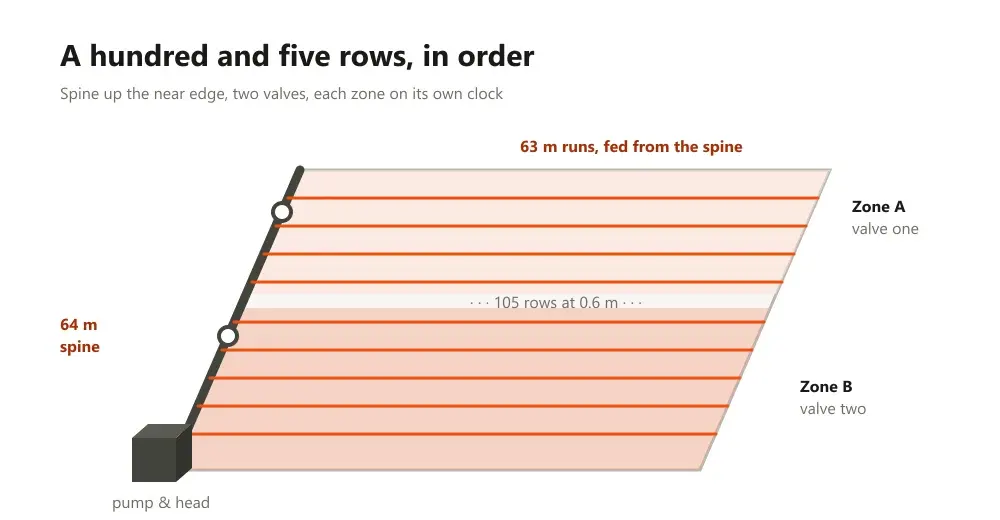
A square acre, 64 by 63 metres, workable slope. Rows at 0.6 metres running the 63 metre direction: **105 laterals of 63 metres**, totalling 6,615 metres of line. The spine crosses the 64 metre end where the pump sits, and the block is split into two valve zones of roughly fifty rows each — for reasons the pump section makes unavoidable.
Tape is the lateral here, not by economy alone but by fit: an annual crop, lifted with it. This sheet uses the 16 mm, 0.2 mm-wall flat tape in 1,000 metre coils.
Seven coils, and fittings counted in pieces
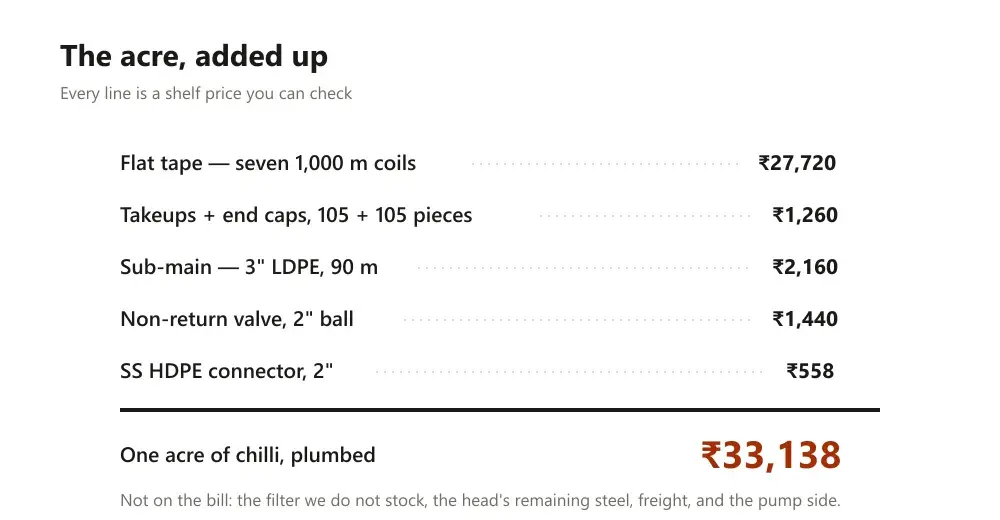
Divide 6,615 metres by thousand-metre coils and buy seven at ₹3,960: **₹27,720**, with 385 metres spare — margin this row-count will absolutely use during transplant week.
The small parts teach a buying rule worth knowing. You need 105 takeups and 105 end caps, and the online floor on these ₹6 fittings is 100 pieces — a floor, not a carton size. So the order reads 105 and 105, priced per piece: **₹1,260** the pair, not two-boxes-each at double the money. Add a fistful of ₹6 joiners for tape mends; tape years eat them.
Spine, head and the two valves
The two ball valves are not optional trim on this crop. They split 105 rows into two zones that water on their own clocks — and chilli gives that split a second job beyond pump arithmetic: when flowering arrives block by block, the valves let the stressed half drink first.
One 3-inch LDPE coil — 15 kg, 90 metres, **₹2,160** — runs the 64 metre boundary with the stub to the pump stand. At the head sit the two parts no sheet should omit: the ball-type non-return valve in 2 inch (**₹1,440**) and the SS HDPE connector (**₹558**) making the steel-to-plastic joint honestly. The rest of the head's steel — bends, nipples, the solvent tin — follows your pump stand, priced part by part here.
Pump duty: the honest hours
Chilli draws 3 to 5 mm a day at its peak — roughly 12,000 to 20,000 litres landing on this acre daily, or 13,500 to 22,500 lifted once drip's efficiency is counted. On a 3,000 litre-per-hour bore that is **four and a half to seven and a half pumping hours a day** in the hard weeks.
That fits inside most power windows — as one block. Run zone A in one slot and zone B in the next and each valve's turn halves, which is the slack that saves the flowering weeks when the supply hiccups. The water requirement calculator re-runs these litres for your bore and acreage in under a minute.
The bill, one column
**₹33,138**, MRP with tax inside, each line checkable on the drip and LDPE ranges. Chilli's acre lands near cotton's famous ₹29,133 despite double the laterals — thin tape is what closes the gap. Outside the column, as always: the filter this crop's tape genuinely requires and we plainly do not stock, the head's remaining steel, freight, and everything pump-side.
- Flat tape, seven 1,000 m coils: ₹27,720
- Takeups and end caps, 105 + 105 pieces: ₹1,260
- Sub-main, 3" LDPE 90 m: ₹2,160
- Non-return valve, 2" ball: ₹1,440
- SS HDPE connector, 2": ₹558
The variant that rewrites the sheet
One planting style deserves its own paragraph before the closing dials: paired rows on mulched beds. Set chilli as twin lines sharing a bed and one tape between the pair can water both — the lateral count collapses from 105 to about 53, the tape line from seven coils to four (**₹15,840**), and the acre's biggest number nearly halves.
It needs the beds built for it, the emitter wetting checked against the bed width, and the tape laid before the mulch film goes down — film placement is a one-chance job, and the film itself is not something we stock.
If that is your system, say so at ordering time and this whole sheet gets recounted around it. Either way, time the tape's arrival to the nursery calendar: the lines go down behind the bed-former and the seedlings transplant into already-wet soil, so pipe that arrives after the trays are ready is pipe that arrived late.
Which numbers move when your field does
Spacing moves the tape line hardest: at 0.75 metres you lay 84 rows and six coils; at 0.9, seventy rows and five. A rectangular field re-lengths the spine, not the laterals. A weaker bore adds valves, never metres. And transplant dates stagger zones naturally — plant zone B a fortnight behind A and the flowering peaks stop competing for water at all.
The chilli crop page holds the agronomy; the system estimator redraws this sheet from your own crop and acres. For the field your patta actually describes, send the measurements — recounting a hundred and five rows on paper is our job, and far cheaper than discovering the count in the field.
Where these numbers come from
- ICAR (opens in a new tab)
Indian Council of Agricultural Research — crop agronomy and regional package-of-practices.
- TNAU Agritech Portal (opens in a new tab)
Crop-wise spacing, water requirement and drip layout references for southern India.
Keep reading
Drip irrigation layout for one acre of banana, worked
A complete drip irrigation layout for one acre of banana at 1.8 m rows — lateral runs, spine, valve, pump hours, and the bill added up line by line.
GuidesDrip for chilli: sizes, grades and the two pitfalls
Chilli needs more lateral per acre than almost any drip crop. The grades that fit a single season, the metres to expect, and the two buying mistakes.
GuidesDrip for banana: sizes, grades and the two pitfalls
Which drip laterals suit a banana crop, why the heavy wall earns its keep over a year in the ground, and the two mistakes banana buyers repeat.