Drip for banana: sizes, grades and the two pitfalls
Which drip laterals suit a banana crop, why the heavy wall earns its keep over a year in the ground, and the two mistakes banana buyers repeat.
14 September 2026 · 3 min read · REDYPLAST
Choosing drip for banana is a different job from choosing drip for cotton or vegetables, and the difference decides both what you spend and whether the system outlives the crop. Banana rewards drip more than almost anything else in the ground here — and punishes two specific buying mistakes more than any other crop does.
Here is the honest specification, in our own catalogue's terms, with the arithmetic shown.
Why banana and drip suit each other
A banana plant stands in its row for well over a year, drinks heavily through Telangana's hottest months, and hates both drought stress and waterlogged feet. That is the exact profile point-watering serves best: steady moisture at the root zone, dry ground between rows, no wet canopy inviting disease.
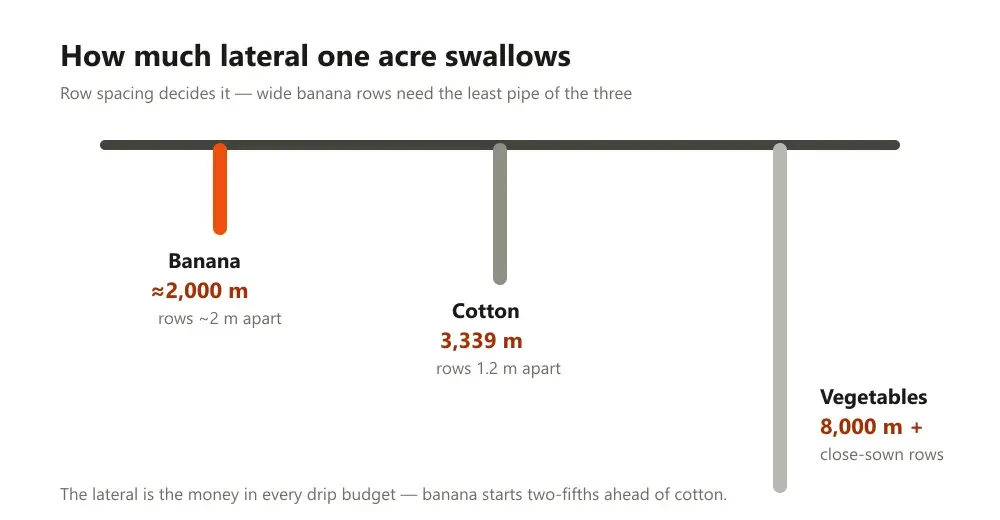
The rows are the second gift. Banana goes in at roughly 1.8 to 2.1 metre spacing, among the widest of any drip crop — and lateral runs along rows, so wider rows mean fewer laterals. Call it 2 metres on a square acre and you are laying around 2,000 metres of lateral, where the same acre of cotton at 1.2 metre rows takes about 3,339 metres, and close-sown vegetables can swallow four times banana's pipe. Our one-acre cotton costing shows how completely the lateral line dominates a drip budget; banana starts that argument two-fifths ahead.
The sizes that actually get used
The lateral itself is 16 mm across the whole range — the choices that matter are wall and construction:
Fittings are the small money: one ₹6 takeup and one ₹6 end cap per lateral, a few joiners for repairs. On roughly 32 rows they come to a few hundred rupees — note the three ₹6 fittings carry a 100-piece online floor, so the spares arrive whether you planned them or not, and they keep.
The mainline from the pump is a separate decision that follows your pump's outlet, not the crop — the pipe-size guide walks that arithmetic.
- Flat lateral, 0.4 mm wall — ₹3,366 for a 500 m coil, about ₹6.73 a metre. The working minimum for banana; five coils cover a 2-metre-row acre with margin, around ₹16,830 of pipe.
- Round inline, standard wall — ₹4,482 for 500 m, about ₹8.96 a metre. Holds its shape under a standing crop and shrugs off handling the flat pipe feels.
- Round inline, heavy wall — ₹7,200 for 400 m, ₹18 a metre. The plantation choice: bought once, left down through more than one crop cycle.
Pitfall one: a pump sized for a lighter crop
Banana's peak demand runs 5 to 8 mm a day; cotton's runs 4 to 6. A borewell and pump combination that watered cotton comfortably can come up short in a banana block's peak weeks — and a system that delivers most of the water a banana needs delivers stress in the exact month the bunch is filling.
So size from the water first: the water requirement calculator gives the daily litres for your acreage, and our sizing guide covers reading your pump's plate against it. If the bore cannot carry the whole block at peak, design it as two valves and water in shifts from day one — a retrofit later means re-trenching the sub-main.
Pitfall two: thin tape under a fifteen-month crop
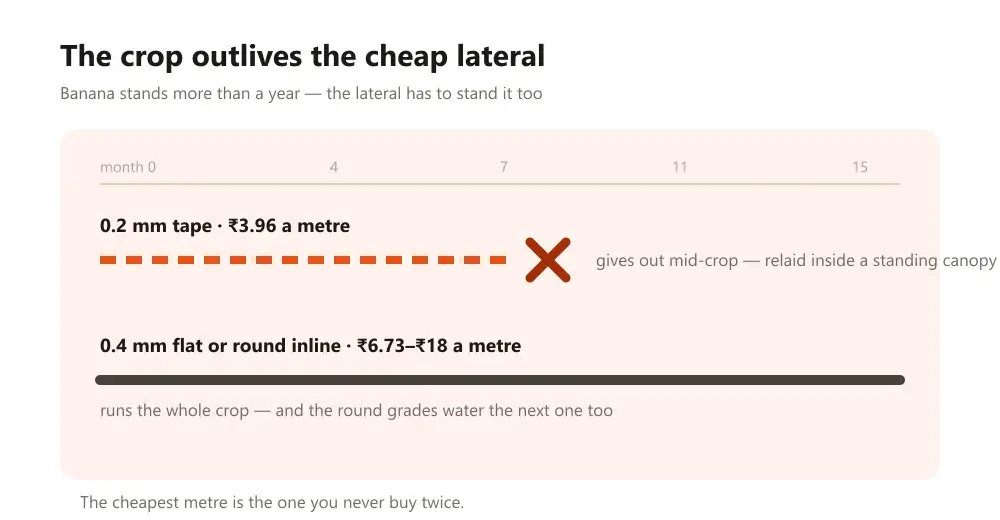
The 0.2 mm flat tape at ₹3.96 a metre is the cheapest lateral we sell and the wrong one here, and it costs banana growers more than anyone. Tape is built for crops that come out in a season — laid, used, rolled up. Banana stands far longer; the tape bakes, gets trodden, and meets every rat in the district, and when it fails at month seven you are crawling a dense standing canopy trying to relay lines between pseudostems.
Spend ₹6.73 a metre on the 0.4 mm flat as the floor, and think honestly about the round pipe: on 2,000 metres, standard round costs about ₹4,460 more than the 0.4 flat — cheap insurance across a crop this long, and it survives to water the ratoon crop after. The heavy wall at ₹18 is for growers planning several cycles on the same layout.
What to order for one acre, in one list
For a 2-metre-row acre, the shape of the order is short:
Prices above are MRP inclusive of 5% GST, each checkable on the drip irrigation range. What this list deliberately leaves out: a filter — banana's long season makes filtration non-negotiable and we do not stock filters, so budget one elsewhere before the first coil is bought. Blocked emitters on a year-long crop are a slow harvest thief.
- Five 500 m coils of 16 mm lateral in your chosen grade — the one decision that moves the money
- One takeup and one end cap per row — the ₹600 boxed hundred covers it with spares
- A handful of ₹6 joiners for future repairs
- Mainline and fittings sized to your pump's outlet, not to the crop
Get the block sized before the truck rolls
Our crop page for banana carries the agronomic profile, and the system estimator turns your acres into a counted parts list in a minute. If your rows are tighter than 2 metres, or a bore report has you unsure about peak weeks, send us the details — sizing a banana block on paper costs nothing, and re-piping one under a standing crop costs plenty.
Where these numbers come from
- ICAR (opens in a new tab)
Indian Council of Agricultural Research — crop agronomy and regional package-of-practices.
- TNAU Agritech Portal (opens in a new tab)
Crop-wise spacing, water requirement and drip layout references for southern India.
Keep reading
Drip for orchard rows: sizes, grades and the pitfalls
Orchard trees take the least drip pipe of any planting — if the system is built for the mature canopy. Sizes, the online-emitter choice, and two pitfalls.
GuidesDrip for chilli: sizes, grades and the two pitfalls
Chilli needs more lateral per acre than almost any drip crop. The grades that fit a single season, the metres to expect, and the two buying mistakes.
GuidesHow to size a drip irrigation system in two numbers
Our estimator sizes a drip system from just crop and acres. Here is what it assumes, which numbers to check on your own field, and when to trust the result.