The fittings from pump to drip lateral
The parts that get left off an order and needed on day one. A checklist from the pump outlet to the field, with real prices and both tax rates.
14 August 2026 · 5 min read · REDYPLAST
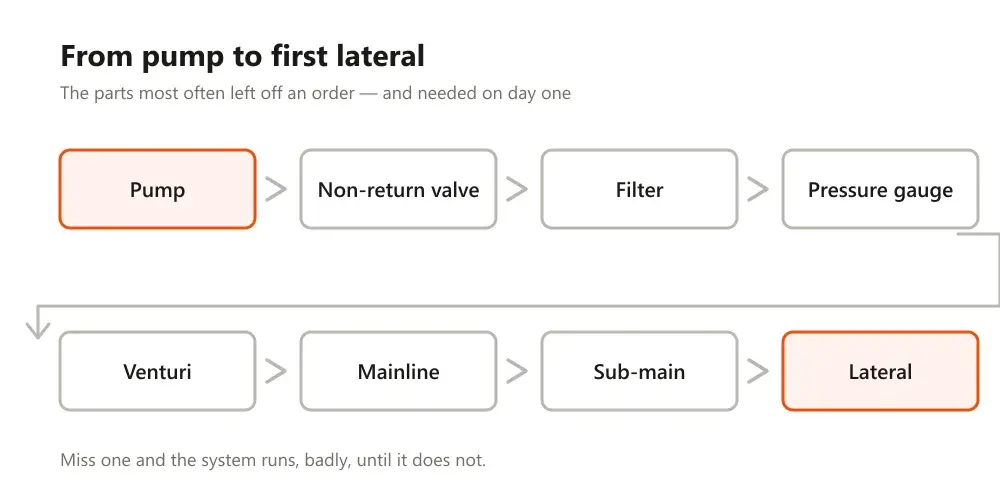
Why this is the order that goes wrong
Nobody forgets the pipe. What gets left off an order is the half metre between the pump outlet and the mainline — six or seven small parts, none of them exciting, all of them needed before water moves.
The pattern is always the same. The pipe and the laterals arrive, work stops on a missing ₹351 nipple, and someone drives to town twice in a week. The parts are cheap; the delay is not, and it usually lands in the fortnight when the crop most needs water.
So walk the line in order, from the pump outlet outward, and price every joint as you go. What follows assumes a 2 inch delivery, which covers most single-borewell farms. Sizes here are given in millimetres because inch names are trade sizes — a 50 mm and a 63 mm part are both "two inch" and will not mate.
From the pump outlet to the non-return valve
If it is a submersible on HDPE column pipe, the column joins the head through a connector before anything else goes on. An SS HDPE connector in 2" is ₹558. The clamp set that grips the column at the wellhead is not something we stock — it normally arrives with the pump — so budget that separately rather than assuming it is on the quote.
At the wellhead you need a non-return valve, and there are two kinds. A CI non-return valve in 2" is ₹1,882; a CI ball type NRV socketed in 2" is ₹1,440. The socketed ball type threads into this chain and is easier to clear when grit holds it open; the flanged type needs a matching flange on both sides — budget for that hardware. Either way, fit one. Without it every shutdown drains the mainline back down the bore, and the pump restarts against an empty line each time.
Open well rather than borewell changes one part: an SS openwell jali bend in 2-1/2" is ₹891 and does the turn and the strainer in one. Our SS items run 25 mm to 80 mm and our CI items 50 mm to 100 mm, so the same chain scales to a bigger pump without redesigning it.
- SS HDPE connector 2" — ₹558, where the column pipe meets the head
- CI non-return valve, flanged end, 2" — ₹1,882, or ball type socketed at ₹1,440
- SS barrel nipple 2" x 6" — ₹351, for the short made-up length between them
- SS bend 2" — ₹1,125, where the line has to turn at the head
- Column pipe adaptor CI 2" — ₹1,206
Threaded steel into plastic pipe
This is the transition that leaks, because it is where two different trades meet. Steel threads into steel; plastic does not thread into anything reliably.
The part that solves it is an HDPE connector or nipple — one threaded end for the steel side, one plain spigot for the pipe. In 2" both are ₹558. The bare nipple takes a clamp; the connector is made up for the pipe. Buy by what the pipe side needs, not by which word you recognise.
The two seamless socket grades are worth a sentence. The 10 mm and the 12 mm differ in wall, and the ₹81 between them is the part that decides whether the thread strips the third time it is opened. On a joint you will never touch again, take the 10 mm. On a joint you will break every season to flush, take the 12 mm. The MS seamless sockets are stocked in both.
- SS HDPE connector 2" — ₹558
- SS HDPE nipple 2" — ₹558
- MS seamless socket 2" — ₹261 in the 10 mm, ₹342 in the 12 mm
- Reducing sizes exist: the 32 x 25 mm HDPE nipple is ₹540
Solvent cement, and why the tin size matters
Every PVC joint downstream of the steel is a solvent weld, and the tin is the part people buy last and smallest.
A 250 ml tin is ₹495, 500 ml is ₹900, and a litre is ₹1,620. Per millilitre that works out to ₹1.98, ₹1.80 and ₹1.62 — so the litre is around a fifth cheaper than the 250, while the 59 ml tin at ₹189 costs nearly twice the litre's rate.
The catch is that solvent cement does not keep once opened. A tin left over the season thickens and is useless the next one, which makes the ₹288 118 ml tin the right choice for a repair kit and the wrong one for an installation.
Buy the size that matches the job in front of you. A whole mainline wants the litre; three joints want the 118 ml. Our solvent cement runs from 59 ml up to a litre for exactly this reason, and the small tins are worth keeping on the shelf regardless.
The field end, and what it costs
Past the sub-main the parts get small and numerous. Drip fittings are listed per piece but supplied in packets of 100, so the per-piece price is the honest number and the packet is what you will be invoiced.
Those three are the whole of it. Our drip range carries no lateral cocks and no rain-pipe fittings, so if a quote lists them they are coming from someone else's shelf — worth knowing before you assume one supplier covers the field end.
Count takeups by rows, not by guesswork: one per lateral, plus an end cap each, plus roughly one spare in twenty. End caps are the part farms run out of, because they are the last thing fitted and the first thing lost. If you are laying out a system from scratch rather than extending one, the system estimator will give you the counts from field size and row spacing.
- Drip takeup 16 mm — ₹6 each, ₹600 per 100
- Drip joiner 16 mm — ₹6 each
- Drip end cap 16 mm — ₹6 each
One invoice, two tax rates
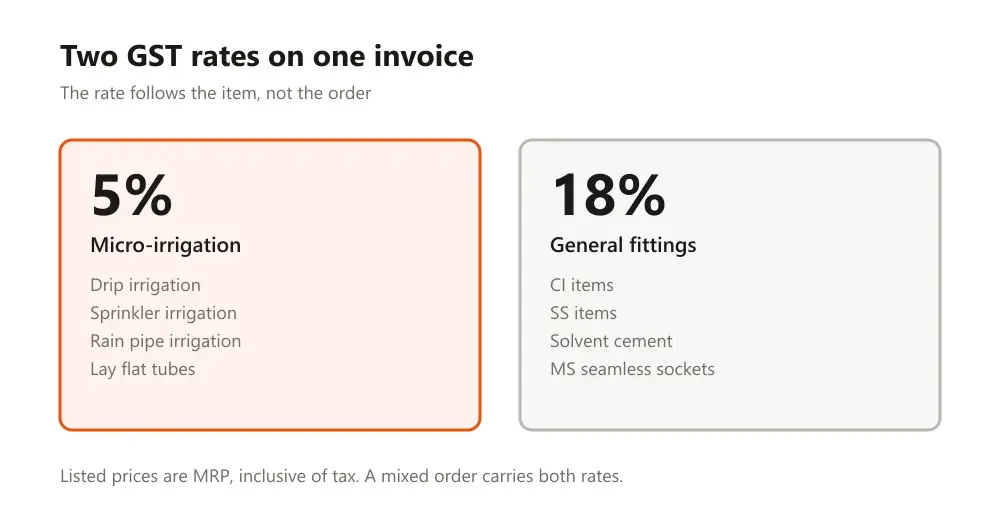
This is the part that makes a quote look wrong when it is right. Micro-irrigation carries 5% GST. General fittings carry 18%.
So the drip takeups, the joiners, the end caps and the laterals themselves are at 5%, while every CI item, SS item, MS socket and tin of solvent cement on the same order is at 18%. A pump-to-lateral order is by its nature a mixed order, and it will always show both rates.
Listed prices are MRP inclusive of tax, which means the split is already inside the number you see rather than added at the end. Two items at the same shelf price therefore have different pre-tax costs, and if you are claiming input credit the line-by-line rates matter more than the total. A quote that shows one blended rate across a mixed order has been rounded somewhere, and that is worth a question before you approve it.
Add the front end up before you start and it comes to a few thousand rupees on a 2 inch system — small against the pipe, and the reason the pipe sits in a shed for a week when it is missing.
Keep reading
Rain pipe for groundnut: sizes, prices and pitfalls
Which rain pipe for groundnut — 40, 63 or 75 mm — with real roll prices, the layout that suits the pod zone, and the pitfalls that waste a roll.
GuidesDrip irrigation layout for one acre of chilli, worked
A drip irrigation layout for one acre of chilli at 60 cm rows, fully counted — 105 laterals, seven coils of tape, valves, pump hours and the total.
GuidesDrip irrigation layout for one acre of banana, worked
A complete drip irrigation layout for one acre of banana at 1.8 m rows — lateral runs, spine, valve, pump hours, and the bill added up line by line.