Rain pipe for groundnut: sizes, prices and pitfalls
Which rain pipe for groundnut — 40, 63 or 75 mm — with real roll prices, the layout that suits the pod zone, and the pitfalls that waste a roll.
7 October 2026 · 4 min read · REDYPLAST
Rain pipe for groundnut is the pairing this product was practically made for: a close-sown crop that wants gentle, even water over the whole bed, from a flexible line that lies between the rows and showers both sides at once. This guide covers which of the five sizes fit groundnut, what the rolls cost, and the pitfalls that separate a roll that lasts from one that disappoints in its first season.
Why groundnut and rain pipe fit
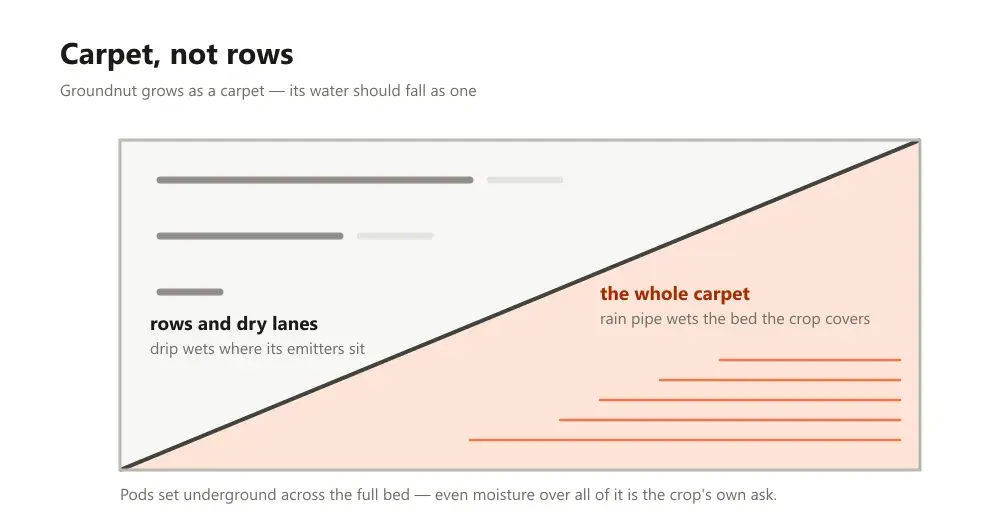
Groundnut sets its pods underground, and the crop's make-or-break weeks — flowering, pegging and pod fill — want the soil around that zone soft and evenly moist. A gentle overhead shower wets the full bed the way the crop grows: as a carpet, not as rows with dry lanes between.
That is exactly the job a laser-punched rain hose does. It throws a uniform spray to either side of the line, it goes down and comes up with the season in an afternoon, and the listing's own claim holds for the whole family: on clean water it performs well without a filter — which matters, because a filter is a part we plainly do not stock. If your source carries silt, screen it first; the rain pipe guide says plainly that silt closes spray holes the way it closes drip emitters.
The drip case for groundnut reaches the same conclusion from the other direction: for this crop, the honest recommendation was almost never drip. This page is where that recommendation lands.
Which rain pipe for groundnut: three of the five sizes
Our rain hose comes in five sizes, and the listings themselves say which belong to groundnut:
Rain pipe's quiet advantage sits behind all three field picks: as the method comparison spells out, drip wants more pressure at the pipe than rain pipe does — so a weaker pump can often still run it. Test one lateral before you cut the rest.
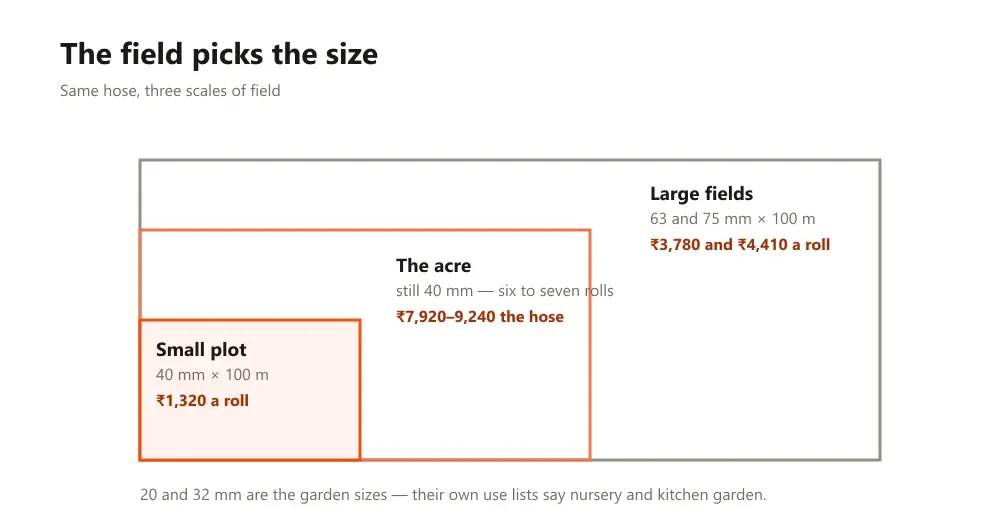
- **40 mm** is the groundnut default. The maker's own use list names groundnut outright, and it is the size [the system estimator](/calculators/system-estimate) quotes when it plans a groundnut field.
- **63 mm** carries bigger flows further — its list spans cotton, maize, groundnut, chilli and pulses, so it is the size to pick when the same roll must serve more crops than this one.
- **75 mm** is the size the maker sends to large groundnut and maize fields.
- **20 and 32 mm** exist for a different life — their own lists say nurseries, leafy vegetables and kitchen gardens. Leave them to the garden.
Rolls, prices and the 5% line
The tax inside is 5%, because rain pipe is micro-irrigation equipment — the same band as drip tape, not the 18% that general hose carries. The striking number is the first one: a small groundnut plot's watering line can cost less than ₹1,500.
Every size ships as a single long roll, MRP with tax inside, from the rain pipe listing:
- 40 mm × 100 m: ₹1,320 — about ₹13 a metre.
- 63 mm × 100 m: ₹3,780 — about ₹38 a metre.
- 75 mm × 100 m: ₹4,410 — about ₹44 a metre.
- The garden end: 20 mm runs ₹1,140 for a 200 m roll, 32 mm ₹1,230 for 100 m.
What an acre roughly takes
The honest answer is: whatever your test lateral says. The spray's reach depends on your pump's pressure, so the spacing between lines — and therefore the count — comes from the field, not a chart.
The scale, though, is settled: an acre of groundnut runs on the 40 mm. With lines spaced a metre inside the tested wetted width, an acre wants roughly 600 metres of hose — six to seven 100 metre rolls, ₹7,920 to ₹9,240 for the hose itself, tax included. That is the hose only: the joiners, end caps and cocks a layout needs are parts we do not list yet, so count them separately. The system estimator does this sum for your own acres in a minute — it prices the rolls and shows the fittings as counts.
The pitfalls that waste a roll
- **Holes facing sideways.** The spray rows must face the sky; a line laid twisted waters one side and a footpath. Lay it slack, stand at the pump end, and sight down the line for the hole rows before the first watering — straightening it later means doing it wet.
- **Laterals longer than the pressure.** A line that mists near the pump and dribbles at the far end is asking for less length, not hope. The fix is more lines fed in turn, never a longer run — and it is exactly what the one-lateral test exists to catch before the field is cut.
- **Laid on stubble and stones.** A pressurised line can shift a little as it fills and runs. On sharp litter that movement becomes wear; sweep the lane the line lies in, the same minute of care the bed itself got.
- **The off-season.** The crop finishes; the roll should not. Drained, coiled loose, off the floor and in shade — [the pipe-life guide](/blog/making-your-pipe-last) applies to rain hose exactly as it does to every roll in the shed, rats included.
Laying it for a groundnut field
Run laterals along the beds with the holes skyward, and set the spacing between lines from a test, not a guess: pressure decides each line's true wetted width on your pump, so lay one lateral, run it, measure the spray's reach on both sides, and space the rest to overlap slightly. An hour of testing settles the whole field's geometry.
One more thought before the order: groundnut rarely farms alone. If the same line must also water the cotton, maize or chilli the field grows in other seasons, that is the case the 63 mm exists for — its use list spans all of them — and a quiet reason not to buy only for today's plot.
The groundnut crop page keeps the agronomy beside the parts. For an odd-shaped field or a shared-pump arrangement, send the measurements and we will size the line and the lengths against the pump that will actually push the water.
Where these numbers come from
- ICAR (opens in a new tab)
Indian Council of Agricultural Research — crop agronomy and regional package-of-practices.
- TNAU Agritech Portal (opens in a new tab)
Crop-wise spacing, water requirement and drip layout references for southern India.
Keep reading
Drip for groundnut? Usually not — and what fits instead
Asked for drip for groundnut, we usually talk you out of it. The arithmetic that says so, the rain pipe that fits, and the one case drip still earns.
GuidesDrip irrigation layout for one acre of chilli, worked
A drip irrigation layout for one acre of chilli at 60 cm rows, fully counted — 105 laterals, seven coils of tape, valves, pump hours and the total.
GuidesDrip irrigation layout for one acre of banana, worked
A complete drip irrigation layout for one acre of banana at 1.8 m rows — lateral runs, spine, valve, pump hours, and the bill added up line by line.