Lay flat tube for banana: sizes, grades and pitfalls
Choosing a lay flat tube for banana blocks — 63, 75 or 90 mm, what each roll costs, the 5% GST advantage, and the pitfalls that shorten one.
2 October 2026 · 4 min read · REDYPLAST
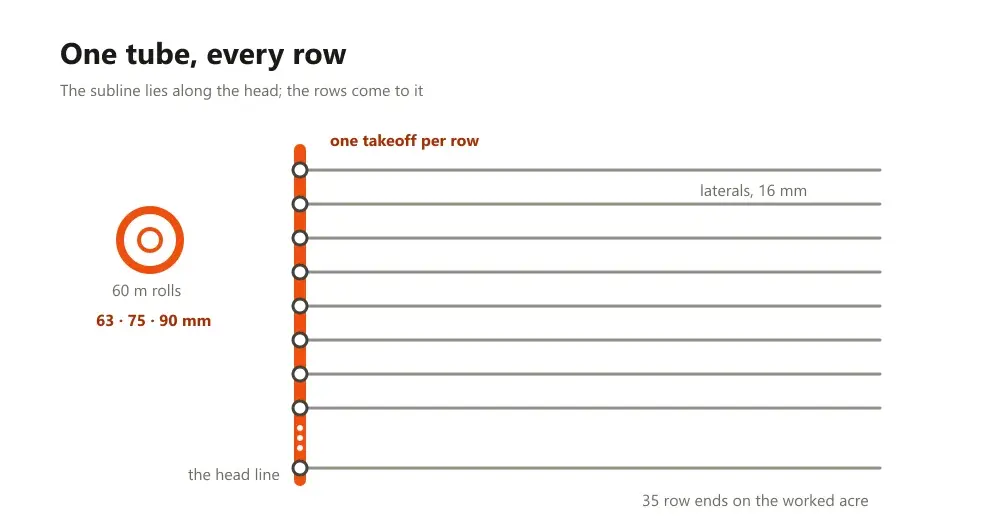
A lay flat tube for banana is the flexible answer to the sub-main question: the R-FLEX subline lies flat along the head of the block, takes one takeoff per row, and carries the water your laterals hand out. This page covers the three widths we stock, what each roll costs, why it shares your laterals' 5% GST band while lookalike rolls pay 18%, and the short list of habits that shorten one.
The job in a banana block
A flat flexible tube does that job lying on the surface. It follows the headland's real ground — the tractor ruts, the bund shoulders — without needing a trench or a straightedge, and each lateral joins it through a punched takeoff exactly where its row happens to be. When the garden is renewed, the tube drains, rolls onto a shoulder and moves — taking its punched holes with it, so the re-laid block either keeps the old row spacing or plugs the odd hole.
Banana plants in rows 1.8 to 2.1 metres apart, so an acre's block presents thirty-odd row ends to whatever pipe runs across its head — the layout sheet counts 35 on its worked acre. The sub-main's job is to sit along that head line and feed every one of them.
If you are still choosing the system rather than its parts, the banana drip case comes first. This page assumes the laterals are decided and the head line is the question.
Which width: 63, 75 or 90 mm
Here is the honest version of the width rule: at the flows most banana borewells deliver — the layout sheet works its acre on 3,000 litres an hour — even the 63 mm bore carries the water with ease. The wider tubes are headroom, not a requirement:
One rule travels with the choice: order by the millimetre printed on the listing, because every takeup punched into the tube must mate with that exact width.
- **63 mm** covers the typical borewell block, and the layout sheet's split option — seventeen and eighteen rows to a valve — sits comfortably on it, one shorter subline per half. The two-subline shape is this page's suggestion for that split, not the sheet's own drawing.
- **75 mm** is headroom: the same block run as one zone, or a pump you might upgrade later.
- **90 mm** belongs to genuinely big water — a large pump pushing one long head line alone.
What the rolls cost, and the 5% line
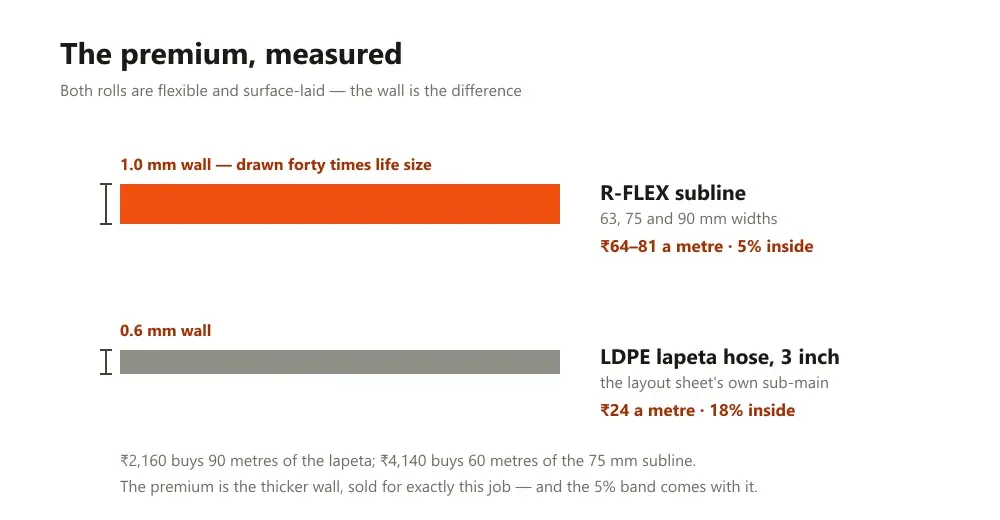
The grade question has a short answer here: there is one. Every width ships in the same black, UV-stabilised wall of 1000 microns — a full millimetre of tube — so nothing on the listing is a quality tier in disguise. The decision is width, and only width.
Each width comes as a 60 metre roll, weighing 11 to 16.2 kg depending on width:
Prices are MRP with tax inside, from the lay flat tube listing — and the tax inside is **5%**, because a drip sub-main is micro-irrigation equipment. The lookalike conveyance rolls sold as lapeta carry 18% inside their MRP instead, a thirteen-point gap the paddy lapeta guide spells out.
Be clear about what the alternative is, because it is not a rigid pipe — we stock none. It is the 3 inch LDPE lapeta coil, ₹2,160 for 90 metres, about ₹24 a metre — the very roll the layout sheet uses as its own sub-main. Both rolls are flexible and both lie on the surface. What the R-FLEX premium buys is a wall made for the job — a full millimetre against the lapeta's 0.6 — and a product sold as a subline rather than a conveyance hose pressed into being one.
- 63 mm: ₹3,843 a roll — about ₹64 a metre.
- 75 mm: ₹4,140 a roll — about ₹69 a metre.
- 90 mm: ₹4,860 a roll — about ₹81 a metre.
The pitfalls that shorten a tube
- **Oversized holes.** Every ₹6 poly takeup seats in a punched hole, and a ragged or oversized hole weeps from day one. One clean hole per row, and resist widening a tight one — tight is what seals. Be aware we list no dedicated lay-flat punch or hole plugs; [ask when ordering](/bulk-enquiry) and bring the takeup you will fit.
- **Dragging it full.** A 75 mm roll's 60 metres holds roughly a quarter tonne of water when charged. Pulling a charged tube to adjust it strains every takeoff on the run; drain it first, always.
- **Stones and stubble under the run.** The tube presses onto whatever it lies on with all that weight. Walk the head line before laying and clear the sharp litter — a minute of sweeping beats a season of weeps.
- **The end nobody opens.** The far end closes the field way — folded back on itself and tied — and everything the water carries settles towards it. A tube that is never opened and flushed starves its last rows slowly — the same silt logic [that blocks drip lines](/blog/why-your-drip-line-keeps-blocking). Flush at season start and after any repair upstream.
- **The off-season heap.** The wall is UV-stabilised, but the tube that lasts longest is still the one drained, rolled loosely and [stored off the ground in shade](/blog/making-your-pipe-last) between crops, out of reach of the shed's rats.
Buying it for your block
Three numbers settle the order: the length of the head line in metres, the count of row ends it must serve, and how the block is zoned — one subline per zone, sized to the rows that drink together.
Mind the roll length against the first of those numbers. The worked acre's head line runs 64 metres — four more than one 60 metre roll — and we list no lay-flat coupler, so a single-line plan means two rolls and a join settled with us in advance. The cleaner shape is usually the split: two shorter sublines, one per valve zone. Decide which on paper before ordering, not at the field end of a roll that stopped short.
The banana crop page keeps the agronomy beside the parts, and the system estimator counts the laterals, takeups and end caps for your acres in a minute — the subline itself is sized from your measurements, not from a form.
For a block that is not a tidy rectangle, or a garden replanted in stages, send the measurements and we will size the widths and roll count against your real head line before anything ships.
Where these numbers come from
- ICAR (opens in a new tab)
Indian Council of Agricultural Research — crop agronomy and regional package-of-practices.
- TNAU Agritech Portal (opens in a new tab)
Crop-wise spacing, water requirement and drip layout references for southern India.
Keep reading
Drip irrigation layout for one acre of banana, worked
A complete drip irrigation layout for one acre of banana at 1.8 m rows — lateral runs, spine, valve, pump hours, and the bill added up line by line.
GuidesDrip for paddy? No — paddy is a conveyance job
Drip for paddy is the wrong question — a flooded crop needs water moved, not dripped. What actually does that work, and the pipe sizes that fill plots fast.
GuidesDrip for banana: sizes, grades and the two pitfalls
Which drip laterals suit a banana crop, why the heavy wall earns its keep over a year in the ground, and the two mistakes banana buyers repeat.