Drip emitter spacing for banana on red loam: one line or two
Drip emitter spacing for banana on red loam is a question of lines per row, since the band is narrow and the mat wide. One line, then two for the ratoon.
12 November 2026 · 5 min read · REDYPLAST
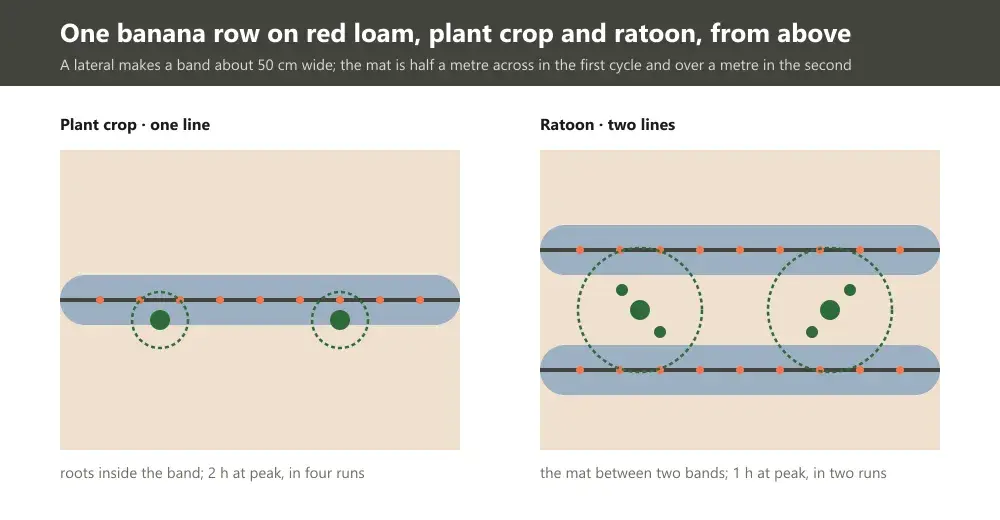
Drip emitter spacing for banana on red loam comes down to how many lines each row carries, because this soil wets a band only about half a metre wide under a lateral and a banana mat in its second year spreads its roots across twice that.
Drip emitter spacing for banana on red loam along the line is already settled by the pipe, since the 40 cm drippers every inline pipe we list carries put four or five under each plant; across the row it is one lateral for the plant crop and a second for the ratoon, or an acre that crops well once and poorly after.
Banana on red soil is the upland case, away from the river belts where most of the crop grows, and it works where the bore is strong and the schedule is kept. This guide covers the narrow band and the wide mat, the one-line and two-line layouts by year, the hours per day split into runs the column can hold, and the two red-loam mistakes that shrink the bunch.
The narrow band and the wide mat
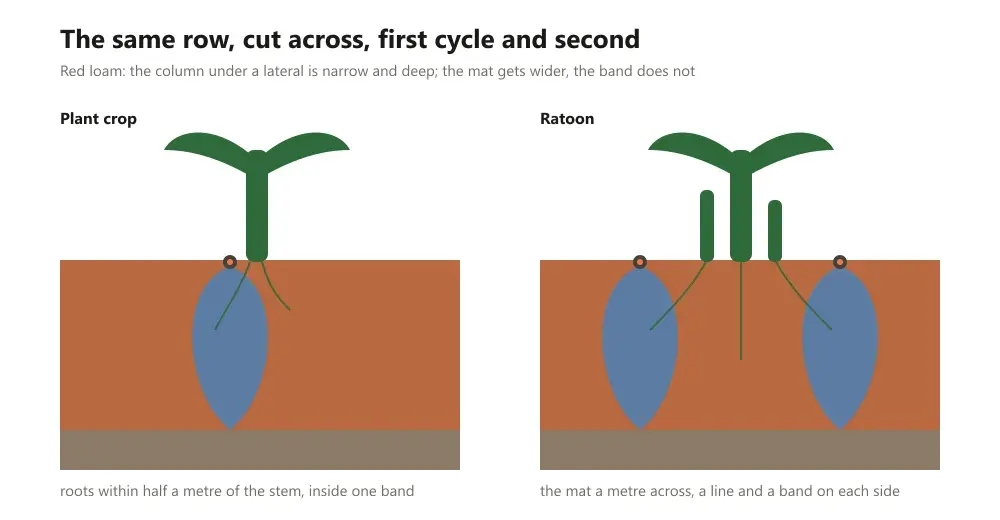
Red loam takes water down and spreads it little. Under a 4 litre dripper the column is 40 to 60 cm across and reaches the murrum gravel within a couple of hours of a long run; drippers 40 cm apart overlap into a band about 50 cm wide along the lateral and the soil beyond it stays dry. The top half metre holds a day of crop water, no more.
Banana roots are shallow and wide. A plant crop feeds mostly within half a metre of the stem, which a single band covers; by the ratoon the mat has thrown suckers on all sides and the feeding roots work a circle a metre or more across, and a single band on one side of the mat is watering a third of them. On alluvial or black soil the band widens with the mat; on red loam it does not, and the second cycle is where the difference shows.
The banana crop page calls banana the thirstiest crop we size for; on this soil it is also the one with the least room to drink from.
- Band: about 50 cm wide under one lateral, deep rather than wide.
- Reach: about 25 cm each side of the line, no more.
- Storage: about a day; daily runs for the whole cycle, split in the heat.
- The mat: half a metre across in the plant crop, a metre or more by the ratoon.
Drip emitter spacing for banana on red loam, by cycle
For the ratoon, add a second lateral on the far side of the row, 20 to 30 cm from the stems, so the mat sits between two bands and the roots on both sides have water. That doubles the pipe for the second cycle and halves the run time per plant, because two lines deliver the same litres in half the hours; on red loam that halving is what keeps each run inside what the column can hold.
The alternative is a loop of inline around each mat, a ring of columns instead of two bands; it suits a wide-spaced planting and is more work on dense rows.
For the plant crop, one lateral per row laid 20 to 30 cm off the stem line is enough: four or five drippers under each plant, a continuous band along the row, and the young roots inside it. Rows go in 1.5 to 2.1 metres apart, and at the usual 1.8 an acre takes about 2,200 metres of lateral, the standard count from the banana drip guide, and the wall it chooses for a fifteen-month crop holds here.
The second line is laid from the drip range after the plant crop is cut, before the suckers are selected, and it stays for the ratoons that follow.
The hours, in runs the column can hold
One lateral puts four or five drippers under a plant, 18 litres an hour, so the hottest day is about two hours of running and a mild one about 40 minutes; two laterals make it 36 litres an hour, an hour at the peak and about 20 minutes in a mild month.
On red loam neither is given in one piece in the hot months. A column holds roughly half an hour's output before the surplus reaches the murrum, so the hottest day's water goes in as four runs of 30 minutes on one line, or two on two, spread across the morning and the evening.
The runs go in every day of the cycle on this soil, with the time on one line falling to about 40 minutes in the cool months and rising again in March. Mulch or the trash of the cut plant crop laid along the lines cuts what the sun takes from the surface of the narrow band and is worth more on red loam than on any heavier soil.
Banana at full cover uses 3.5 to 10 mm a day, the top of it a hot-month figure for the driest district, which on one acre is roughly 14,200 to 40,500 litres at the root, or about 15,700 to 45,000 litres from the pump once drip's losses are allowed for; the water requirement calculator gives the figure for your own acreage. Per plant at 1.8 by 1.8 metres that is about 13 litres a day from the pump in a mild month and up to 36 in the hottest weeks.
The two mistakes that shrink the bunch
The first is the one-line ratoon. The plant crop was fine on a single lateral, so the second cycle runs on it too; the mat has spread, half its roots are in dry soil, the suckers are thin and the ratoon bunch is two thirds of the plant crop's. The second line, laid before the suckers are chosen, is the cheaper answer.
The second is the long run. Two hours in one piece on one line puts most of the second hour into the murrum, and a banana that has been given its full day's water on paper stands in soil that dried by the afternoon. Four short runs give the same litres and keep them; on this soil the split is not a refinement but the schedule.
A blocked dripper on red loam shows within days as one plant falling behind its neighbours; the blocked-line guide covers flushing, and the filter it depends on is not something we stock.
- A single line into the ratoon: half the mat dry, thin suckers, a small bunch.
- Two hours in one run: the second hour to the murrum, a dry afternoon anyway.
- A skipped day in April: a plant that leans, and a bunch that fills late.
- The check: a trowel a hand deep beside the stem on the far side from the lateral, the morning after a run; dusty there is a mat outgrowing its line.
The figures are a starting point
The 3.5 to 10 mm a day and the band widths are published agronomic ranges, not measurements from your field, and red loams vary in depth over the murrum from one bund to the next. Treat four runs of half an hour on one line as the plant crop's hottest-month schedule and let the trowel correct it. The same crop on river silt is worked in the alluvial banana guide, and the same soil under other crops in the red-loam pomegranate guide and the red-loam chilli guide.
If you want the line count and the runs sized to your bore, send us the row spacing, the acreage, the bore yield and whether you intend a ratoon and we will say whether one line or two, and how many runs a day the field needs.
Where these numbers come from
- FAO Irrigation and Drainage Paper 56 (opens in a new tab)
The reference method for crop evapotranspiration and crop coefficients that daily water figures derive from.
- ICAR (opens in a new tab)
Indian Council of Agricultural Research — crop agronomy and regional package-of-practices.
- TNAU Agritech Portal (opens in a new tab)
Crop-wise spacing, water requirement and drip layout references for southern India.
Keep reading
Drip emitter spacing for cotton on red loam: the dry inter-row
Drip emitter spacing for cotton on red loam keeps the water in a band under the plant line and the inter-row dry. The band, the minutes, the monsoon break.
GuidesDrip emitter spacing for sugarcane on red loam, and the minutes
Drip emitter spacing for sugarcane on red loam settles the paired-row question, since the bulb is narrow. The pair that works, the minutes by phase, the ratoon.
GuidesDrip emitter spacing for chilli on red loam, and the run time
Drip emitter spacing for chilli on red loam matters, because the wet bulbs barely meet. Where the plants go, the minutes per day, and two schedules that fail.