Drip irrigation with iron-rich water for vegetables: tank first
Drip irrigation with iron-rich water for vegetables works when the iron comes out in a tank, not in the tape. The tank, the filter, the weekly flush, the tape.
24 November 2026 · 5 min read · REDYPLAST
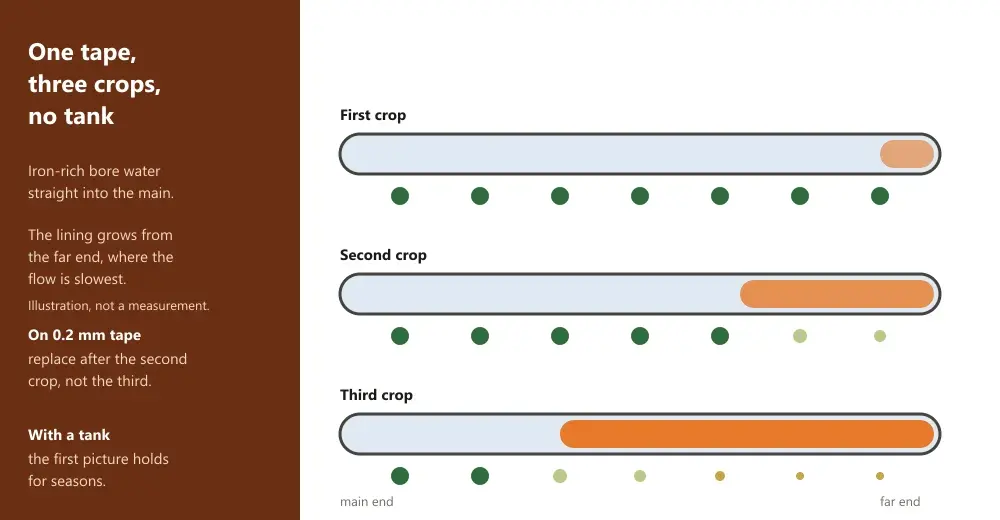
Drip irrigation with iron-rich water for vegetables fails in a recognisable way: the water is clear at the pump, the tape runs well for the first crop, and by the second the far end of every bed is short and pale, with an orange slime in the end caps. The iron was dissolved when it went in and came out of the water inside the pipe.
Drip irrigation with iron-rich water for vegetables works when that happens somewhere else first, which means an open tank before the filter, a flush that is a weekly habit, and a tape chosen as a consumable; of those, only the tape and its fittings are ours to sell.
This guide covers what iron does in a line, the tank and filter that answer it, the flushing regime, and the drip line that tolerates this water best.
Drip irrigation with iron-rich water for vegetables, crop after crop
Bore water in iron country carries the metal dissolved, so it is clear at the pump and passes any screen. It comes out of solution when it meets air: a bucket left overnight shows an orange film by morning, and a tank wall or a cement channel on the farm is stained rust-brown at the waterline. That is the test, and it costs nothing.
In a drip line the air is met inside the pipe, at the end of every run when the line drains and at every dripper outlet. The orange particles that form are fine enough to travel, and iron bacteria that live on them make a slime that glues them to the pipe wall, thickest where the flow is slowest, which is the far end of each lateral.
The published guide for drip puts water under 0.1 mg of iron a litre at little risk, 0.1 to 1.5 at moderate risk, and anything above 1.5 at severe risk of blocked emitters.
Vegetables meet it sooner than most crops. The tape is thin, the dripper passages are small, and a short crop that loses its far end for three weeks has lost a third of its life.
- Clear at the pump, orange by morning in a bucket: dissolved iron, and no screen stops it.
- Orange slime in the end caps: the iron is coming out inside the line.
- Short, pale plants at the far end of every bed: the last drippers are closing.
The tank before the filter
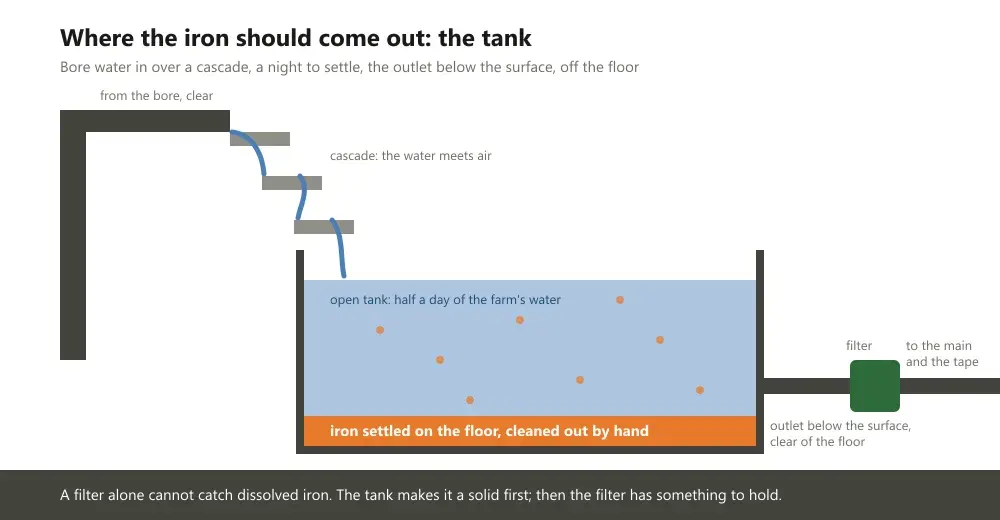
A filter alone does not answer iron, because dissolved iron goes through the screen and turns to particles on the other side of it. The answer is to make it turn first. The bore discharges into an open tank over a cascade or through a spray, so the water meets as much air as possible on the way in.
The iron usually comes out there within hours, though the bucket test shows how fast yours does. It settles on the floor as an orange sludge, cleaned out a few times a year before the layer reaches the outlet. A sand filter still has to catch what stays suspended.
The outlet is drawn from below the surface and clear of the floor, for example with the suction hung from a float.
After the tank comes the filter, which now has something to catch: a screen or disc filter, with a sand filter ahead of it where the slime is heavy, cleaned on a schedule and not when the far end wilts.
An open tank also drops the pressure, so the water needs a second lift out of it: a pump from the tank into the filter and main, or a tank raised high enough to feed them by gravity. The tank, the cascade, that pump and the filters are from elsewhere; we stock none of them, and a system on iron water quoted without them is quoted to fail.
The tank is sized to give the water those hours. Vegetables at full cover use 3.5 to 6.5 mm a day, about 15,700 to 29,000 litres an acre from the pump once drip's losses are allowed for, and the water requirement calculator gives the figure for your acreage. A tank that holds half a day of it, filled in the evening and drawn in the morning, has had the night to settle.
The flushing regime for a relay
Flushing keeps a line alive on this water, with or without the tank. Through the crop, the end caps of every lateral are opened once a week in the hot months and once a fortnight in the cool, a few beds at a time so the flow stays fast, and run until the water changes from orange to clear.
The chlorine dose that kills the bacteria is a dealer's job, with chemicals we do not sell.
At every relay the whole system is opened. The tape comes up, the submain is flushed from its far end, and each new or relaid lateral is run open-ended for a minute before its cap goes on. The blocked-line guide covers the method, and the caps and joiners that make it a two-minute job per bed come from the drip range. The ₹6 caps and joiners have a minimum order of 100 pieces.
The tape that tolerates it
Every inline line we list carries a 4 litre an hour dripper every 40 cm. On iron water that flow is a small point in its favour: a 4 litre passage is wider than a low-flow one, and a wider passage is somewhat slower to close. The choice within the range is the wall.
The 0.2 mm flat tape is the consumable. With no tank yet, it is laid for one crop or two, flushed weekly, and replaced when the end caps run orange inside. The 0.4 mm tape and the round inline pipe are the lines to buy once the tank and the filter are in: they stand the flushing and the relaying for several seasons, and on settled, filtered water they last them.
One thing iron water rules out for leafy crops is overhead watering. Rain pipe and sprinklers put the water on the leaf, where the iron dries as a rust-coloured stain that the market marks down; drip keeps it in the soil. The vegetables drip guide covers the beds and the relay itself.
- No tank yet: 0.2 mm tape as a one or two crop consumable, flushed weekly.
- Tank and filter in: 0.4 mm tape or round inline, relaid for several seasons.
- The check: open one end cap a week into a white bucket; orange water means flush now, and orange grit means look at the tank.
The figures are a starting point
The 3.5 to 6.5 mm a day and the iron risk bands are published ranges rather than readings from your bore, and two bores in one village can differ tenfold in iron. A sample tested by a dealer or the agriculture office tells you which band you are in; the bucket left overnight tells you whether to ask.
The same water under long crops on laterite is covered in the laterite cane guide, and hard water, which leaves chalk and not slime, in the hard-water guide. If you want the tape and the fittings worked for your beds on this water, send us the bed plan, the acreage, the crops in your relay and what the bucket shows by morning and we will say which line suits it and what must stand between the bore and the main.
Where these numbers come from
- FAO Irrigation and Drainage Paper 56 (opens in a new tab)
The reference method for crop evapotranspiration and crop coefficients that daily water figures derive from.
- FAO Land and Water (opens in a new tab)
Irrigation water management guidance, including scheduling and application efficiency.
- ICAR (opens in a new tab)
Indian Council of Agricultural Research — crop agronomy and regional package-of-practices.
- TNAU Agritech Portal (opens in a new tab)
Crop-wise spacing, water requirement and drip layout references for southern India.
Keep reading
Drip irrigation with algae-prone water for banana: the plan
Drip irrigation with algae-prone water for banana has no off-season to recover in. Where the algae comes from, the right filter, and the flushing it needs.
GuidesDrip irrigation with hard water for cotton: what scale does
Drip irrigation with hard water for cotton loses the far end by flowering, as chalk forms where water dries. What the filter cannot stop, and the flushing.
GuidesDrip emitter spacing for vegetables on laterite soil, on the pan
Drip emitter spacing for vegetables on laterite soil is a plant at every dripper and runs of ten minutes: the gravel holds nothing, the pan holds too much.