Drip emitter spacing for sugarcane on laterite soil, on the pan
Drip emitter spacing for sugarcane on laterite soil is a tight pair or single rows over a pan that stores water in April and drowns the stool in August.
22 November 2026 · 5 min read · REDYPLAST
Drip emitter spacing for sugarcane on laterite soil is one lateral per row, or one between a pair planted 40 cm apart or less, because the wet column under a 4 litre dripper on this gravelly ground is 35 to 50 cm across and the 40 cm drippers on every inline pipe we list merge into a strip that reaches about 20 cm either side of the pipe.
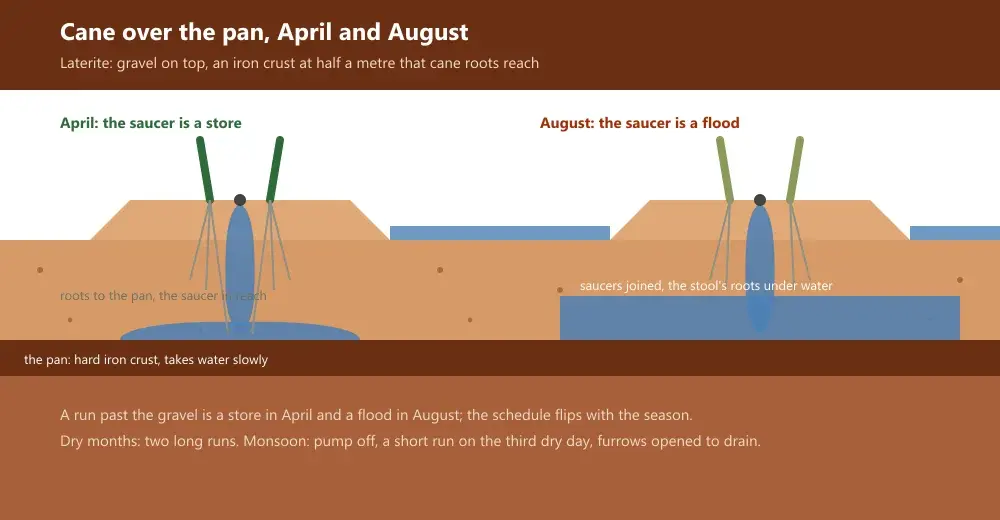
What drip emitter spacing for sugarcane on laterite soil has to reckon with below the strip is the pan, the hard iron crust at 40 to 80 cm that every column lands on: cane roots reach it, so in the dry months the water pooled there is a store, and in the monsoon the same pool is what the stool drowns in.
Cane on laterite is the crop of the Bobbili and Cheepurupalli uplands, watered from bores that run orange with iron. This guide covers the column and pan, the pair, the two schedules, and three years in iron water.
The column, and the pan it lands on
Laterite is a leached red soil: loose gravel on top over an iron crust that takes water slowly. The column under a dripper drops through the gravel in a quarter of an hour and spreads on the pan into a saucer, so the wet zone is a narrow stem with a wide foot, and the gravel above holds less than a day of a cane crop's water.
The foot is the difference from every other soil in this series. A cane stool roots to 60 cm and more, down to the pan, so the saucer on it is within reach, and in April a run deliberately long enough to fill the saucer gives the stool a store the gravel cannot. In August the rain fills the same saucers, they join, and the pan holds the field's water above the roots for weeks; cane on the flat rots from the bottom in a wet year.
The sugarcane crop page counts the season's water as a total; on laterite the question is where in the profile it sits, and that changes by month.
- Column: 35 to 50 cm across through the gravel, spreading into a saucer on the pan at 40 to 80 cm.
- Store: less than a day in the gravel; a second day in the saucer, which cane roots reach.
- Monsoon: the pan holds the rain, so the row is ridged and the furrows cut through to drain.
Drip emitter spacing for sugarcane on laterite soil, pair or single
The pan's depth is not even. A patch of shallow pan floods in August and dries in April, and it wants a valve of its own; the valve is an item from elsewhere that we do not stock.
Single rows at 1.2 metres take one lateral each in the furrow beside the setts, about 3,400 metres on an acre. The paired layout that the cane conversion guide prices as the big saving works only with the pair at 40 cm or less around the line, about 2,250 metres at 1.8 metres between pairs; a pair at 60 cm straddles dry gravel on both sides and is thin from germination.
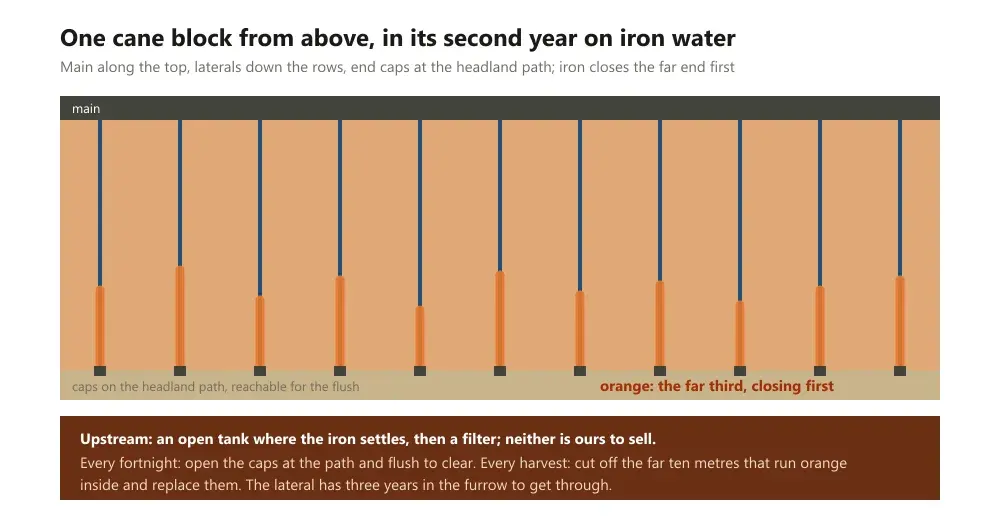
The lateral is 16 mm inline from the drip range, in the wall thickness the cane drip guide describes for a pipe that stays in the furrow through the ratoons, and on laterite it is laid with its end caps at the headland, not buried in the stand, because it will be flushed every fortnight for three years.
The minutes, in two shapes
On single rows at 1.2 metres a metre of lateral with 10 litres an hour serves 1.2 square metres, about 8 mm an hour, so a 9.5 mm day is about 68 minutes and a 4.5 mm day about 32; on tight pairs at 1.8 metres the rate falls to about 5.5 mm an hour and the minutes run about half as long again.
The dry shape runs from February to the first rain. The day's minutes go in as two runs, early and late, each long enough to fill the gravel and put the rest on the pan where the roots will find it by afternoon; it is the one time in this series a run past the gravel is not waste.
The wet shape begins with the monsoon: the pump runs only on the third dry day, for a short run that wets the gravel and no more, and the furrows between ridges are opened at the low end so the saucers drain to the field edge instead of into the stool.
Cane in full growth uses 4.5 to 9.5 mm a day, the top of that range in the hottest dry weeks and the bottom in the cool ones, which on one acre is roughly 18,000 to 38,000 litres at the root, or about 20,000 to 43,000 litres from the pump once drip's losses are allowed for; the water requirement calculator gives the figure for your own acreage.
Three years in iron water
Laterite-country bores carry iron, and iron in a drip line comes out of the water in the pipe as an orange slime that bacteria build on, closing drippers from the far end of the lateral inward. A cane lateral lies in the furrow for the plant crop and two ratoons, three years in that water, and a lateral that was clear at planting is half closed by the first ratoon if nothing is done.
What is done is upstream and in the routine, and none of it is ours to sell: the bore water passes through an open tank where the iron settles in the air, a filter stands between tank and main and is cleaned on a schedule, and every lateral is flushed from its headland cap once a fortnight through the growing months.
At each harvest the far ten metres of any lateral that runs orange inside are cut off and replaced; the blocked-line guide covers the flushing itself.
- The dry-season runs carried into August: saucers already full of rain, a stool standing in water.
- Caps buried in the stand: a flush nobody does, a lateral closed from the far end by the ratoon.
- The check: a trowel a hand deep beside the stool at noon; in April moist to the bottom is right, in August wet at the bottom and dry on top means the pan is full and the pump stays off.
The figures are a starting point
Only the 4.5 to 9.5 mm a day is a published range. The column widths, the pan depth and the saucer store are working rules to check with the trowel test above, not readings from your field. Laterite varies most in the depth to its pan, which decides how much the saucer stores and how soon it floods.
Treat two runs of 34 minutes on single rows, the 9.5 mm day, as the April schedule, and a short run on the third dry day as the August one, and let the trowel move both.
The same crop on soils without a pan is worked in the red-loam cane guide and the sandy-loam cane guide, and the same pan under a shallow crop in the laterite vegetables guide. For the coil count and the flushing plan sized to your field, send us the row or pair spacing, the acreage, the bore yield and whether the water runs orange and we will say how many coils the field takes and what has to stand between the bore and the main.
Where these numbers come from
- FAO Irrigation and Drainage Paper 56 (opens in a new tab)
The reference method for crop evapotranspiration and crop coefficients that daily water figures derive from.
- ICAR (opens in a new tab)
Indian Council of Agricultural Research — crop agronomy and regional package-of-practices.
- TNAU Agritech Portal (opens in a new tab)
Crop-wise spacing, water requirement and drip layout references for southern India.
Keep reading
Drip emitter spacing for vegetables on laterite soil, on the pan
Drip emitter spacing for vegetables on laterite soil is a plant at every dripper and runs of ten minutes: the gravel holds nothing, the pan holds too much.
GuidesDrip emitter spacing for sugarcane on sandy loam: the pump's day
Drip emitter spacing for sugarcane on sandy loam is a tight pair or a single row, run in short bursts all day through June. The column, the pump's day.
GuidesDrip emitter spacing for sugarcane on alluvial soil: wide pairs
Drip emitter spacing for sugarcane on alluvial soil lets a pair of rows share one lateral, and the silt holds days of water. The pair, the minutes, the stop.