Why drip emitters block, and what actually clears them
Grit, scale or slime — why drip emitters block depends on your water. How to tell the three apart, and the flush habit that keeps a line clear.
20 February 2026 · 4 min read · REDYPLAST
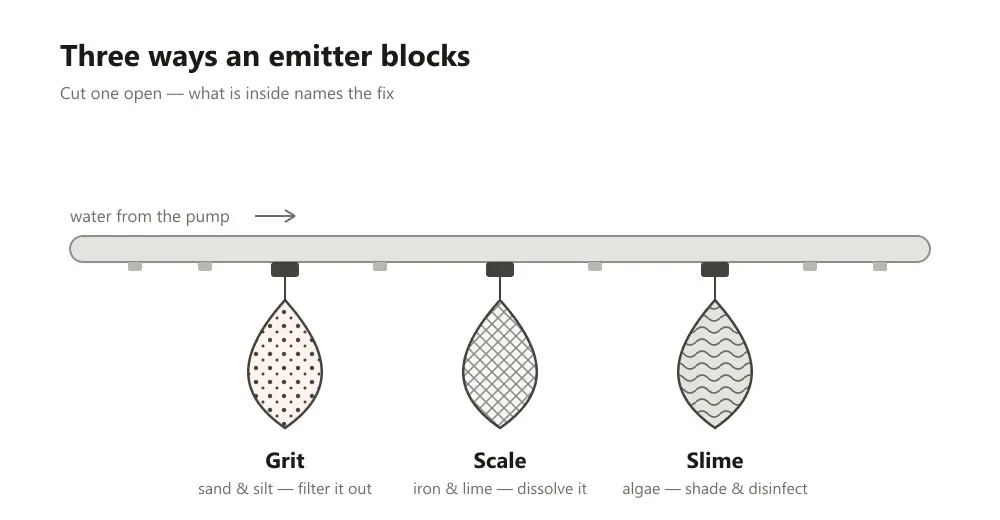
There are only three answers to why drip emitters block: grit, scale or slime. Every quiet emitter you will ever meet traces back to one of them, and each needs a different cure, which is why a fix picked on a guess so often clears nothing.
The line itself will tell you which one you have, for the price of a single sacrificed emitter and a knife. Start there, before you spend a rupee on any treatment.
Cut one open before you treat anything
Pull the deadest emitter off the line — the far end usually offers plenty of candidates — and slice it open. What is sitting in the passage names the problem.
Ten seconds with a blade replaces a week of guessing. Mixed deposits are common too — silt bound up in slime where a pond feeds the system, for instance — and then you treat both causes rather than arguing about which came first.
- Hard and gritty, like fine sand between your fingers: a physical blockage. The water is carrying particles larger than the passage.
- A pale chalky crust, or a rust-coloured stain that will not rinse away: a chemical blockage. Calcium or iron has come out of solution inside the pipe.
- Soft, slippery, sometimes green, often smelling of a stale tank: a biological blockage. Algae or bacterial slime is growing in the dark of the lateral.
The fix has to match the blockage
Scale is dissolved, not strained. An acid treatment run through the line takes chalk and iron deposits back into solution so they leave through the open ends. The right chemical and its strength depend on your water, so take both from the treatment's supplier or your local agriculture office — we will not print a recipe, because a wrong one burns crops and pipe alike.
Slime is starved. Shade or cover the storage tank so sunlight cannot feed algae, and disinfect the water periodically — chlorination is the usual route — to knock back what still grows. Keep the chemical detail with the people who sell it; the principle, no light plus occasional disinfection, is the part that matters.
Grit is stopped before the lateral, never inside it. That means filtration at the head of the system, and here we should be plain: REDYPLAST does not stock filters, pressure gauges or venturis. Budget for a filter from a specialist supplier and count it as part of the system's real price, because a drip line fed unfiltered borewell water is a consumable. Where a filter belongs in the chain of parts is walked through in fittings from the pump to the first lateral.
Why drip emitters block at the far end first
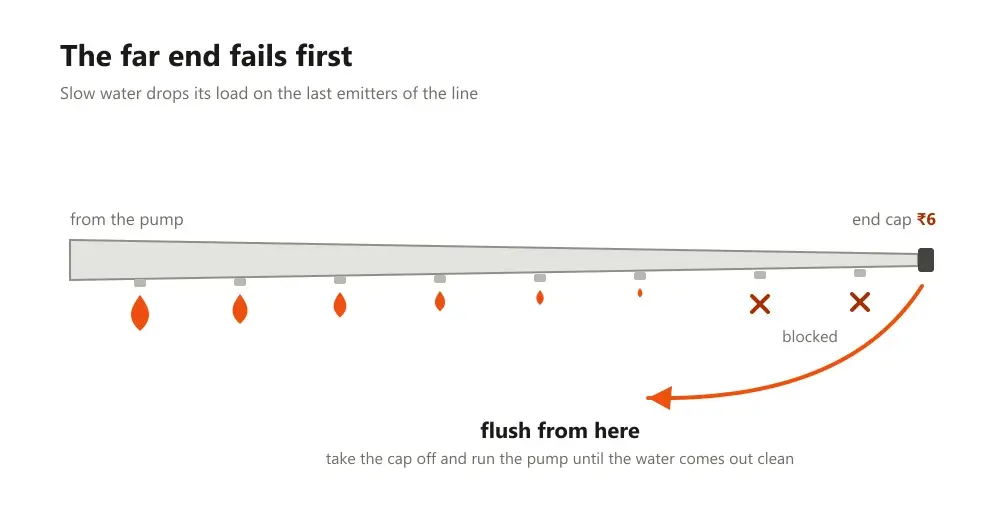
Water enters the lateral fast and gives up a share at every emitter, so by the last few metres it is barely crawling. Slow water drops whatever it carries. The sediment therefore settles at the tail of the line, directly over the final emitters, and the pattern every farmer recognises — a healthy field that fades towards one edge — is that physics made visible.
It is also why the failure hides for so long. The rows near the pump look perfect, the far rows droop a little more each week, and the soil or the seed gets blamed. Walking to the tail of a few laterals and checking the last plants tells you more about your system than any amount of staring at the head unit.
A flushing routine that costs almost nothing
Flushing is the cheapest maintenance in irrigation. Take the end caps off, run the pump, and let each lateral discharge until it runs clean; the sediment leaves through the open end instead of packing into the last emitters. Do a few laterals at a time so the pressure stays high enough to scour the pipe.
Flush before the first irrigation of the season, then every few weeks while the system runs — more often on dirty water. Tie it to a job you already do on a schedule, such as fertigation, so it actually happens. Watch what comes out. Water that clears in seconds says the routine is winning; a long brown flush says the filter upstream needs attention before the lateral does.
The hardware is trivial. A 16 mm end cap is ₹6 and a box of 100 is ₹600 — the small drip fittings have a floor of 100 pieces online — so one box, shared across seasons or across neighbours, covers years of caps, joiners and repairs.
Thin tape blocks on what thick pipe shrugs off
The lateral you chose decides how much abuse the water is allowed to deliver. Flat drip tape with a 0.2 mm wall — ₹3.96 per metre in the 1,000 m coil — has fine passages and no spare depth anywhere. It is the cheapest way to cover an acre precisely because there is so little material in it, and it collects that saving back by demanding genuinely clean water.
A round heavy-walled lateral at ₹18 per metre will pass small grit that would finish tape in a season, and standard round inline pipe at ₹8.96 per metre sits between the two. None of them survives unfiltered water indefinitely; the thicker walls just lose the fight more slowly.
So match the lateral to the water you actually have, not the water you intend to have someday. A silty source and no budget for serious filtration argues for the tougher pipe and relentless flushing. A clean bore and a good filter make tape's economy real rather than theoretical.
Blockage is a system problem, not an emitter problem
The emitter is only where the trouble becomes visible. The causes live upstream — the uncovered tank, the absent filter, the flush that never happens — and the same neglect that silences emitters also ages the pipe itself, which making your pipe last covers from the pipe's side.
The habit that beats all three blockages is attention on a schedule rather than attention after a failure. Skipped maintenance sits high on our list of common irrigation mistakes because it quietly undoes systems that were designed and bought perfectly well. And the physics does not care about scale: a terrace drip line running on tank water blocks for exactly the reasons above, just sooner.
If a line of yours is already down, cut an emitter open, look at what is inside, and tell us what you found. We will say honestly what to do next — including when the answer is a filter, which we do not sell, from someone who does.
Keep reading
Six common irrigation mistakes, and how to fix them
The six common irrigation mistakes we see most on Telangana and Andhra farms, and the practical fix for each — from schedules to system choice.
MaintenanceHow to make irrigation pipe last: sun, bends, storage
Sun, sharp bends and bad storage kill far more pipe than wear does. The habits that make irrigation pipe last season after season.
GuidesDrip irrigation layout for one acre of chilli, worked
A drip irrigation layout for one acre of chilli at 60 cm rows, fully counted — 105 laterals, seven coils of tape, valves, pump hours and the total.