Your borewell decides your acreage, not your field
A 3,000 lph bore running six hours waters about one acre of cotton on drip. Here is the arithmetic, and what to do when the field is bigger than the water.
5 September 2026 · 5 min read · REDYPLAST
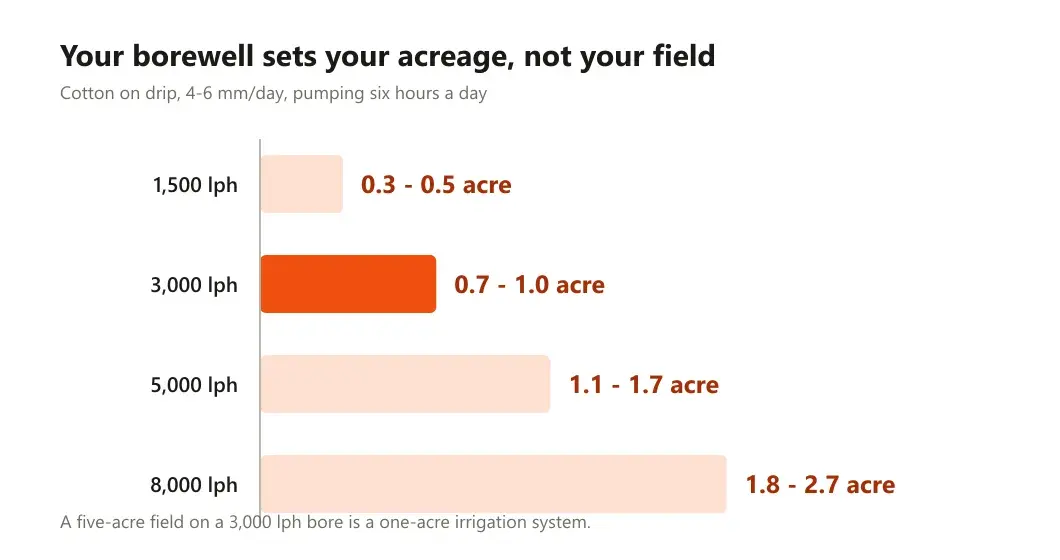
Most irrigation plans start from the wrong number. Someone says five acres, and the layout gets designed for five acres — mainline, sub-mains, laterals, the lot. Then it goes in, and half the field never gets a proper watering.
The field was never the constraint. The borewell was.
The only two numbers that set your ceiling
What a bore delivers in a day is just yield times hours:
**Litres per day = yield in litres per hour × hours you can actually pump.**
A 3,000 lph bore running six hours gives 18,000 litres. That is the entire water budget. Nothing downstream — no pipe size, no emitter, no layout — creates more of it.
The hours matter as much as the yield, and they are the number people overstate. Pumping hours are limited by the power supply, by how long the bore holds its yield before it starts drawing down, and by how much of the day the supply is single-phase. A bore that gives 3,000 lph for the first hour and 1,800 lph by the fourth is not a 3,000 lph bore for planning purposes.
What an acre actually drinks
A crop's demand is quoted in millimetres per day, which sounds abstract until you convert it. One millimetre of water over one square metre is one litre, and an acre is 4,047 square metres. So one millimetre over one acre is about 4,047 litres.
Cotton wants 4 to 6 mm a day. That is 16,000 to 24,000 litres a day landing in the root zone, per acre.
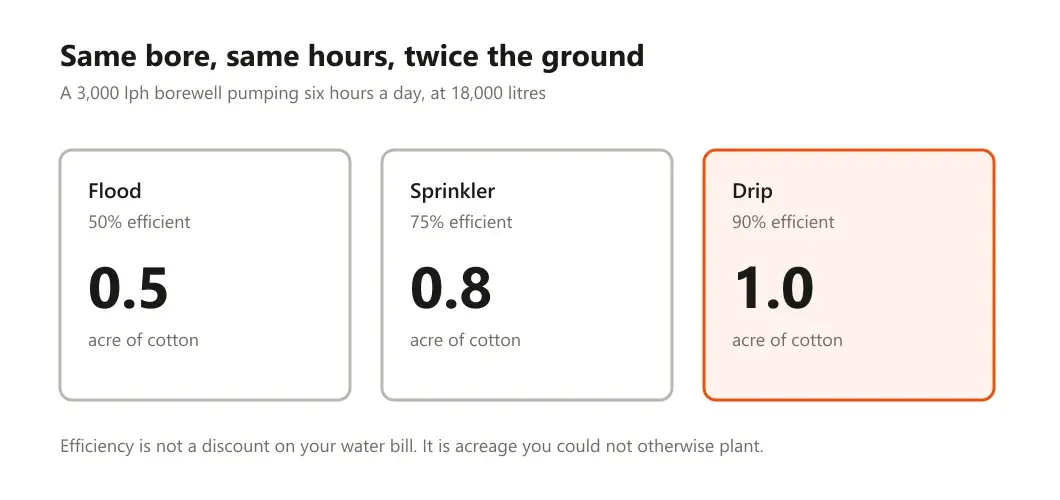
But you have to pump more than lands, because some is lost on the way. On drip roughly 90% reaches the roots, on sprinkler about 75%, on flood about half. Dividing through:
Now put the two halves together. Your 3,000 lph bore on six hours gives 18,000 litres. Cotton on drip needs 18,000 to 27,000 per acre. That bore waters **about one acre** — and only at the low end of the crop's range, on a good day.
Not five. One.
- **Drip** — 18,000 to 27,000 litres a day, per acre of cotton
- **Sprinkler** — 21,600 to 32,400 litres a day
- **Flood** — 32,400 to 48,600 litres a day
Which is the real argument for drip
Look at the same bore under the three methods and the case for drip stops being about saving water, which is an abstraction to most people, and becomes about acreage, which is not.
Eighteen thousand litres a day irrigates roughly half an acre of cotton under flood, about eight-tenths under sprinkler, and about a full acre under drip. Same bore, same hours, same crop. Twice the ground on drip as on flood.
That is the number worth arguing with a supplier about. Water saved is money you never see. Acres planted is money you do.
A worked example, end to end
Say you have four acres of chilli and a bore that gives 2,500 litres an hour. Power is reliable for about five hours.
Your supply is 2,500 x 5 = 12,500 litres a day.
Chilli wants 3 to 5 mm a day, so on drip that is roughly 13,500 to 22,500 litres per acre. Divide your 12,500 by the low end and you get about nine-tenths of an acre. Call it one acre in a kind season, and rather less in a dry one.
So the question stops being "how do I irrigate four acres" and becomes "which acre, and what happens to the other three". That is a harder conversation, but it is the real one, and it is much cheaper to have before the pipe arrives than after.
When the field is bigger than the water
Most fields are. The honest options are all about matching the area to the supply rather than pretending the supply is bigger:
- **Irrigate in shifts.** Split the field into blocks and water one block a day, or two blocks on alternate days. The layout has to be designed for this from the start — valves at the head of each block, and a sub-main sized for one block's flow, not the whole field. Retrofitting shifts onto a system built for simultaneous flow rarely works, because the mainline was never sized for it.
- **Plant to the water.** Put the high-value crop on the area the bore can genuinely serve, and something less thirsty or rain-fed on the rest. A well-watered acre of chilli beats three stressed ones.
- **Store, then apply.** A tank lets you pump through whatever hours the power allows and irrigate on the crop's schedule instead of the supply's. It does not create water, but it decouples the two clocks, which is often the actual problem.
- **Change the crop's demand, not the bore.** Paddy at 6 to 10 mm a day needs about twice what chilli does. On a weak bore the crop choice is the irrigation decision.
Work it out before you buy pipe
Do this arithmetic before anyone quotes you a system, because it changes what you should be buying. A layout designed for five acres on a one-acre bore is not an ambitious plan; it is pipe you paid for that will sit dry.
One more thing worth saying plainly: the figures here are published agronomic and irrigation-engineering ranges, not a measurement of your field. Soil, slope, wind and how much your bore drops through the day all move them. They are a starting point to argue with — and a much better starting point than the size of the field.
You need three things: your bore's yield, the hours you can honestly pump, and your crop's daily need. The first two you find at the bore. For the third, our water requirement estimator has the per-crop figures this article uses, and will do the conversion for your acreage and method.
Once you know the area you can genuinely serve, the system estimator will price the pipe for *that* area rather than the one on your patta. And if you are still choosing between methods, the efficiency numbers above are the same ones behind our comparison of drip against sprinkler by crop.
Where these numbers come from
- FAO Irrigation and Drainage Paper 56 (opens in a new tab)
The reference method for crop evapotranspiration and crop coefficients that daily water figures derive from.
- ICAR (opens in a new tab)
Indian Council of Agricultural Research — crop agronomy and regional package-of-practices.
- TNAU Agritech Portal (opens in a new tab)
Crop-wise spacing, water requirement and drip layout references for southern India.
Keep reading
Drip for pomegranate: control decides the crop
Drip for pomegranate is less about saving water than commanding it — resting blocks on purpose, ripening fruit without cracks, keeping alleys dry.
GuidesDrip for cotton: when it pays, and the pitfalls
Drip for cotton pays back fastest of any field crop. When that's true, which lateral grades survive the season, and the pitfalls cotton buyers keep hitting.
GuidesDrip vs sprinkler: which one suits your crop?
Drip vs sprinkler comes down to row spacing, water quality and wind. Here is the honest two-way comparison, with real per-acre lateral costs.