Drip vs sprinkler: which one suits your crop?
Drip vs sprinkler comes down to row spacing, water quality and wind. Here is the honest two-way comparison, with real per-acre lateral costs.
12 May 2026 · 3 min read · REDYPLAST
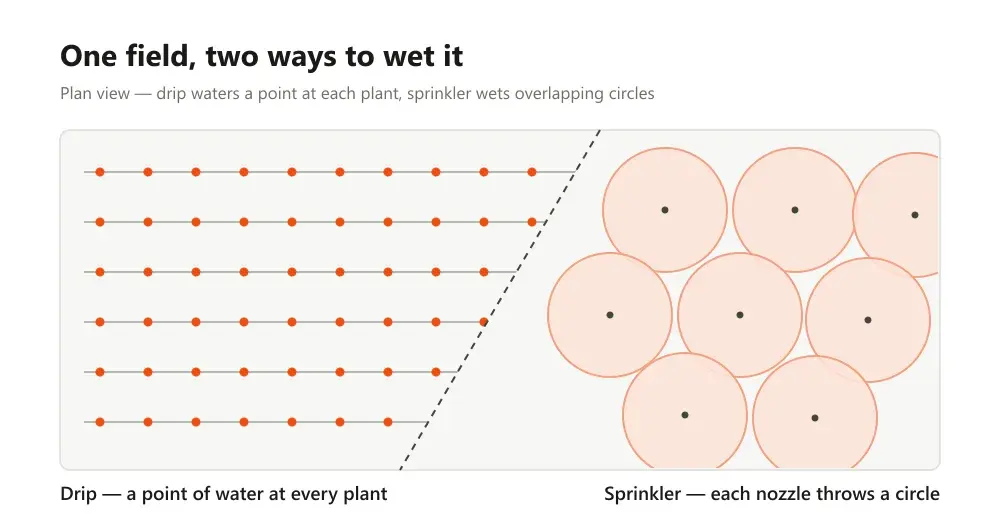
Drip vs sprinkler: three questions settle it
Row spacing leads because it decides where water should land. A crop standing in defined rows with open soil between them — cotton, chilli, banana — leaves ground that holds no roots, and a method that wets that ground is irrigating weeds. A crop that closes over the whole surface — groundnut, pulses, fodder — has roots under every square metre, so overhead coverage stops being waste and becomes the point.
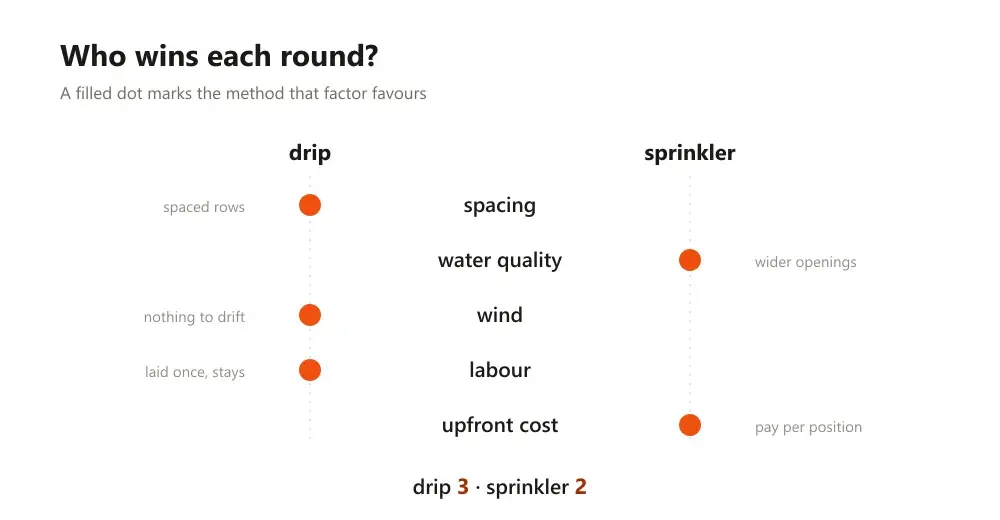
Water quality and wind then act as vetoes. Either one can overturn what spacing decided, which is why they sit second and third rather than nowhere.
The drip vs sprinkler decision comes down to three questions, asked in this order: how far apart are your rows, what is in your water, and how hard does the wind blow across your field? Answer those three honestly and the method usually picks itself. This is the deep two-way comparison; if you want the quick crop-by-crop version including rain pipe, that is its own article.
Where drip earns its keep
A drip lateral meters water out plant by plant, so very little lands where no root can drink it. ICAR field figures put drip near 90% application efficiency, against about 75% for sprinkler and 50% for flood — the difference is evaporation, and wetted ground that never needed wetting.
Drip also asks for a habit sprinkler does not: routine flushing and a watchful eye on the lines. It is not a heavy burden, but a farmer who knows he will not walk the field is better served admitting that now than replacing laterals later.
Drip favours spaced, long-season, high-value rows: cotton, chilli, tomato, brinjal, banana, papaya, sugarcane and orchard fruit. A long season lets the water saving compound month after month, and a high-value crop carries the heavier upfront spend. Two quieter advantages ride along: foliage stays dry, which eases fungal pressure in humid spells, and delivery stays even across gentle slopes where flood never was.
The spend scales with row length. Cotton at 1.2 m rows needs about 3,339 m of lateral per acre; tighten to 0.9 m and it rises to roughly 4,470 m. Our drip range prices laterals from ₹3.96 per metre for 0.2 mm flat tape up to ₹18 per metre for heavy round pipe — so that 1.2 m acre costs about ₹13,200 in tape, or about ₹60,100 in heavy line, before fittings. Tape is a per-season spend; heavy pipe is a many-season one.
Where sprinkler is the better buy
A sprinkler throws water from a riser and lets it fall as droplets over a full circle. One position covers ground that would take several drip lines, and for a crop sown dense there is no bare strip worth avoiding anyway.
Two honest limits. Water lands on the leaves, and crops prone to leaf disease resent that in humid weather. And droplets spend time in the air, which brings us to wind.
It suits close-sown field crops: groundnut, wheat, mustard, millets, pulses, green fodder and anything broadcast rather than row-planted. Germination is where it shines — an even overhead wetting brings a sown field up uniformly in a way furrow watering never manages.
The economics work by position, not by metre. In our sprinkler category, a PVC nozzle costs ₹216 and a brass one ₹1,206; clamps run ₹81 to ₹306 and nylon washers ₹45 to ₹54. You buy a handful of nozzle positions plus pipe to feed them, and the pipe moves between stands — so the cost tracks the area covered, not the number of rows in it.
Water quality decides more than people admit
Be clear-eyed about what that means for the budget: drip on doubtful water needs filtration, and we do not stock filters, pressure gauges or venturis — price a filter from a supplier who carries them before you price a single lateral. A sprinkler nozzle, by contrast, passes most of what would kill an emitter, which is why sprinkler is often the sane choice on an old bore pulling sand.
A drip emitter's passage is narrow by design, and silty or iron-heavy borewell water closes it from the far end of the line inward. The failure is quiet — the crop at the tail end shows stress before any emitter looks blocked. Why drip lines block, and what clears them covers the diagnosis in detail.
Wind and labour pull in opposite directions
Wind barely touches drip — the water is on the soil before a gust can carry it. Sprinkler droplets hang in the air for a second or two, and on an exposed field the wetted circles stretch into ovals, soaking one edge and starving the other. If your afternoons blow hard through the season, irrigate at night or lean back toward drip.
Labour runs the other way from what most buyers assume. Drip goes down once and stays down; a season of irrigation is a season of opening valves. Sprinkler stands usually need shifting every few hours unless you have bought enough pipe to cover the whole block at once — and that shifting is a person in the field, every watering, all season. On a farm short of hands, this line alone can settle the argument.
Schemes, GST and the 5% line
Both methods sit inside the micro-irrigation concession, so drip and sprinkler equipment carries 5% GST while general pipe and fittings carry 18%. Central and state support under the PMKSY umbrella has covered both methods for smallholders, but the terms shift by season and by district — treat any figure you read online as stale, and ask the horticulture office for your district what applies this year.
Deciding without guessing
Run the three questions in order. Spaced rows, clean-enough water, any amount of wind: drip. Close-sown crop, doubtful water, calm mornings or night watering possible: sprinkler. When the answers conflict, water quality and wind veto spacing, because a blocked emitter or a drifted spray wastes more than a wetted gap between rows ever will.
Then size the water before the pipe. The water requirement calculator turns crop, area and season into litres per day, which tells you whether the bore can feed the method at all — a system the source cannot supply is the one mistake no comparison survives.
Plenty of farms rightly run both: drip on the cotton block, sprinkler on the fodder strip. If the two still look level for your field, tell us the crop, the row spacing and the water source through the bulk enquiry form or talk to us directly — we will say plainly which one we would lay, and what it should cost per acre.
Where these numbers come from
- ICAR (opens in a new tab)
Indian Council of Agricultural Research — crop agronomy and regional package-of-practices.
- PMKSY — Per Drop More Crop (opens in a new tab)
The central micro-irrigation scheme. Subsidy rates and eligibility are set here, not by suppliers.
Keep reading
Drip for pomegranate: control decides the crop
Drip for pomegranate is less about saving water than commanding it — resting blocks on purpose, ripening fruit without cracks, keeping alleys dry.
GuidesDrip for cotton: when it pays, and the pitfalls
Drip for cotton pays back fastest of any field crop. When that's true, which lateral grades survive the season, and the pitfalls cotton buyers keep hitting.
IrrigationDrip, sprinkler or rain pipe: a decision guide by crop
Row spacing, water source and budget decide which of the three methods fits. Here is the reasoning, crop by crop, with what each one costs.