Drip for pomegranate: control decides the crop
Drip for pomegranate is less about saving water than commanding it — resting blocks on purpose, ripening fruit without cracks, keeping alleys dry.
12 September 2026 · 3 min read · REDYPLAST
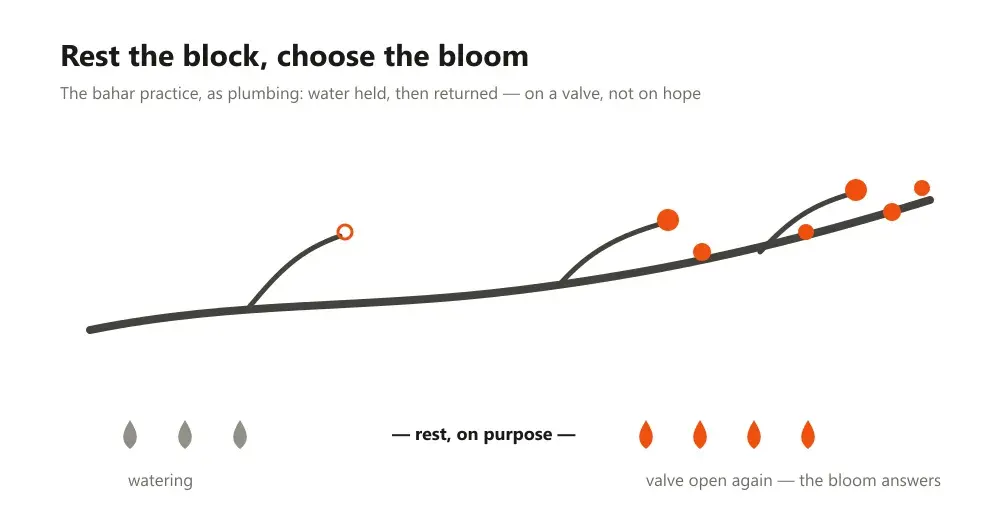
Most crops want drip because it delivers water; drip for pomegranate earns its place because it can also refuse to. This is the orchard crop farmers manage by scheduling — resting a block dry on purpose, then flooding it back to life to set a synchronised bloom — and no other irrigation method turns water off and on that cleanly.
Add the fruit's famous intolerance for erratic moisture, and pomegranate is less a customer for pipe than for control. Here is what that means at buying time.
One of the cheapest orchards to convert
The economics start friendly. Pomegranate plants at 3 to 4.5 metre rows, so a square acre carries only fourteen to twenty-one laterals — roughly 900 to 1,300 metres of pipe, against the 3,339 metres a cotton acre lays. Few plantings put a whole acre under drip for less.
Because the planting stays put for years, buy the wall that stays put with it: the round inline laterals at ₹8.96 a metre, or the heavy grade at ₹18 for a system intended to outlast several bahars — the small metre-count keeps even the premium grade to roughly ₹16,000–24,000 of lateral for the acre. The ₹3.96 seasonal tape has no business under a permanent bush, and the longevity habits apply with years in view: shade or bury the runs, and elbow the corners.
The tap you can schedule is the crop you can time
Here is the pomegranate-specific part. Growers force the tree's flowering — the bahar — by holding water back for a rest period and then resuming it, choosing which season's bloom to take. The agronomy of when and how long belongs to your horticulture officer; what belongs to us is the plumbing truth that the practice depends on a system that can actually stop.
A channel-fed or rain-fed orchard cannot rest on command. A drip system with a ball valve at each block's head can — closed, the block rests bone dry whatever the rest of the farm is doing; open, every bush drinks the same day. Valve the orchard block by block and you can stagger bahars across the holding, spreading harvest and cash across the calendar instead of gambling one giant picking. That valve-per-block layout costs little at installation and cannot be retrofitted cheaply; ask for it on day one, and the sizing guide shows how the mainline and pump carry blocks running on different clocks.
Steady water or split fruit
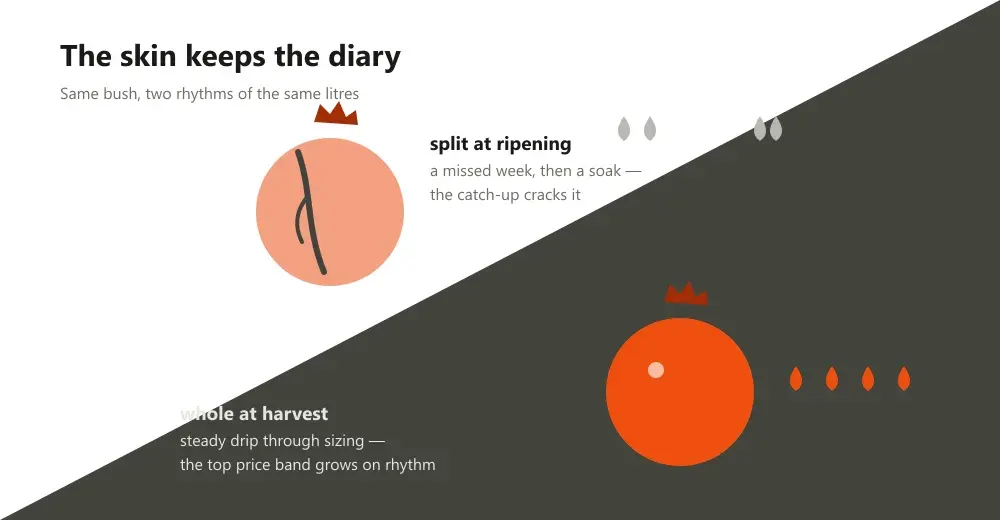
Pomegranate's second demand is the opposite of the first: once fruit is sizing, the water must be boringly steady. Swing a ripening bush between drought and soak — a missed week, then a generous catch-up — and the skins split faster than the flesh can be sold. Cracked fruit is the classic pomegranate loss, and it is mostly an irrigation rhythm problem, not a variety problem.
Drip is the rhythm instrument, but only while every emitter drips. One blocked dripper is a private drought for one bush — invisible under mulch, priced in cracked fruit months later. Flush the laterals on schedule and keep the filter clean — and as always, said plainly: we stock no filters, so that line of the budget is bought elsewhere and non-negotiable on a fruit this fussy.
Dry alleys pay twice
Point-watering keeps the ground between rows dry, and on pomegranate that dryness earns its keep twice over. Through the humid months, dry alleys and dry foliage mean less of the disease pressure that haunts this crop than any overhead method invites. And at harvest — pickings that stretch across weeks — dry alleys keep baskets, boots and vehicles moving on days when a flooded orchard would stand idle.
Neither benefit shows up on a quotation, which is exactly why they are worth writing down before you compare a drip bill against a sprinkler one.
The laterals moonlight as a third tool, too: pomegranate feeding is done in small, repeated doses through the season, and the drip line is how those doses ride to every bush without a labourer walking a bucket to each one. Fertigation hardware is its usual honest footnote — the venturi injector that drives it is not something we stock, so it joins the filter on the bought-elsewhere list — but the pipe you are buying is already the delivery half of that system.
And the payoff for all this control is graded at the mandi, not the pump shed. Unsplit, unblemished skins are what separate the top price band from the cooking-grade crate; a bush that never felt a drought week and never wore a fungicide-defeating wet canopy is how such skins are grown. On a crop sold by appearance, the control premium is not a luxury line — it is the product.
Sizes, grades, and the two pitfalls
The shopping list is orchard-standard and short: 16 mm laterals in a long-life wall from the drip range, emitters at bushes rather than blind intervals, a ₹6 takeup and end cap per lateral, mainline to match the pump. The two mistakes to refuse:
Our pomegranate crop page sits beside the products. If you are planning blocks and bahars on paper, send the layout across — valving an orchard for control costs pennies at design time, and it is the difference between owning a watering system and owning a calendar.
- One valve for the whole orchard. It waters beautifully and schedules nothing — no staggered bahar, no resting one block while another ripens. Valves are the cheapest control you will ever buy.
- Letting the power schedule replace the crop's. A ripening block missed for a week and then double-watered is how cracks happen; plan block run-times inside your reliable pumping hours, using the [water requirement calculator](/calculators/water-requirement) for the daily litres.
Where these numbers come from
- ICAR (opens in a new tab)
Indian Council of Agricultural Research — crop agronomy and regional package-of-practices.
- TNAU Agritech Portal (opens in a new tab)
Crop-wise spacing, water requirement and drip layout references for southern India.
Keep reading
Drip for cotton: when it pays, and the pitfalls
Cotton is the crop drip pays back fastest on. When that is true, which lateral grades survive the season, and the pitfalls cotton buyers keep hitting.
GuidesDrip vs sprinkler: which one suits your crop?
Drip vs sprinkler comes down to row spacing, water quality and wind. Here is the honest two-way comparison, with real per-acre lateral costs.
GuidesDrip for banana: sizes, grades and the two pitfalls
Which drip laterals suit a banana crop, why the heavy wall earns its keep over a year in the ground, and the two mistakes banana buyers repeat.