Drip emitter spacing for chilli on red loam, and the run time
Drip emitter spacing for chilli on red loam matters, because the wet bulbs barely meet. Where the plants go, the minutes per day, and two schedules that fail.
26 October 2026 · 4 min read · REDYPLAST
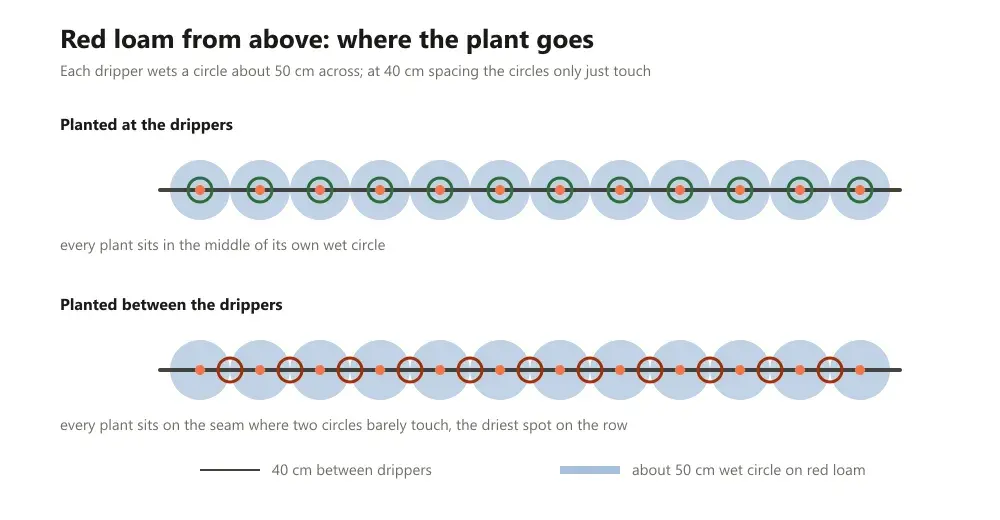
Drip emitter spacing for chilli on red loam is a real decision, unlike on a heavy clay, because this soil takes water straight down and the wet bulb under each dripper is a narrow column that only just reaches its neighbour. Get drip emitter spacing for chilli on red loam right and every plant sits in its own wet column; get the planting out of step with the drippers and every third plant is dry.
The run time is the other half, and on red loam it is short and frequent. This guide covers how the soil moves and holds water, where the plants go along the lateral, the minutes per day from the calculator's figures, and the two schedules that fail on it: the one copied from a cotton field and the one that tries to save emitters.
How red loam moves water
Red loam is the light, well-drained soil of much of upland Telangana and Rayalaseema: sandy to loamy on top, often over a gravelly murrum layer, low in clay and quick to drain. Water from a dripper goes down before it goes out, so the bulb is deep and narrow, roughly 40 to 60 cm across at the surface and tapering below. It stores little: a day or two of crop water in the root zone, not the week a black soil holds.
Three consequences follow. Long runs are wasted, because water past the root zone drains into the murrum and is gone. Gaps between bulbs stay dry, because the soil does not spread water sideways to close them. And the field cannot be left for three days, because the small store empties fast and chilli pays for a dry spell at flowering with dropped flowers.
- Narrow bulb: 40 to 60 cm across, deep rather than wide.
- Fast drainage: anything beyond the root zone is lost within hours.
- Low storage: a day or two, so the gaps between runs are short.
- Dry gaps: the soil will not join two bulbs that do not already meet.
Drip emitter spacing for chilli on red loam
Every drip line we list carries a 4 litre per hour dripper every 40 cm, and on red loam those bulbs meet only just. The spacing is right for chilli, whose plants stand 40 to 45 cm apart along the row, but only if the plants are set at the drippers. Transplant a seedling midway between two emitters on this soil and it sits at the thinnest edge of two bulbs; set it at the emitter and the whole column is its own.
So the first rule is to lay the lateral before transplanting, run it once, and plant into the dark spots. On a heavy soil that fuss is unnecessary because the band is continuous; on red loam it is the difference between an even stand and a row that alternates tall and short. The chilli crop page and the chilli drip guide both treat the lateral count as the big decision; on this soil the plant positions along it matter almost as much.
Lateral spacing is one line per row at the 0.6 to 0.9 metres chilli is planted at, and here the sideways spread is too small to tempt anyone into one line per two rows. Paired rows on a single lateral work on red loam only when the pair is planted close on either side of the line, within about 20 cm of it, which is a planting layout rather than an irrigation one. The 16 mm inline pipe from the drip range is the standard lateral.
The run time, in minutes
A dripper every 40 cm at 4 litres an hour puts 10 litres an hour onto each metre of lateral, and on rows 0.75 metres apart that metre serves three quarters of a square metre, so the line applies about 13 mm an hour wherever it runs.
Five millimetres a day is therefore a little over twenty minutes of running, and the lighter days nearer a quarter of an hour. Across an acre that is about 5,400 metres of lateral drinking 54,000 litres an hour, which few pumps hold at once, so the block runs in shifts and each shift gets its twenty minutes.
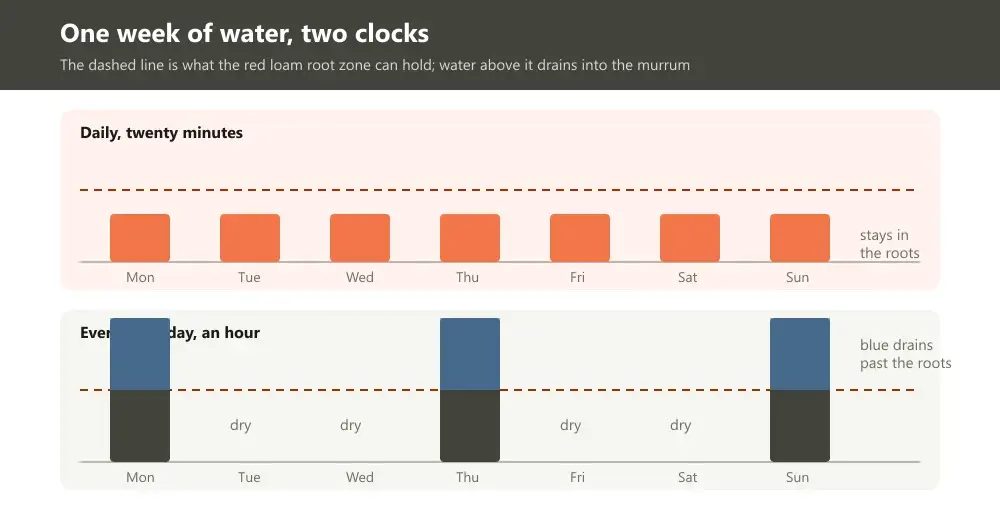
On red loam those minutes are given every day, and in the hottest fortnight of flowering and fruit set they are better split into a morning and an evening run of ten minutes each. The bulb refills before it empties, the plant never meets a dry afternoon, and nothing is pushed past the roots into the gravel.
Chilli in active growth uses about 3 to 5 mm a day, which on one acre is roughly 12,000 to 20,000 litres at the root, or about 13,500 to 22,500 litres from the pump once drip's losses are allowed for; the water requirement calculator gives the figure for your own acreage.
The two schedules that fail
The first failure is the cotton schedule. A grower who also runs drip on a black-soil cotton field waters it every second or third day with a long run, because that soil stores water and takes it in slowly, and brings the habit to the chilli on red loam. Here the long run drains below the roots within the hour, the plants are dry by the second afternoon, and the flowers drop before anyone sees wilting.
The second failure is saving emitters. A lateral with drippers every 60 or 80 cm costs less per metre and is a fair economy on soils that spread water sideways; on red loam it leaves a dry 20 to 40 cm between bulbs, and chilli planted at 45 cm lands in those gaps on every other plant. Our listing carries the 40 cm spacing only, which on this soil is the right economy to keep.
On a soil this quick a blocked dripper shows within days as one wilting plant, which is at least easy to find; the blocked-line guide covers flushing, and the filter it depends on is not something we stock.
- Cotton schedule on red loam: long runs every third day, water lost to the gravel, flowers dropped in between.
- Wider spacing on red loam: dry gaps between bulbs, an alternating stand of strong and weak plants.
- The check: a trowel beside the plant line the morning after a run, and a second a hand's width off the line; both should be moist, neither sodden.
The figures are a starting point
The 3 to 5 mm a day and the bulb widths are published agronomic ranges, not measurements from your field, and red loams vary in depth over the murrum and in how much gravel they carry. Treat the twenty minutes as the first week's schedule and let the trowel correct it, upward in a dry wind and downward once the canopy closes and shades the row.
If you want the lateral count and the shifts sized to your pump and your row spacing, send us the spacing, the acreage and the bore yield and we will say what the pipe delivers per hour and how many runs a day the field needs.
Where these numbers come from
- FAO Irrigation and Drainage Paper 56 (opens in a new tab)
The reference method for crop evapotranspiration and crop coefficients that daily water figures derive from.
- ICAR (opens in a new tab)
Indian Council of Agricultural Research — crop agronomy and regional package-of-practices.
- TNAU Agritech Portal (opens in a new tab)
Crop-wise spacing, water requirement and drip layout references for southern India.
Keep reading
Drip emitter spacing for cotton on black cotton soil: run times
Drip emitter spacing for cotton on black cotton soil is the easy part; run time is the hard one. The minutes per day, and how the standard schedule fails.
GuidesConverting chilli from flood to drip: cost and steps
Converting chilli from flood to drip: what you keep, what you buy, what it costs at MRP, how the work and the water change, and who should not convert.
GuidesFlood to drip conversion for garden and orchard: cost and steps
A flood to drip conversion for garden and orchard priced at MRP for this year's rows and the finished acre, with the main sized once and who should wait.