Converting chilli from flood to drip: cost and steps
Converting chilli from flood to drip: what you keep, what you buy, what it costs at MRP, how the work and the water change, and who should not convert.
16 October 2026 · 5 min read · REDYPLAST
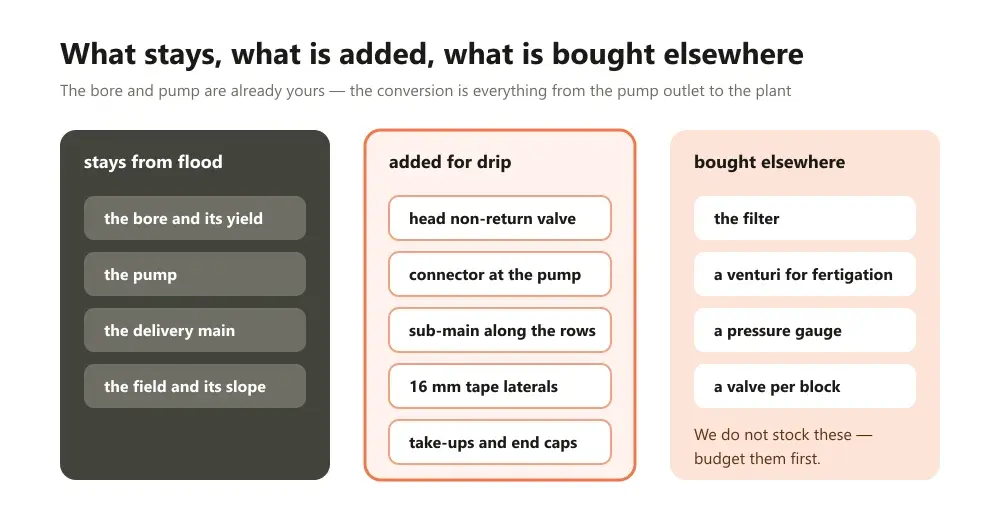
Converting chilli from flood to drip means keeping the bore, the pump and the delivery main you already have, and adding everything from the pump outlet to the plant: a head with a filter we do not stock, a sub-main, a lateral down every row, and the fittings that join them. For a one-acre chilli layout at 0.6 metre rows, the parts we sell come to about ₹33,000 at MRP, valve and connector included; wider rows cost less, and the filter and the other pump-side steel sit outside that figure.
Laying happens before transplant and lifting after the last picking; how long each takes depends on the crew.
Converting chilli from flood to drip: what you keep and what you buy
Flood irrigation already paid for the costly part. The bore and its yield, the pump, the main that brings water to the field edge and the field's own slope all stay. Drip starts where the furrow started, with a sub-main laid along the row ends and a lateral turned off it down every row.
Chilli is planted at 0.6 to 0.9 metres between rows, closer than almost any other drip crop here, so an acre takes more lateral than most — and the lateral is most of the bill.
The head is the other thing flood never needed: a filter sized to the source, which we do not stock; the socketed ball-type non-return valve in 2 inch (₹1,440) so the main does not drain back down the bore at every stop; and a steel-to-plastic connector at the pump (₹558 in 2 inch) if the main does not already have one.
To run the field in turns, each block also needs a valve of its own. We stock no drip block valves or lateral cocks, so those are bought elsewhere, with the filter.
The one-acre chilli layout counts the parts we sell to the last end cap at ₹33,138, MRP with tax inside, for 0.6 metre rows on a 64 by 63 metre acre, and the chilli drip guide explains why the row count makes the lateral the biggest line.
The cost, honestly
That ₹33,138 is the 0.6 metre case: 105 rows and seven coils of tape. Rows at 0.75 metres need about 84 laterals and six coils, and by the same method the parts we sell come to about ₹29,000; at 0.9 metres, about ₹25,000.
Outside every one of those figures sit the filter, a venturi if you want to fertigate, a pressure gauge, the block valves, the rest of the pump-side steel, trenching and labour, and freight; we stock none of the first four. The site shows any discount running on the day.
The lateral for chilli is thin flat tape, because the crop is an annual: it goes down at transplant and comes up after the last picking.
The 16 mm tape with a 0.2 mm wall is ₹3,960 for a coil of about 1,000 metres and is budgeted per season; the 0.4 mm wall is ₹3,366 for about 500 metres, the heavier choice for rough ground, and it can serve a second crop if it is lifted gently. Takeups, joiners and end caps are ₹6 a piece, with an online floor of 100 pieces on each.
There is support for micro-irrigation under PMKSY's Per Drop More Crop component. Rates vary by state and by the farmer's category and they change, so we do not quote them; the district horticulture office is the place to ask, before buying.
For a parts list from your own crop and acres, the system estimator builds one from laterals, take-ups, end caps and joiners only, at the crop's middle spacing and on the sturdier round inline pipe, so an acre of chilli comes out near ₹50,000 — well above the tape bill, and without the sub-main, valve or connector.
The steps, in order
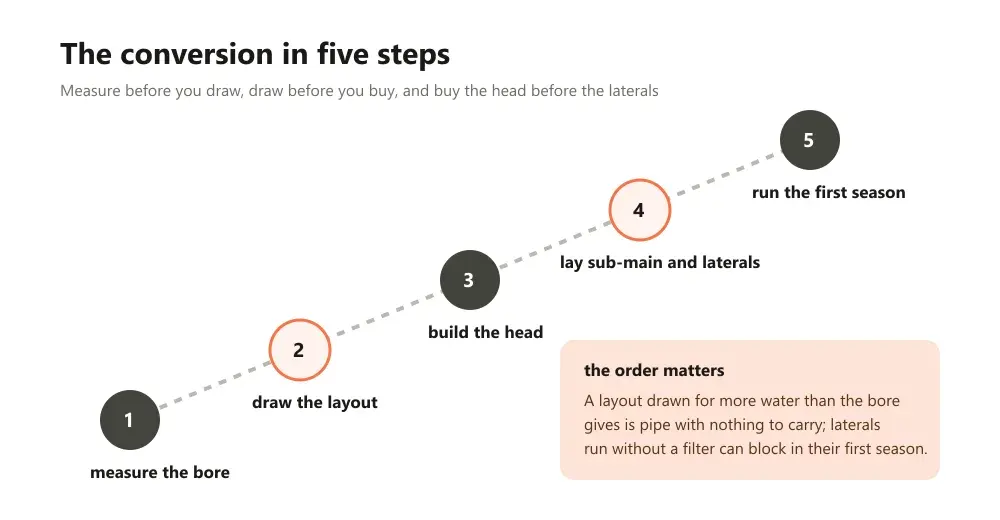
Measure before you draw, draw before you buy, and buy the head before the laterals. A layout drawn for more water than the bore gives is pipe with nothing to carry, and laterals run before the filter is fitted can block in their first season.
The borewell guide gives the first number — the bore's yield times the hours you can honestly pump — and its arithmetic also says a bore that irrigates one acre by flood can irrigate about two on drip, because far less of the water is lost on the way to the root.
- Measure the bore: litres an hour at the start of pumping and again towards the end of a normal pumping run, and the hours the power allows.
- Draw the layout: rows, blocks sized so each one gets its water inside the pumping hours, and the sub-main route along the row ends.
- Build the head in flow order — connector at the pump, non-return valve, then the filter — and have the filter fitted before a single coil is opened.
- Lay the sub-main and laterals before transplant, flush each lateral with its end cap off, then cap and run.
- Run the first season from the crop's need: check the soil at root depth before each run, set the run time from that, and flush on a fixed day.
The first season's learning curve
Flood taught you to judge water by a wet field. Drip wets a strip along the row and leaves the surface between rows dry. A common first mistake is to run the system longer until the field looks watered; that floods the wetted strip, starves the roots of air and washes fertiliser past them. Judge by the soil at root depth and by the plant, not by the surface.
Flood was a person guiding water from bund to bund; drip is a valve opened for the run the soil asks for, then the next block. Weeds in the dry strips tend to come slower, and the labour that guided the water is freed. Fertigation through the line needs a venturi or dosing unit — we stock neither.
Lines stay open through a clean tank, a filter and flushing together, and flushing is the free one. Chilli tape runs on small outlets, and a line that is never flushed closes from the far end first; the blocking guide explains why, and the mistakes guide lists the mistakes that cost yield quietly.
Who should not convert
Here are the cases to settle before converting. A field watered by gravity from a canal or a tank, with no pump, cannot run drip without adding one. Land leased for a single season needs the tape to move with you when the lease ends, or a lease long enough to use it — count that before converting.
A source that carries sand or silt, with no budget for the filter, means a tougher pipe and relentless flushing, as the blocking guide puts it; decide whether you will do that work before you buy. A field going into paddy next season gives the tape nothing to do under standing water, so it sits idle for that season. And a farm that cannot lift, roll and store the tape each season will buy even the heavier 0.4 mm tape again each season.
If none of those is you, the next step is a parts list against your own bore and rows. Send us the details — the bore's yield, the hours, the acres and the row spacing — and we will price what we sell at MRP, with the filter, venturi, gauge and block valves named as what you buy elsewhere; the chilli crop page describes the crop's method and spacing, and the drip range holds today's prices.
Where these numbers come from
- ICAR (opens in a new tab)
Indian Council of Agricultural Research — crop agronomy and regional package-of-practices.
- TNAU Agritech Portal (opens in a new tab)
Crop-wise spacing, water requirement and drip layout references for southern India.
- FAO Irrigation and Drainage Paper 56 (opens in a new tab)
The reference method for crop evapotranspiration and crop coefficients that daily water figures derive from.
- PMKSY — Per Drop More Crop (opens in a new tab)
The central micro-irrigation scheme. Subsidy rates and eligibility are set here, not by suppliers.
- Telangana Horticulture Department (opens in a new tab)
State subsidy administration and the district offices that process micro-irrigation applications.
Keep reading
Converting banana from flood to drip: cost and steps
Converting banana from flood to drip suits a crop that drinks heavily for a year and suffers with wet roots: the acre bill, the pump check, the steps.
GuidesConverting cotton from flood to drip: cost and steps
Converting cotton from flood to drip roughly doubles the ground one bore can water. The published acre bill at MRP, the order of work, and who should wait.
GuidesRain pipe for chilli: sizes, prices and pitfalls
Where rain pipe for chilli genuinely fits — the nursery and the unconverted field — with the right sizes, real roll prices and the pitfalls.