Drip emitter spacing for cotton on black cotton soil: run times
Drip emitter spacing for cotton on black cotton soil is the easy part; run time is the hard one. The minutes per day, and how the standard schedule fails.
26 October 2026 · 5 min read · REDYPLAST
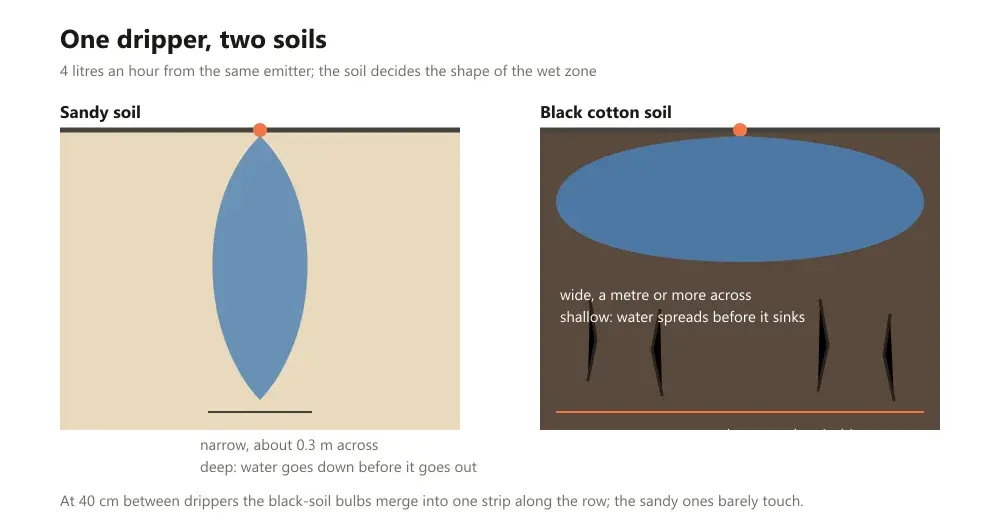
Drip emitter spacing for cotton on black cotton soil is settled by the soil before the crop gets a say: this clay spreads water sideways so far that the drippers along a lateral wet one continuous strip, and the 40 cm spacing on every inline pipe we list is already wider than the soil needs. The question behind drip emitter spacing for cotton on black cotton soil is how long to run the line and how often, because the same soil takes water in slowly and cracks when it dries.
This guide covers how black cotton soil moves and holds water, the wetting pattern it makes under a lateral, the run time that follows from the calculator's figures, and the two ways the standard daily schedule goes wrong on it.
How black cotton soil moves water
Black cotton soil is a heavy, swelling clay. Wet, it closes up and lets water in slowly; a dripper running onto it builds a shallow pool that spreads outward before it goes down, so the wet bulb under one emitter is wide and flat rather than the deep narrow carrot sandy soil makes. Dry, the same clay shrinks and opens cracks a hand deep, and water poured onto a cracked surface runs down the cracks and past the roots.
Two more properties follow from the clay. The soil holds a great deal of water between waterings, so it can go longer between runs than a loam; and it drains poorly, so water given faster than it can take in sits on the surface and, along a row, runs off. Cotton dislikes wet feet, and a row left standing in water through a hot afternoon sheds squares and bolls.
- Sideways spread is wide: one emitter can wet a metre or more across on this soil, against a third of that on sand.
- Intake is slow: a long run ponds and runs off before it soaks in.
- Storage is high: the root zone holds several days of crop water once it is full.
- Cracks are the trap: a dried-out surface swallows the next watering below the roots.
Drip emitter spacing for cotton on black cotton soil
Every drip line we list, the round inline Aquaflow and both flat tapes, carries a 4 litre per hour dripper every 40 cm. On black cotton soil the bulbs from neighbours at that spacing overlap well before the water reaches root depth, so the lateral wets a continuous band along the row and no plant sits between two dry spots.
A wider spacing would also merge on this soil, which is why heavier soils tolerate the economy of fewer emitters, but 40 cm is what the listing carries and it is more than adequate here.
Lateral spacing is the row spacing, one line per row at the 0.9 to 1.2 metres cotton is planted at, and the wide sideways spread means the band from one line reaches well towards the next.
The temptation that follows is one lateral per pair of rows. On a deep black soil with rows under a metre it can work, and it halves the pipe bill; the test is a trowel at the far row after a full run, not a rule, and the cotton crop page says measure your rows before deciding anything.
The 16 mm inline pipe from the drip range is the standard lateral for the job. The cotton drip guide covers wall thickness and the dry commissioning that cotton's calendar forces; this page is about what happens after the water is turned on.
The run time, in minutes
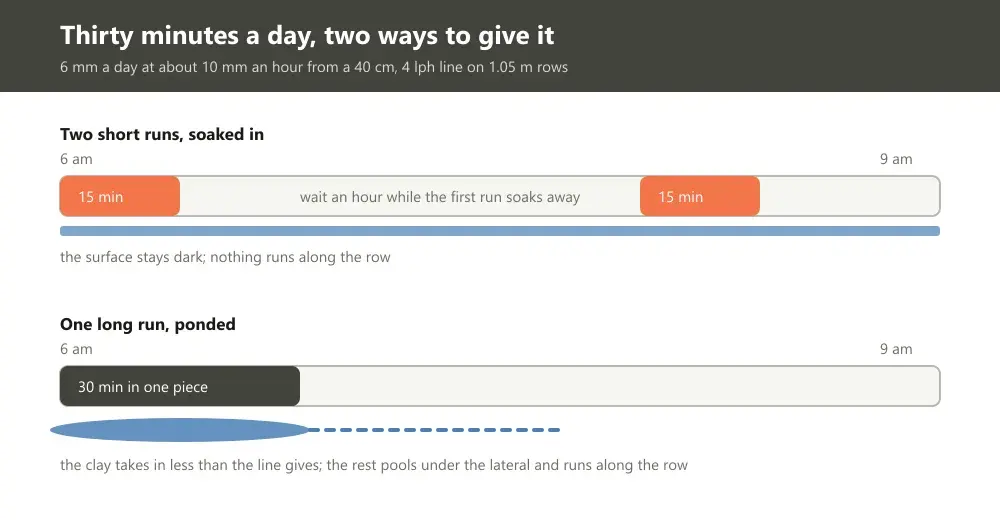
Now the pipe. A dripper every 40 cm at 4 litres an hour puts 10 litres an hour onto each metre of lateral. On rows 1.05 metres apart that metre serves about one square metre of field, so the line applies close to 10 mm an hour wherever it runs.
Six millimetres a day is therefore a little over half an hour of running, and the lighter days are nearer twenty minutes. If the pump cannot hold the whole acre at once, the block runs in shifts and each shift gets those minutes.
On black cotton soil that half hour should not be given in one piece on a hot day. Ten millimetres an hour is faster than this clay takes water in, so a single long run ponds along the row. Split it: two runs of fifteen minutes with an hour between let the first soak away before the second arrives, and the surface stays dark rather than shining.
Start from the water. Cotton in active growth uses about 4 to 6 mm a day, which on one acre is roughly 16,000 to 24,000 litres at the root, or about 18,000 to 27,000 litres from the pump once drip's losses are allowed for; the water requirement calculator gives the figure for your own acreage.
How often, and the two standard mistakes
The standard drip schedule says water every day. On this soil it is usually wrong in both directions at once. Daily short runs keep the surface wet and the band between rows damp, which grows weeds and keeps roots shallow, while the soil's deep storage is never used.
The better rhythm on a deep black soil is a fuller watering every second or third day in the main season, with the trowel deciding, and daily runs only in the weeks of peak demand around flowering and boll filling.
The opposite mistake is worse. A grower who stretches the interval until the soil cracks, then runs the line for an hour to catch up, watches the water vanish down the cracks and the plants wilt the next afternoon anyway.
On black cotton soil the surface must never be allowed to crack open under the lateral; once it has, the first run back is a long slow one at low pressure to close the cracks, and the schedule restarts from there.
Keep the drippers clear, because on a soil this slow a blocked emitter shows only as a thin patch weeks later; the blocked-line guide covers flushing, and the filter it depends on is not something we stock.
- Standard mistake one: daily sips that wet the surface, feed weeds and waste the soil's storage.
- Standard mistake two: a dried, cracked surface and a long catch-up run that bypasses the roots.
- The check that settles both: a trowel a hand deep beside the plant line, the morning after a run.
The figures are a starting point
The 4 to 6 mm a day and the spread under an emitter are published agronomic ranges, not measurements from your field, and black cotton soils vary in depth and in how far they have been worked. Treat the minutes above as the first week's schedule and let the trowel correct them.
If you want the lateral count and the shifts sized to your pump, send us the row spacing, the acreage and the bore yield and we will say what the pipe can deliver per hour and how many runs a day the field needs.
Where these numbers come from
- FAO Irrigation and Drainage Paper 56 (opens in a new tab)
The reference method for crop evapotranspiration and crop coefficients that daily water figures derive from.
- ICAR (opens in a new tab)
Indian Council of Agricultural Research — crop agronomy and regional package-of-practices.
- TNAU Agritech Portal (opens in a new tab)
Crop-wise spacing, water requirement and drip layout references for southern India.
Keep reading
Converting cotton from flood to drip: cost and steps
Converting cotton from flood to drip roughly doubles the ground one bore can water. The published acre bill at MRP, the order of work, and who should wait.
GuidesFlood to drip conversion for garden and orchard: cost and steps
A flood to drip conversion for garden and orchard priced at MRP for this year's rows and the finished acre, with the main sized once and who should wait.
GuidesFlood to drip conversion for pomegranate: cost and steps
A flood to drip conversion for pomegranate costs less than most crops because the rows are wide. The acre at MRP two ways, the steps, and who should skip it.