Drip fitting price per piece: what the box rate means
Every drip fitting price per piece comes with a box rate beside it. Which one you pay, the three products with a real minimum, and when the box is worth buying.
10 September 2026 · 4 min read · REDYPLAST
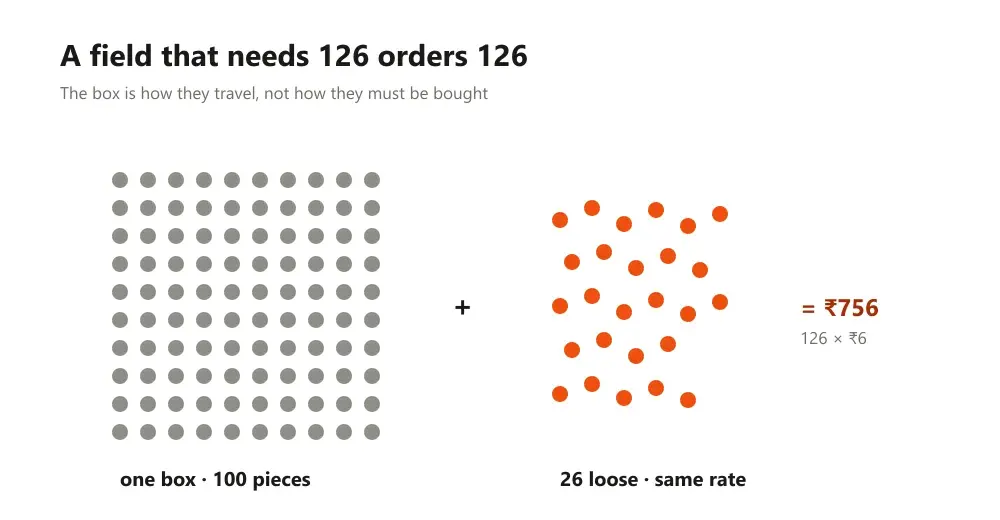
Every drip fitting price per piece comes with a second number lurking beside it — the box rate — and most ordering mistakes in this trade are one of those numbers read as the other. The short version: the piece price is the price, the box is how the factory ships them, and on 110 of our 113 products you may buy exactly the count you need, starting from one.
The long version has two twists worth five minutes: the box is not a discount, and three products really do carry a minimum.
Why a ₹6 part has a ₹600 number beside it
Fittings leave a factory in cartons because loose parts cannot be counted, stacked or freighted sanely. So a 16 mm takeup exists in the world as "₹6 each, box of 100" — one fact about the part, one fact about the carton.
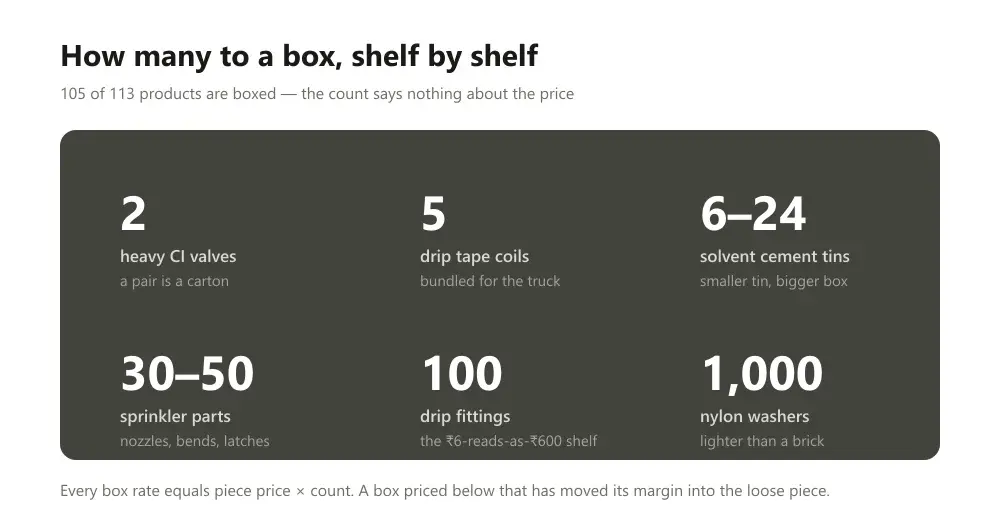
That convention runs right through our shelves: 105 of the 113 products are boxed, in pack sizes from 2 coils to a carton of 1,000. Solvent cement tins travel 6 to 24 to a box depending on size, drip tape 5 coils to a bundle, kundi clamps 100 to a carton. None of that changes what a single unit costs; it changes what a full carton weighs.
The reading error works in both directions, and both are expensive. Take the box rate as the unit price and a ₹6 part looks like ₹600 — a hundredfold overestimate that kills a fair quote. Take the unit price as the box rate and you budget ₹6 where the invoice will say ₹600.
The box is not a discount either
Here is the part almost nobody checks: our box rate is exactly the piece price times the count — ₹6 a piece, ₹600 the hundred; the ₹81 kundi clamp, ₹8,100 the carton. Buying the full box buys convenience, not a lower rate.
The trade mostly runs the other way, and it is worth recognising at other counters: a "loose rate" above the "box rate", sometimes well above, framed as a favour for breaking a carton. Sometimes that reflects real handling cost. Just as often it is a quiet penalty on the small buyer — so when two quotes differ on fittings, check whether one of them priced you as loose.
That is deliberate, and it is worth demanding from any supplier. A listing that quietly prices the box below piece-times-count has moved its margin into the loose piece — which means the farmer buying seven of something subsidises the dealer buying cartons. One price per piece, whatever the count, is the arrangement that treats both fairly. How to read a pipe listing covers the same both-numbers discipline for coils.
Drip fitting price per piece, and the three real minimums
Now the honest exception. Three products in the whole catalogue carry a minimum order: the 16 mm poly takeup, joiner and end cap — the ₹6 drip fittings themselves — with a floor of 100 pieces each on the site. Below that count, the packing and handling would cost more than the parts; a hundred of them together weigh less than a water bottle.
Read the floor correctly, though. It is a floor of 100 pieces, not a rule of whole cartons — a field that needs 126 takeups orders 126, priced at 126 × ₹6, not two boxes at 200. And everything else at the counter still starts at one piece — from the ₹45 sprinkler washer that ships a thousand to a carton, to the ₹4,491 four-inch valve that ships in twos.
The floor does bite at garden scale, and honesty says so. A terrace plot needing 26 takeups meets the same 100-piece minimum online, and pays ₹600 where the parts alone would be ₹156 — that gap is the handling reality the floor exists to cover, not a margin trick. The spare 74 pieces keep, and at ₹6 each they are the cheapest insurance on the shelf.
If a repair genuinely needs seven takeups and nothing else, ask us rather than abandoning the cart — odd counts are a conversation, and the drip irrigation range states each product's own floor right on its own product page, so nothing here has to be memorised.
When the whole box is the right buy anyway
Some buyers should ignore everything above and take the carton.
The test is never "is the box cheaper" — it is not, by design. The test is whether the extra pieces will be used before they are lost.
- Anyone laying more than an acre. Lateral counts climb fast with area, and the gap between your count and the next hundred disappears.
- Anyone far from town. End caps are the part fields lose — they are the last thing fitted, the first thing kicked loose — and a shelf with spares beats a second trip. A spare for every twenty fitted is the habit that saves seasons.
- Dealers and contractors, for whom the carton is the genuine unit of trade, at the same per-piece rate as everyone else.
Count what the field needs, then order that number
Which is the closing point worth keeping: the fittings are never where an irrigation budget is won or lost — the pipe is. Getting the piece-versus-box reading right does not save you thousands; it stops you from *believing* wrong thousands, in either direction, before the real decision gets made.
The counts come from the layout, not from guesswork: one takeup and one end cap per lateral, joiners for repairs and turns, all set by how many rows you run. The system estimator does that arithmetic from crop and acres, and our one-acre costing shows the fitting lines sitting inside a full system bill, where they are the smallest money on the page.
Keep reading
Drip for vegetables: tape, joiners and the relay year
Vegetable plots replant two or three times a year, and drip for vegetables has to keep up: thin tape, a box of joiners, and what the spine costs.
GuidesHow to size a drip irrigation system in two numbers
Our estimator sizes a drip system from just crop and acres. Here is what it assumes, which numbers to check on your own field, and when to trust the result.
GuidesPepsi drip: what the name means, and what to buy
Pepsi drip is the trade name for flat drip tape. What it costs per metre, how it differs from round inline pipe, and when the thin wall is the right buy.