Pipe bore size vs coil length: reading a listing
A pipe listing gives you a size, a length and sometimes a weight. Here is what each number means, and which one you are probably misreading.
14 August 2026 · 5 min read · REDYPLAST
Three numbers doing three different jobs
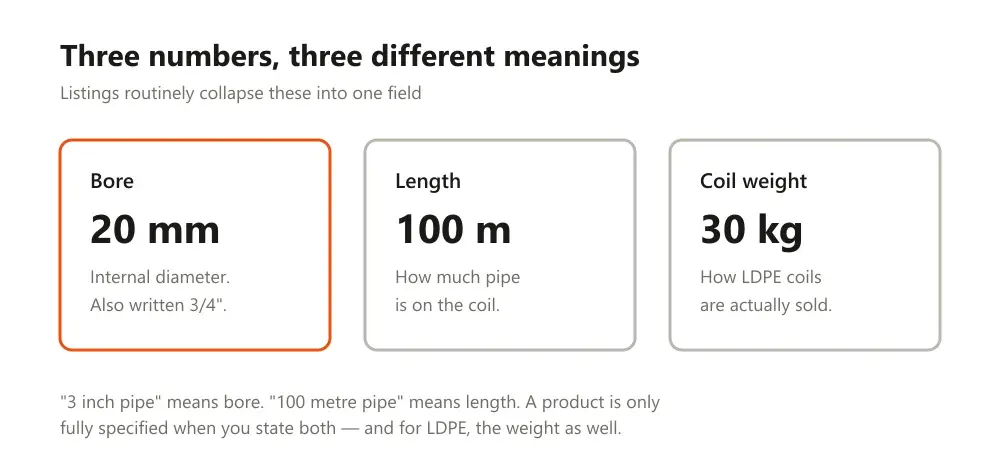
Open any Indian pipe listing and you will see something like "3 inch, 100 metre, 30 kg". Those are three unrelated facts, and most listings — ours included, until recently — shove them into one field called "size". A buyer then argues with a shopkeeper about whether a "3 inch pipe" is the same as a "90 metre pipe", when the two words are answering different questions.
Bore is how wide the pipe is inside. Length is how much of it is on the coil. Weight is how much plastic went into making it. You need all three before a price means anything, and only one of them is usually printed clearly.
The confusion is not laziness. Different pipe types are genuinely sold on different conventions: garden pipe by bore and metres, LDPE by bore and kilograms, lapeta by bore and metres. A shop quoting all three from the same counter ends up with one column that holds whichever number the supplier happened to lead with.
Bore: the number that decides pressure
Bore is internal diameter, and it is written two ways that mean the same thing. The imperial name and the metric name are both on the packet, and neither is more correct.
That fifth line is where people get caught. Two different bores share one imperial name, because the imperial name is a trade size rather than a measurement. A 63 mm sprinkler clamp and a 50 mm CI adaptor are both "two inch" and will not fit each other. When a part has to mate with another part, order by the millimetre figure and ignore the inches.
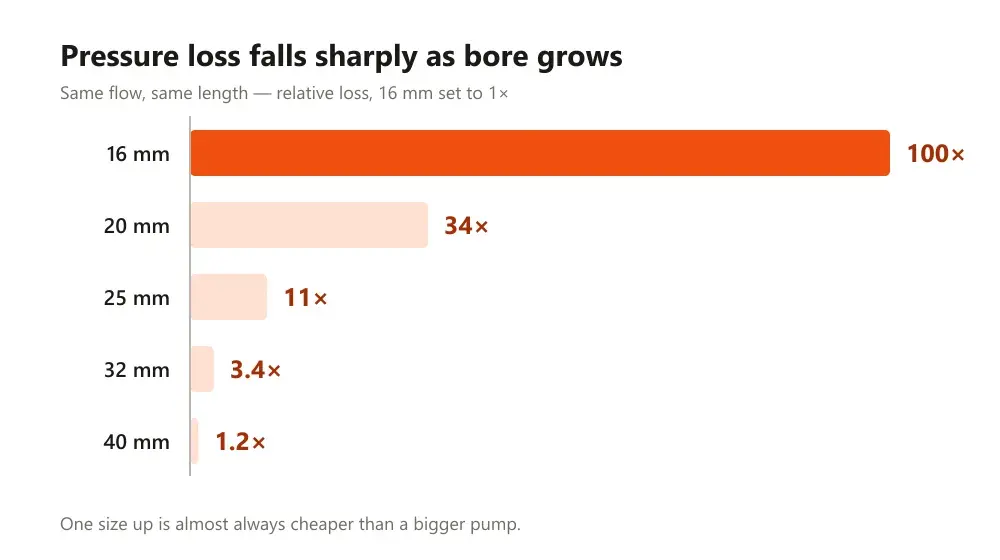
Bore matters more than any other number because friction loss does not rise gently as bore falls — it climbs steeply. Going one size up is nearly always cheaper than going one pump size up. If you are working out a whole layout rather than replacing a single run, the system estimator does this arithmetic from your field size and pump output, and our guide to choosing a pipe size covers the reasoning behind the answer it gives.
- 20 mm is 3/4"
- 25 mm is 1"
- 32 mm is 1-1/4"
- 40 mm is 1-1/2"
- 50 mm and 63 mm are both sold as 2"
- 65 mm and 75 mm are both sold as 2-1/2"
- 80 mm and 90 mm are both sold as 3"
- 100 mm is 4"
Length: what is actually on the coil
Length is the honest number, and it is the one to compare prices on. Same bore, same colour, same grade, twice the metres — the price should roughly follow.
Premium garden hose in 3/4" is ₹900 for 10 metres, ₹1,800 for 20, ₹2,700 for 30 and ₹8,991 for 100. That is ₹90.00 a metre at every length but the last, which works out at ₹89.91 — the hundred-metre coil saves you nine paise a metre — ₹9 across the whole roll, not the third that "bulk" usually implies. Whether the long coil suits you depends on whether you can use 100 metres. A coil you cut into three and store two ends of is not a saving.
All prices here are MRP inclusive of tax, and per piece — one coil, one tin, one fitting. Where a listing also shows a pack size, the headline number is still the single piece.
Length also decides the joint count, which is the hidden cost. Every coil end is a joint, and every joint is a fitting plus a chance of a leak. Two 30-metre coils covering a 60-metre run need a connector in the middle of the field; one 100-metre coil does not. Our garden pipes run from 10 to 100 metres for exactly this reason.
Weight: why LDPE is sold in kilograms
This is the one that costs people money. LDPE coils are named by weight, not length. A coil listed as LDPE Pipe Black 3" 10 KG is ten kilograms of pipe. How many metres that is depends on how thick the wall is, and the listing may not say.
Three real examples, all 3 inch, all ten kilograms:
Same weight, same bore, and half again as much pipe between the cheapest and the longest. If you ordered "10 kg of 3 inch" and budgeted for 90 metres, you could receive 60 and be 30 metres short with the trench already dug.
Bore eats weight too. Black 3" at 15 kg is 90 metres; black 4" at 15 kg is 65 metres. The wider pipe uses more plastic per metre, so the same kilos reach less far. The whole LDPE range lists both the weight and the metres — read the metres.
- Black, 0.6 mm wall — 60 metres, ₹1,440
- Double colour yellow, 0.6 mm wall — 70 metres, ₹1,980
- Premium black — 90 metres, ₹1,980
Wall thickness: the number nobody prints
Wall thickness decides how far a given weight of coil reaches, not what it costs. Two coils that read identically on a quote — 3 inch, 15 kilos of LDPE — are ₹2,160 (Black, 0.6 mm, 90 m) and ₹2,970 (Double Layer, 0.6 mm, 105 m): ₹810 apart on grade, not wall. What the wall changes is length — a 0.3 mm wall (Premium Black) packs 135 metres into that same 15 kg that a 0.6 mm wall packs into 90, and that ratio rarely appears on the label.
Garden pipe steps up with bore: 3 mm at 3/4", 4 mm at 1", 5 mm at 1-1/4" and above. Within one bore it does not vary at all — every 3/4" length is the same 3 mm wall at 0.22 kg a metre, so there the weight only ever tells you the length back. Where the tell matters is LDPE, because one bore carries several walls.
Matty yellow 3" at 0.3 mm wall gives 120 metres for 11.5 kg — thin, light, cheap per metre, and correct for a season crop where the line comes up anyway. A 0.6 mm wall is what you want under a twelve-month cane crop. Neither is better; they are answers to different questions.
Reading any listing in ten seconds
Work through it in this order and the ambiguity disappears.
None of this requires trusting a listing. It requires asking for the metre figure before you agree a price, and getting the millimetre figure before you order anything that has to screw into anything else.
That last point surprises people. Micro-irrigation carries 5% GST, while general pipe and fittings carry 18%. Garden pipe, LDPE and lapeta pipe are all at 18%; a lay flat tube doing similar conveyance work is at 5%. Since listed prices are MRP inclusive of tax, two pipes at the same shelf price are not the same pre-tax cost, and on a large order that gap is real money.
- Find the bore in millimetres. If only inches are given, ask which mm size.
- Find the length in metres. If the listing gives only kilograms, ask for metres.
- Divide price by metres. That is the only number worth comparing.
- Ask the wall thickness, or use the coil weight as a proxy for it.
- Check the tax rate, because it is not the same across the catalogue.
Keep reading
LDPE pipe weight to length: the wall thickness rule
Converting LDPE pipe weight to length takes one number — the wall. A 15 kg coil of 3 inch can be 90 or 135 metres; here is the arithmetic.
GuidesHow to check irrigation pipe quality before you pay
How to check irrigation pipe quality with five checks at the counter or on the truck: wall, weight, printing, flex and finish.
GuidesHow to size a drip irrigation system in two numbers
Our estimator sizes a drip system from just crop and acres. Here is what it assumes, which numbers to check on your own field, and when to trust the result.