Drip, sprinkler or rain pipe: a decision guide by crop
Row spacing, water source and budget decide which of the three methods fits. Here is the reasoning, crop by crop, with what each one costs.
5 September 2026 · 4 min read · REDYPLAST
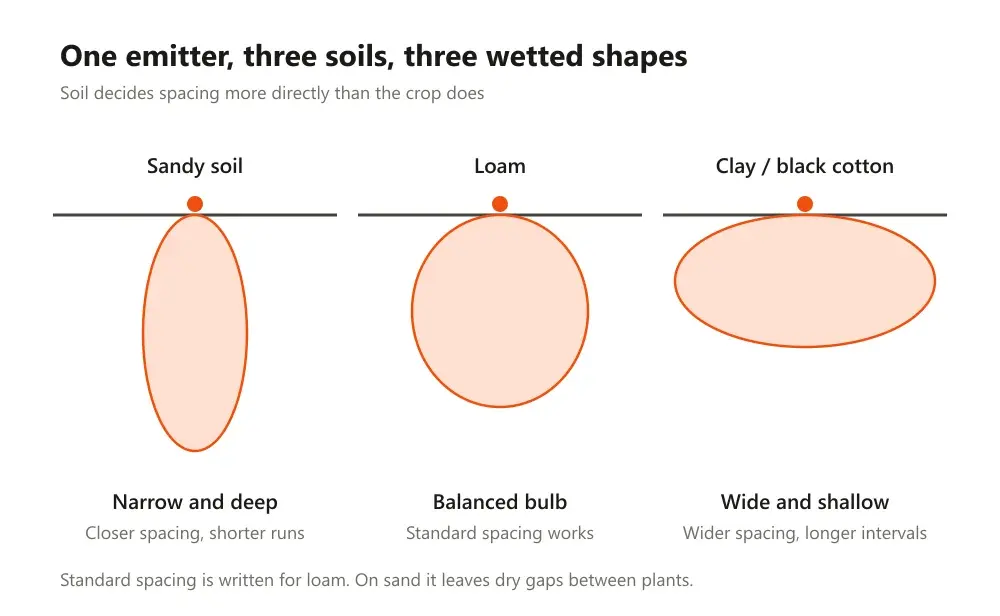
Start with row spacing, not with the method
Almost every wrong system starts with someone deciding they want drip and then working out how to fit their crop to it. Turn it around. Measure the gap between your rows, and the method mostly picks itself.
Drip puts water at a point. That only makes sense if plants are far enough apart that wetting the gaps would be waste. Sprinkler and rain pipe wet an area, which is what a densely sown crop needs and what a widely spaced one does not.
The threshold sits around half a metre. Above roughly 0.6 m between rows, one lateral per row is practical and drip usually wins. Below that, the pipe count per acre stops making sense long before the water saving does.
What each method actually does
Drip runs a 16 mm lateral along each row with emitters built in or punched in. Inline pipe with the holes already made is the normal choice: standard grade is ₹4,482 for a 500 metre roll and heavy grade ₹7,200 for 400. Flat tape — pepsi drip — is cheaper per metre at ₹3,960 for around 1,000 metres, and lighter, which suits a crop where the line is lifted every season.
Sprinkler throws water over the canopy from nozzles on risers. A PVC nozzle is ₹216, brass ₹1,206. The parts count is higher than people expect — clamps, bends, foot bottom sets, washers — and each one is a size decision.
Rain pipe is a perforated sprayline that wets a strip as it goes. A 40 mm, 100 metre roll is ₹1,320; 20 mm at 200 metres is ₹1,140; 63 mm at 100 metres is ₹3,780. It is by far the cheapest way to cover ground per rupee, and it is the right answer more often than its reputation suggests.
All three carry 5% GST, and all prices here are MRP inclusive of tax, per piece.
Crop by crop
Wide rows, long season, high value — drip. Close rows, short season, broadcast sowing — sprayline. The specifics:
Groundnut and paddy are the two worth spelling out, because they are the two where a supplier keen on a sale will not. On groundnut the rows are too close for drip to make arithmetic sense; a sprayline wets a strip roughly 7 m across and the lines are laid to overlap slightly. For paddy the question is not how to apply water to a root zone but how to move it to and around the field, which is lay flat tube and lapeta work.
- Cotton — 1.2 m rows. Drip, one lateral per row. At 1.2 m an acre needs about half the pipe it would at 0.6 m, so measure before ordering.
- Chilli — 0.6 to 0.9 m rows. Drip. More lateral per acre than cotton, and water stress at flowering costs yield directly.
- Vegetables — close rows, replanted several times a year. Drip, with thin-wall tape and spare joiners, because laterals get lifted and relaid.
- Sugarcane — twelve months in the ground. Drip on heavier-wall pipe; you cannot replace a lateral mid-crop.
- Banana — 1.8 to 2.1 m rows, 5 to 8 mm a day at peak. Drip, and size the pump for banana rather than for cotton's 4 to 6 mm.
- Pomegranate — 3 to 4.5 m rows. Drip, and one of the cheapest crops to convert because pipe per acre is low.
- Garden and orchard — 3 to 5 m spacing. Drip, built for the mature canopy rather than the sapling.
- Groundnut — 0.3 to 0.45 m rows. Rain pipe. One lateral per row would need an absurd amount of pipe.
- Paddy — grown in standing water. Neither. This is a conveyance job.
Your water source changes the answer
Row spacing picks the method; the water source decides whether it survives.
Borewell water arrives clean but carries grit in pulses, and it arrives at whatever pressure the pump makes. Surface water from a tank, canal or pond carries a continuous organic load, which blocks 16 mm emitters far faster than it troubles a rain pipe perforation. If your source is open water and your budget will not stretch to proper filtration, rain pipe is the honest recommendation over drip.
Pressure is the third constraint. Drip wants more pressure at the pipe than rain pipe does, so a weak pump can rule out drip and leave rain pipe as the only thing that will work on what you have.
Yield matters as much as quality. A borewell that gives two hours of useful water does not run a whole acre of drip at once, whatever the field size says — you design in shifts instead. Working out how much water the crop actually needs comes first, and the water requirement calculator will give you a starting figure by crop and area to argue with.
Budget, and the mistake in reading one
Per acre, rain pipe is cheapest, sprinkler sits in the middle, drip costs most up front and returns most on a spaced high-value crop. That ranking is stable enough to plan with.
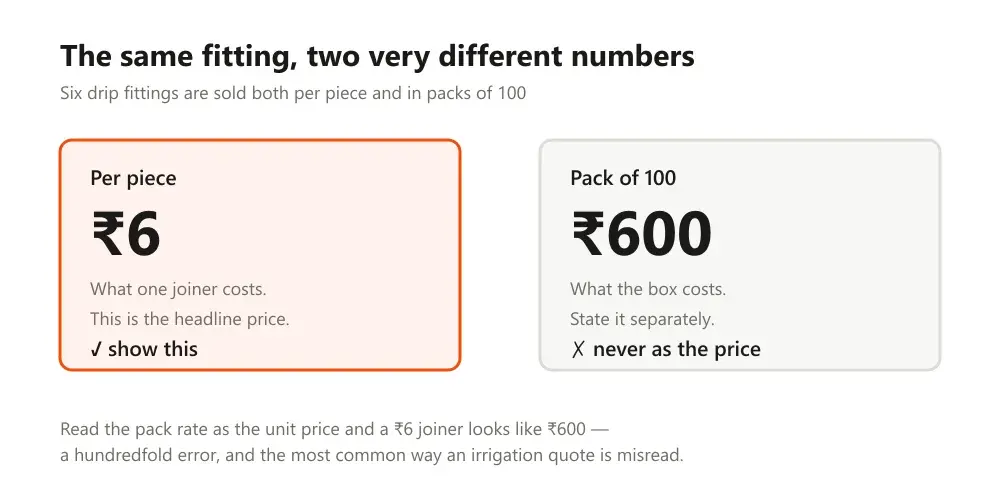
Where budgets go wrong is the small parts. Drip fittings are listed per piece — a joiner, an end cap and a takeup are ₹6 each — but they are supplied in packets of 100. The pack of 100 joiners is ₹600.
Read the pack rate as the unit price and the fitting looks a hundred times more expensive than it is; read it the other way and you have budgeted ₹6 for something you will be invoiced ₹600 for. On a full acre of laterals you need hundreds of these, so the error compounds in whichever direction you made it. The drip irrigation range states both numbers separately for that reason.
When to mix rather than choose
Nothing says one field gets one method. A holding with cotton on one block and groundnut on another is a drip block and a rain pipe block sharing a pump, a mainline and a filter — and that shared front end is most of the cost either way.
The one thing worth resisting is buying a method because it is the one being promoted. Drip earns its price on spaced, long-season, high-value crops and nowhere else. On a 30 cm row crop it is a worse system that costs more, and any supplier who will not say so is not worth buying from.
Mixing also lets you stage the spend. Put the rain pipe in this season on the block that needs least investment, size the mainline for both, and add drip on the high-value block next year. What you must not do is size the front end for the cheap half and discover the pump cannot carry the second block.
Where these numbers come from
- FAO Irrigation and Drainage Paper 56 (opens in a new tab)
The reference method for crop evapotranspiration and crop coefficients that daily water figures derive from.
- TNAU Agritech Portal (opens in a new tab)
Crop-wise spacing, water requirement and drip layout references for southern India.
Keep reading
Drip for groundnut? Usually not — and what fits instead
Asked for drip for groundnut, we usually talk you out of it. The arithmetic that says so, the rain pipe that fits, and the one case drip still earns.
GuidesDrip vs sprinkler: which one suits your crop?
Drip vs sprinkler comes down to row spacing, water quality and wind. Here is the honest two-way comparison, with real per-acre lateral costs.
IrrigationRain pipe irrigation benefits, and where they stop
Rain pipe irrigation benefits, priced per roll — why a fine shower on a small pump suits close-sown crops, and the fields where it fails.