Drip for groundnut? Usually not — and what fits instead
Asked for drip for groundnut, we usually talk you out of it. The arithmetic that says so, the rain pipe that fits, and the one case drip still earns.
12 September 2026 · 2 min read · REDYPLAST
If you came here pricing drip for groundnut, here is the answer we give across the counter: we will usually talk you out of it. Not because drip is bad — we sell it happily for a dozen crops — but because groundnut's rows are so close that the arithmetic collapses, and a cheaper method genuinely waters this crop better.
This page shows the sums, what to lay instead, and the narrow case where drip still deserves the conversation.
The arithmetic that kills it
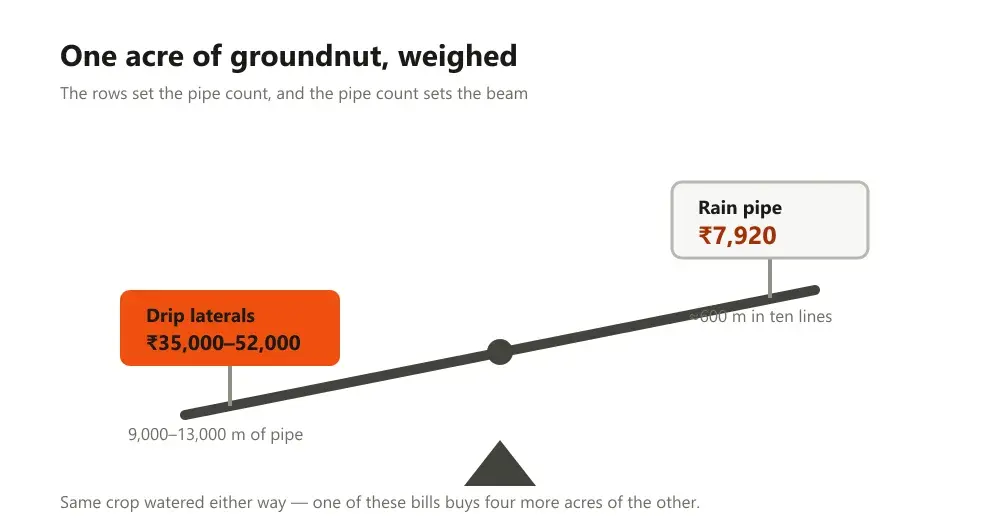
Drip runs one lateral along every row, and groundnut is sown at 0.3 to 0.45 metres — nearly broadcast. Walk that across a square acre, roughly 63 metres wide, and you get somewhere between 140 and 210 laterals: **9,000 to 13,000 metres of pipe** for a single acre.
Even at the cheapest lateral we sell — the thin tape the trade calls pepsi, ₹3.96 a metre — that is ₹35,000 to ₹52,000 of laterals alone, before a single fitting or the mainline. Cotton, for contrast, lays 3,339 metres on the same acre. No grade choice rescues sums like these on a crop of groundnut's value; the pipe count is the problem, and it is set by the rows.
Our method-by-crop decision guide reaches the same verdict from the spacing side: below roughly 0.6 metre rows, point-watering stops making sense.
What groundnut actually wants
The good news is that the crop is not asking for drip. Groundnut grows as a dense, low canopy covering the whole strip — there are no bare middles to keep dry, which is drip's whole trick. It wants even moisture across the full bed, gently applied, especially through pegging and pod fill when the developing pods are drawing steadily.
Even, gentle, area-wide water is precisely what a sprayline delivers. This is not a compromise for the poor man; it is the correct tool, and the cheaper one.
Rain pipe: the fit, and its price
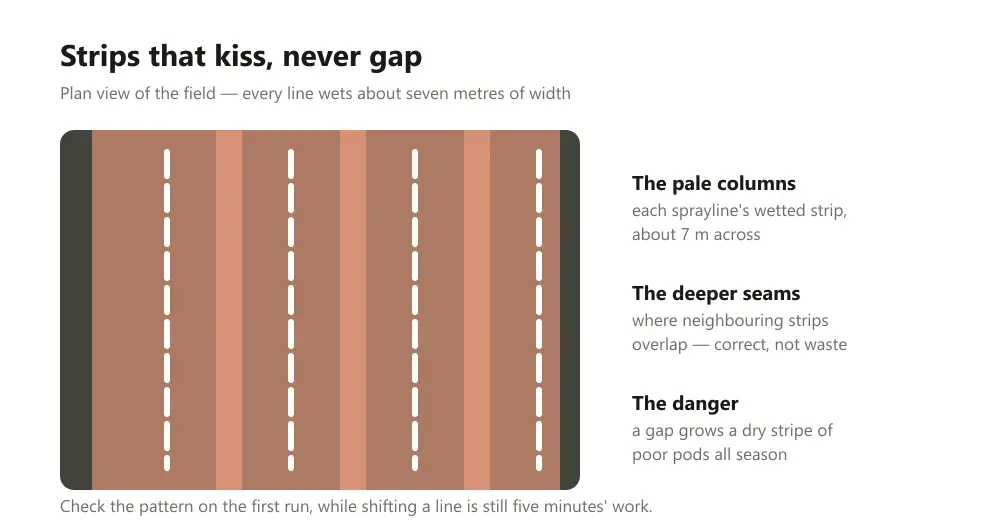
A rain pipe throws a fine shower over a strip roughly 7 metres wide, so an acre takes only nine or ten lines laid across it — about 600 metres of pipe, with the strips overlapping a little. At ₹1,320 for a 40 mm × 100 metre roll, six rolls come to **₹7,920** — between a quarter and a seventh of the drip laterals it replaces, with far fewer fittings and no emitter to block.
Rain pipe brings one more gift drip never offers: it moves. The same six rolls water the groundnut this season, the fodder block after it, and a neighbour's pulses on a shared arrangement — rolled, shifted and relaid in an afternoon. For a rotating smallholding, one kit serves the whole calendar instead of one crop's rows.
The 20 mm roll (₹1,140 for 200 m) suits smaller pumps and plots; the 63 mm (₹3,780 for 100 m) carries bigger flows further. What rain pipe does well and where it stops is written up separately; the full range is here, priced at MRP with 5% GST inside.
Classic riser sprinklers from the sprinkler range are the sturdier cousin — more pressure, more parts, the same area-wetting idea — and the middle option where a farm already owns the pump for them. The parts are counted in tens, not thousands: a kundi latch clamp is ₹81, a foot-bottom base ₹306, a PVC nozzle ₹216.
Do budget the delivery side while comparing: the water still has to reach the lines through a main, and that pipe is common to every method — so it cancels out of the comparison, but not out of the bill. A lay flat tube doing that conveyance carries 5% GST where lapeta carries 18%, which the lay flat range makes worth a look at order time.
Laying it so no stripe goes dry
The one skill rain pipe asks for is respecting the overlap. Each line's wetted strip must touch the next line's — laid too far apart, the field grows in visible stripes, and the dry ones set pods poorly. Pace the gap between lines a metre inside the wetted width, and check the pattern on the first run while moving a line is still a five-minute job.
Two habits keep it honest: run the pump at the pressure the holes want rather than everything the motor has — over-driven holes throw a coarse jet short instead of a fine shower far — and walk the far line while it runs, because coverage problems always start furthest from the pump. The water requirement calculator gives the block's daily litres so runs match the crop instead of habit.
The one case drip still earns a hearing
Scarce water changes arithmetic. Where a weak bore is the binding limit and every litre must land at a root, drip's efficiency can still argue for itself on groundnut — at full cost, eyes open, usually on a small high-stakes block such as a seed plot rather than the whole holding.
If that is your situation, do not buy either answer off a page. Send us the bore's yield, the acreage and the rows, and we will run both bills beside each other — we stock all three methods, so the honest sum costs us nothing and saves you the wrong system. For everyone else growing groundnut: lay the spraylines, overlap the strips, and spend the ₹30,000 you just kept on the crop.
Where these numbers come from
- ICAR (opens in a new tab)
Indian Council of Agricultural Research — crop agronomy and regional package-of-practices.
- TNAU Agritech Portal (opens in a new tab)
Crop-wise spacing, water requirement and drip layout references for southern India.
Keep reading
Drip, sprinkler or rain pipe: a decision guide by crop
Row spacing, water source and budget decide which of the three methods fits. Here is the reasoning, crop by crop, with what each one costs.
GuidesFlood to drip conversion for groundnut: what to buy instead
A flood to drip conversion for groundnut is the wrong buy; a rain pipe shower is the right one. The acre at MRP, the test lateral, and who should keep flooding.
GuidesRain pipe for groundnut: sizes, prices and pitfalls
Which rain pipe for groundnut — 40, 63 or 75 mm — with real roll prices, the layout that suits the pod zone, and the pitfalls that waste a roll.