Rain pipe irrigation benefits, and where they stop
Rain pipe irrigation benefits, priced per roll — why a fine shower on a small pump suits close-sown crops, and the fields where it fails.
22 February 2026 · 4 min read · REDYPLAST
What a rain pipe actually is
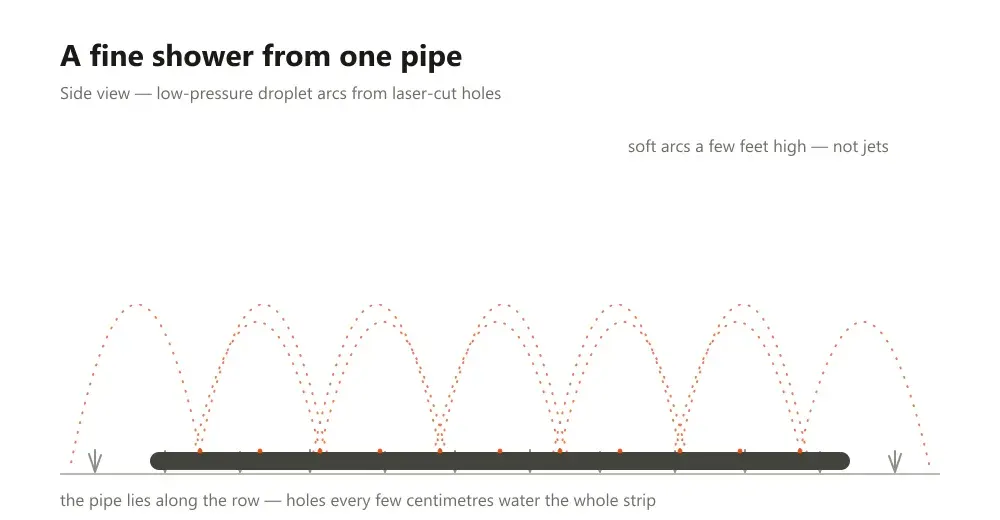
Most rain pipe irrigation benefits trace back to one design decision: instead of forcing water through a few large nozzles, the pipe carries hundreds of pinhole perforations, laser-cut along its whole length. Give it modest pressure and every hole lifts a thin arc of droplets, so the full run of pipe drizzles steadily onto the crop beneath it.
The pipe itself is flexible, lies flat when empty and arrives as a long roll. You unroll it along the planting, couple it to the water you already pump — borewell, open well or tank — and it rounds out the moment the pump starts. The strip on either side of the line gets watered in a single pass, with nothing else to assemble.
There are no stands to plant, no rotors to aim, no separate heads to unblock one at a time. That missing hardware is not a shortcut. It is exactly why the method costs what it does, and why it asks so little of the pump.
The rain pipe irrigation benefits that matter
Put it beside flood on one side and a pressurised sprinkler grid on the other, and the case reads like this:
On water saving, we will not quote you a percentage — soil, crop and scheduling swing the figure too far for any single number to be honest. What holds everywhere is this: a gentle shower aimed along the rows gives runoff and open-channel evaporation far less to steal than flooding the field does.
- A modest pump drives it, because thin arcs need far less pressure than a rotating head does
- Rolls are cheap for the ground they wet, which keeps the price of covering an acre low
- An empty roll weighs little, so one person can carry the line to the next plot between crops
- Droplets land softly, so a freshly sown bed is not beaten flat and germination comes up together
- Water falls on the cropped strip rather than the whole field, leaving the weeds between rows thirsty
Pressure, and why your power bill cares
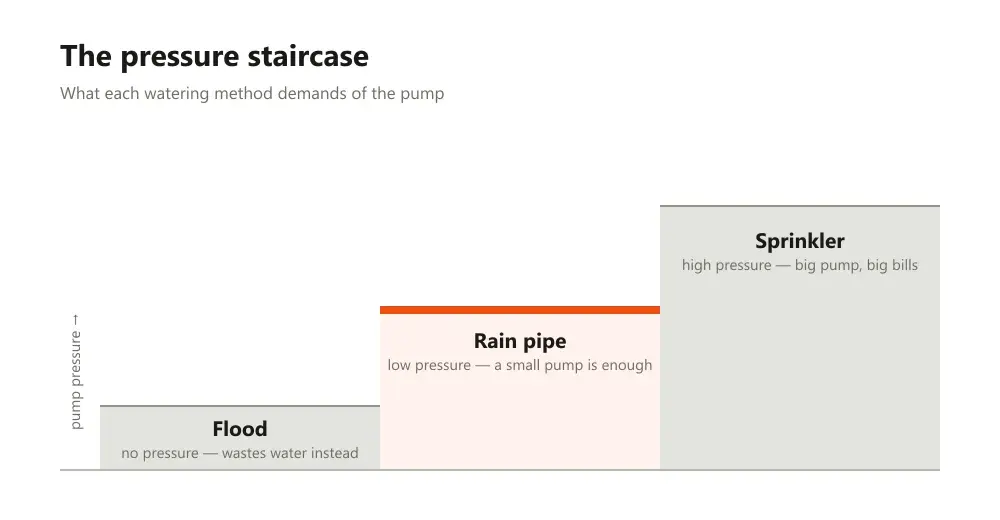
Every watering method has a pressure appetite, and the pump — with the electricity behind it — is what feeds it. Flood asks for none and squanders water instead. A sprinkler grid asks for plenty: enough head to spin each nozzle and fling water in a wide circle. Rain pipe stands on the step between the two, needing only enough push to lift droplets a few feet into the air.
That middle step is worth real money across a season. A smaller pump costs less to buy, draws less current for every hour it runs, and wears slower because it never strains at the top of its curve. Where the supply is shaky, a system content with modest pressure is also the system that keeps working on a weak phase.
What a roll costs
All prices are MRP with the tax already inside, and rain pipe carries the 5% micro-irrigation GST rate rather than the 18% that general fittings attract:
For scale, our cheapest drip tape is ₹3.96 a metre and waters a single line of plants at the root. A 40 mm rain pipe at ₹13.20 a metre throws its shower several metres to either side of the line. Measured as ground wetted per rupee of pipe, nothing else we stock comes close. The full set of sizes and roll lengths is in rain pipe irrigation.
- 20 mm × 200 m roll — ₹1,140, which works out to ₹5.70 a metre
- 40 mm × 100 m roll — ₹1,320, or ₹13.20 a metre
- 63 mm × 100 m roll — ₹3,780, or ₹37.80 a metre
The fields where it earns its keep
These are also the crops where an even shower pays twice. Once at sowing, when a soft fall of water brings the whole bed up at the same time, and again mid-season, when the canopy closes over and row-by-row watering stops being practical anyway.
Rain pipe belongs over close-sown crops on level ground, or close to it — plantings where drip would demand a lateral against every row, and a sprinkler would demand pressure the crop never asked for. Groundnut is the textbook fit, and maize, millets and pulses sit in the same bracket, along with fodder and most leafy vegetables.
Where the benefits stop
Wide spacing defeats it. In an orchard, or any crop planted metres apart, most of the shower lands on bare ground between plants — that work belongs to drip, which puts water only where a root sits. Wind is the second limit: arcs of fine droplets drift badly in a stiff breeze, and a field that turns windy every afternoon will never water evenly by any overhead method.
The third limit is the leaf. Rain pipe wets foliage by design, and crops prone to fungal trouble in humid spells would rather stay dry. If you are unsure which side of these lines your crop falls on, the crop-by-crop comparison walks drip, sprinkler and rain pipe through the common Telangana and AP crops one at a time.
Keeping the holes open
The perforations are tiny, and anything tiny that passes water can block — silt, algae and scale close rain pipe holes the same way they close drip emitters. Flush the open end of the line regularly and run the cleanest water you can. We do not stock filters, so if your source carries silt, budget for screening from another supplier before the pipe, not after the holes have sealed.
Two more habits protect the roll itself. Never chase a wider throw by winding the pressure up — the holes are cut for a soft arc, and over-driving them distorts the spray pattern long before anything bursts. And keep the pipe rolled, shaded and off hot ground between seasons, because sunlight ages plastic faster than use ever will. The longer version of that argument is in making your pipe last.
The other half of the decision
This article covers the product: what the pipe is, what a roll costs, and what it will and will not do. Whether a rain pipe setup suits your farm as a whole — how the mains run, which blocks to convert first, how the spending stages out — is a different question, and is a rain irrigation system right for your farm takes it up properly.
If you would rather talk it through first, send us the crop, the field size and your water source through a bulk enquiry. We will say plainly whether rain pipe fits your case, and quote the rolls if it does.
Keep reading
Drip, sprinkler or rain pipe: a decision guide by crop
Row spacing, water source and budget decide which of the three methods fits. Here is the reasoning, crop by crop, with what each one costs.
IrrigationIs a rain irrigation system right for your farm?
A rain irrigation system is a pump, a main and rain pipe laterals working as one chain. Where it wins, what it trades away, and how to stage the buy.
GuidesDrip vs sprinkler: which one suits your crop?
Drip vs sprinkler comes down to row spacing, water quality and wind. Here is the honest two-way comparison, with real per-acre lateral costs.