How to check irrigation pipe quality before you pay
How to check irrigation pipe quality with five checks at the counter or on the truck: wall, weight, printing, flex and finish.
9 September 2026 · 4 min read · REDYPLAST
Knowing how to check irrigation pipe quality is a ten-minute skill that pays for itself on the first coil. A price list tells you bore, length and a number — it does not tell you what the pipe is made of or how evenly it was made, and those two things decide whether it survives five seasons or one.
This shop has traded pipe since 2007. These are the checks our own counter uses, written down.
Read the pipe before you read the price
Good pipe introduces itself. Along its length, at intervals, runs a printed line: the maker's name, the size and class, and usually a batch. That printing is accountability — a manufacturer willing to sign every metre expects to answer for it.
Anonymous pipe is the opposite signal. No name, no class, no batch means nobody intends to be found when it splits, and a low price is how anonymous pipe gets chosen anyway. Where a standard applies, look for the ISI mark too — pipe made to a BIS specification says so on the surface, and a dealer selling marked pipe will not mind you reading it.
The word to look for on fittings and woven pipe is "virgin" — it means fresh resin rather than reprocessed scrap. Thirteen of our own products carry it in their names because it is the material claim that matters most and hides best.
The five checks, in the order worth doing them
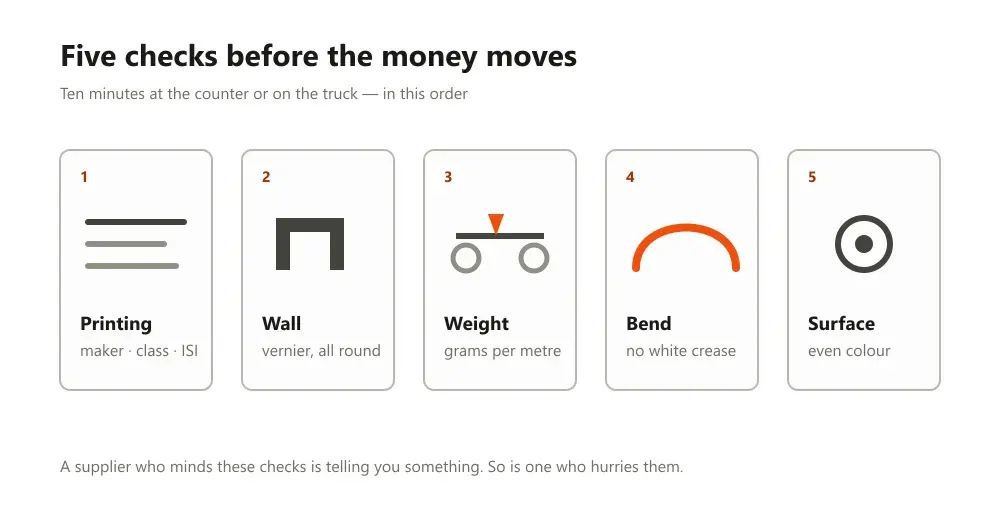
- Read the printing: maker, class, batch, ISI mark where one applies. Two minutes, no tools.
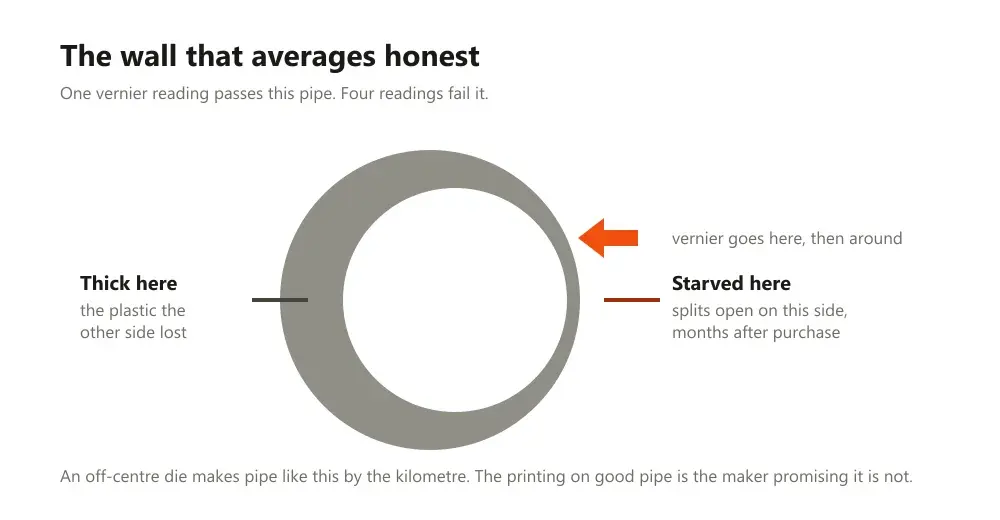
- Measure the wall — with a vernier if the counter has one, at several points around the cut end. Cheap pipe's secret is rarely a thin wall; it is an uneven one, thick on one side and starved on the other, which is where it will split under pressure.
- Weigh a known length. Wall you cannot see shows up as grams you can — the [weight-to-length arithmetic](/blog/ldpe-coils-sold-by-weight) works in reverse as a quality check, because a coil that is light for its stated wall is lying about one of the two.
- Bend a loop and let it go. Honest polyethylene flexes and recovers; high-scrap pipe creases, whitens at the fold, or stays kinked. Never buy pipe that cracks white on its first bend.
- Look at the surface in sunlight. Virgin material runs uniform in colour and gloss; reprocessed material shows dull patches, streaks, or specks of whatever the scrap used to be.
What the price list is quiet about
Two coils of the same bore and the same coil weight can sit ₹800 apart on a list, and the list will not say why. The difference is almost always wall thickness or material grade — the two properties listings routinely omit, and the two this whole page is about. Reading a pipe listing's three numbers covers the decoding; the quality question is simpler: if a list will not state the wall, assume the wall is the reason for the price.
The same goes for colour. Black pipe earns its sun life from carbon black mixed through the resin — it is not paint, and not decoration. A black pipe that fades chalky-grey in its first year told you its carbon black was underdosed, and sunlight will finish the job early.
How to check irrigation pipe quality at delivery
The counter checks work on the truck too, and delivery is the last moment the checks are free.
None of this insults a good supplier. Our own listings state bore, wall, length and weight as four separate fields precisely so every one of them can be checked against the goods.
- Check the printing on every coil, not the top one — and check the batches roughly match. A mixed-batch delivery is how one odd coil enters a good order.
- Measure the wall at both free ends of a coil. The two ends were made minutes apart; if they disagree, the die was drifting the whole run.
- Weigh one coil against its stated weight. A shortfall is missing plastic, and missing plastic is missing wall or missing metres.
- Unroll the outer turn and look for flat spots, ovality and storage kinks — transport damage is the supplier's problem only until the truck leaves.
Buy one coil before you buy twenty
With a supplier you have not used before, order a single coil first and run every check above at home, unhurried — including cutting a ring from the coil's middle, where a drifting die hides best, and weighing a measured ten metres against the stated weight.
One honest coil does not certify a factory, but one dishonest coil condemns the lot before the lot is paid for, and a ₹2,000 lesson beats a ₹20,000 one. A supplier who objects to selling a sample quantity has answered the quality question already.
A fair note on marks while you compare: not every product type carries an ISI mark — woven tarpaulin pipe and many fittings have no applicable specification — so its absence alone is not guilt. The right question at the counter is "made to which standard?", and the wrong answer is silence.
When cheap is expensive
Underweight pipe does not fail at the counter; it fails in month eight, mid-season, holding water your crop was counting on — and then it fails again at replacement, because the trench work costs more than the pipe. Buying the honest coil the first time is the cheapest irrigation decision there is.
If you want the checks done for you, ask us for the spec sheet of anything we stock before you order — wall, weight, length and material grade in writing, against the LDPE and garden pipe ranges they describe. Paper first, pipe second, money last.
Where these numbers come from
- Bureau of Indian Standards (opens in a new tab)
The IS specifications irrigation pipe and fittings are manufactured and tested against.
Keep reading
LDPE pipe weight to length: the wall thickness rule
Converting LDPE pipe weight to length takes one number — the wall. A 15 kg coil of 3 inch can be 90 or 135 metres; here is the arithmetic.
GuidesPipe bore size vs coil length: reading a listing
A pipe listing gives you a size, a length and sometimes a weight. Here is what each number means, and which one you are probably misreading.
GuidesDrip for vegetables: tape, joiners and the relay year
Vegetable plots replant two or three times a year, and drip for vegetables has to keep up: thin tape, a box of joiners, and what the spine costs.