LDPE pipe weight to length: the wall thickness rule
Converting LDPE pipe weight to length takes one number — the wall. A 15 kg coil of 3 inch can be 90 or 135 metres; here is the arithmetic.
30 August 2026 · 4 min read · REDYPLAST
Turning LDPE pipe weight to length is the whole trick of buying this hose. Ask for LDPE hose in most of Telangana and the quote comes back in kilograms. Not metres — kilograms. A dealer will say fifteen kilo, twenty kilo, thirty kilo, and quote a rate per kilo against each.
That is a real unit of sale, not a quirk. LDPE is priced on the plastic in it. But it creates a problem the moment you try to plan a field with it, because the number you were quoted is not the number you need. You need metres.
LDPE pipe weight to length is a fact about the plastic
A coil's weight tells you how much polyethylene you bought. It says nothing about how far that polyethylene reaches, because the same mass can be drawn thin and long or thick and short.
Two things change the conversion. The first is bore, and most buyers already account for it: a 4 inch hose has more material in every metre than a 3 inch hose, so the same weight gives you less of it. In our own catalogue a 15 kg coil is 90 metres at 3 inch and 65 metres at 4 inch. Same weight, about 28 percent less reach.
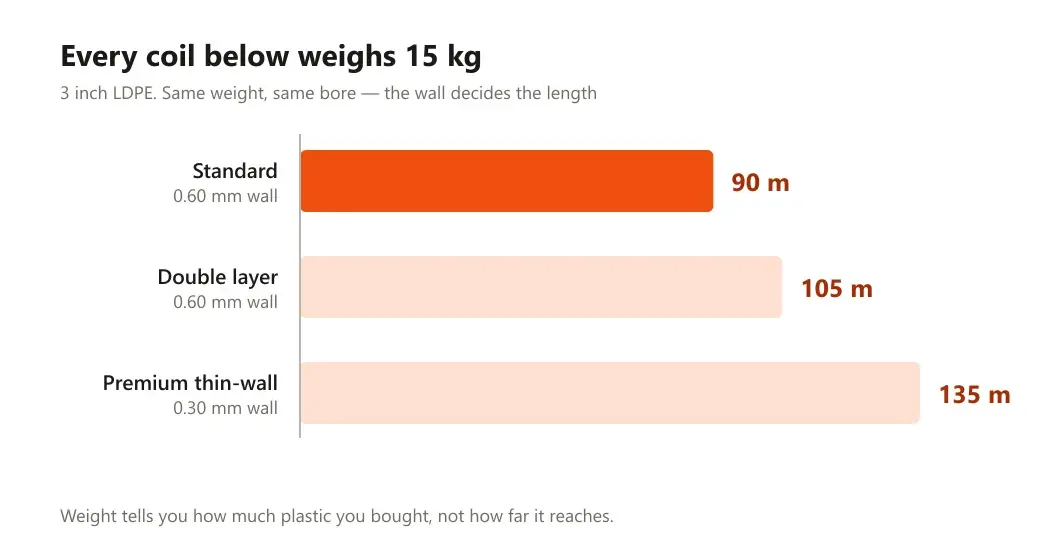
The second is wall thickness, and this is the one that catches people out — because two coils can share a bore, share a weight, and still differ by fifty percent in length.
The same 15 kg, three different coils
Here are three products from our range. All 3 inch. All 15 kg.
Halve the wall and you get half again as much pipe out of the same kilo. Across the whole 3 inch range the pattern holds within a line: the standard 0.60 mm coils run at almost exactly 6 metres per kilo, whatever their size, the double-layer 0.60 mm coils run closer to 7, and the 0.30 mm coils run at 9 to 10.6 metres per kilo.
That consistency is useful. It means you can convert any weight quote into metres with one number, provided you know the wall:
Twenty kilos of 3 inch standard is 120 metres. Twenty kilos of 4 inch standard is 85. If nobody told you the wall thickness, you cannot do this arithmetic at all — which is the first thing worth asking for.
- Standard Lapeta hose, 0.60 mm wall — **90 metres**
- Double layer, 0.60 mm wall — **105 metres**
- Premium black thin-wall, 0.30 mm wall — **135 metres**
- 0.60 mm wall, 3 inch, standard line — about **6 m per kg**
- 0.30 mm wall, 3 inch — about **9 m per kg**
- 0.60 mm wall, 4 inch — about **4.3 m per kg**
The rate per kilo hides the rate per metre
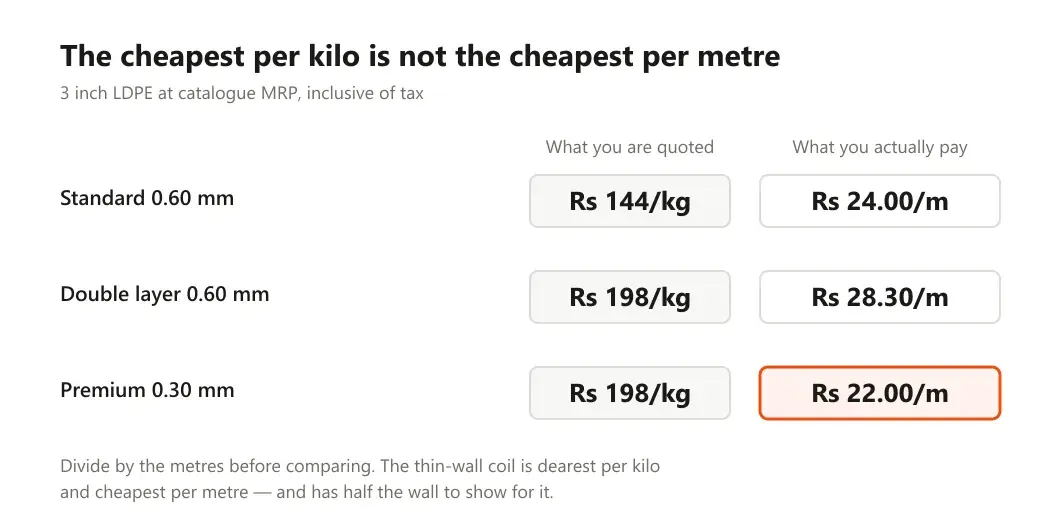
Once you know the metres, convert the price too — and the ranking changes.
Our standard 0.60 mm coil is ₹144 per kilo. The premium 0.30 mm coil is ₹198 per kilo, which reads as considerably dearer. Per metre it is the other way round: the standard works out at ₹24.00 a metre, the thin-wall at ₹22.00.
So the coil that looked thirty-eight percent more expensive is actually the cheaper one to lay, by about two rupees a metre. On a run of five hundred metres that is a thousand rupees.
This is not an argument for buying thin-wall. It is an argument for comparing the same thing. A rate per kilo and a rate per metre will rank the same three coils differently, and only one of those rankings is about the job you are doing.
What the thin wall costs you back
Cheaper per metre is not the whole answer, and it would be dishonest to stop there.
A 0.30 mm wall is half the material of a 0.60 mm wall at the same point. It handles being dragged over stubble worse, it punctures more easily, and it will not take the same seasons of being rolled up wet, stored in the sun and unrolled again. The thicker coil is not a worse deal — you are paying more per metre for pipe that survives handling that would finish the thin one.
The honest rule is about how the pipe will live:
We have written elsewhere about what actually kills a pipe in storage and sunlight, and it applies harder to thin wall than thick.
- Hose that gets shifted daily, dragged across a field, and rolled up between waterings should be the thicker wall. The extra per metre is cheap next to replacing it mid-season.
- Hose that is laid once, left in place, and lifted only at the end of the crop can be the thin wall, and the saving is real.
- Anywhere with stubble, stones or livestock, take the thicker wall regardless of the arithmetic.
Three questions before you accept a quote
If a quote arrives in kilograms, you are one conversion away from being able to compare it. Ask for:
1. **The wall thickness in millimetres.** Without it, no weight can be converted to a length, and a quote you cannot convert is not a quote you can compare. 2. **The bore, stated separately from the length.** Three inch and 3 metres are both written "3" on a label often enough to matter. 3. **The metres on the coil**, in writing. Any supplier who sells by weight can tell you what the coil runs to — and if they cannot, that is itself an answer.
You can see all of this stated per product on our own listings — every LDPE coil shows its bore, its wall, its length and its weight as four separate fields, because collapsing them into one is what causes the problem in the first place. The 15 kg standard coil is a good one to look at first.
And when you know the metres, the system estimator will tell you how many of them your field actually needs before you commit to a single coil.
Keep reading
Pipe bore size vs coil length: reading a listing
A pipe listing gives you a size, a length and sometimes a weight. Here is what each number means, and which one you are probably misreading.
GuidesHow to check irrigation pipe quality before you pay
How to check irrigation pipe quality with five checks at the counter or on the truck: wall, weight, printing, flex and finish.
GuidesHow to size a drip irrigation system in two numbers
Our estimator sizes a drip system from just crop and acres. Here is what it assumes, which numbers to check on your own field, and when to trust the result.