How to make irrigation pipe last: sun, bends, storage
Sun, sharp bends and bad storage kill far more pipe than wear does. The habits that make irrigation pipe last season after season.
18 March 2026 · 3 min read · REDYPLAST
Most irrigation pipe on a farm dies young, and almost never from honest wear. To make irrigation pipe last, you defend it from four things — sunlight, forced bends, careless storage and end-of-season neglect — and none of the four costs real money to prevent. This guide works through each of them, then covers the two warning signs that say a length is already past saving.
Sunlight does the most damage
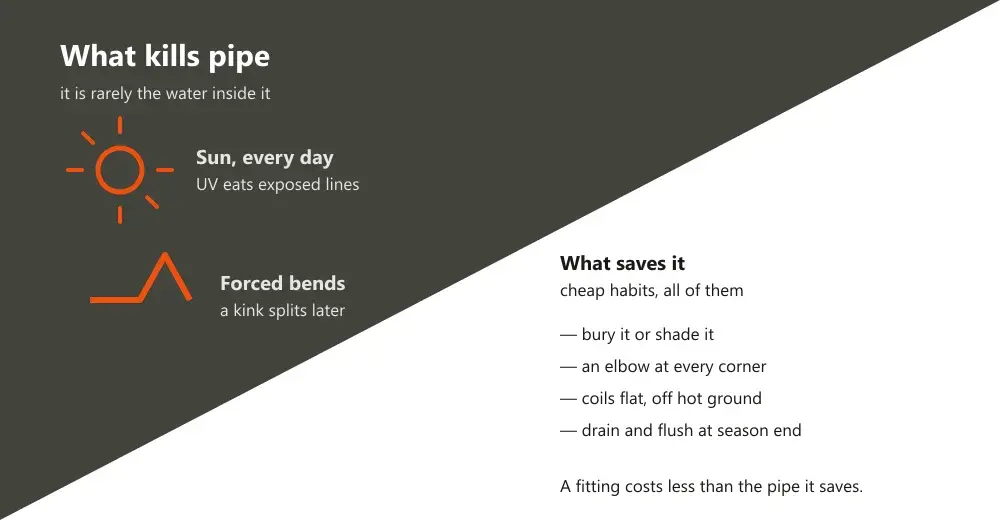
Ultraviolet light attacks the plastic itself. Year after year it cuts the long molecules that give the wall its flexibility, until the pipe you eventually pick up is stiff, faded and ready to crack at the first rough handling. Nothing else on this list destroys pipe as reliably as leaving it lying in the open.
Black pipe resists this because of carbon black mixed through the material when it was made. The colour is the protection — it lives in the wall, not on it. Painting a faded pipe black achieves nothing, because by the time the fade is visible, the damage has already gone deeper than the surface.
A label that says UV-stabilised means the ageing has been slowed, not switched off. Stabiliser buys extra seasons; it does not buy immunity. So run lines underground or beneath crop shade wherever the layout allows, and treat any stretch that must stay exposed — crossing a bund, rising to a tank — as being on a shorter clock. Wall thickness adds margin too, which is one reason our garden pipes carry a full 3 mm wall at the 3/4 inch size.
A forced corner is a delayed split
Every pipe has a curve it will accept and a curve it will not. Pull it tighter than that and the wall creases along the inside of the turn. The crease chokes flow from day one, but the real bill arrives later: the folded material has yielded, and that exact line is where the split opens — often a full season on, when nobody remembers the corner being forced.
Give corners a fitting instead. An elbow at a tight turn costs less than the metres of pipe a crease condemns, and it keeps the bore fully open where a fold would strangle it. The worst offenders are usually at the pump shed and at field corners, where a line changes direction hard — walk those two points and look.
While laying, walk a coil around obstacles rather than hauling it through under tension. Pipe dragged hard around a post is being bent and scraped at the same time, and cold pipe takes both worse — lay in the warmth of the afternoon when you can.
Storage habits that make irrigation pipe last
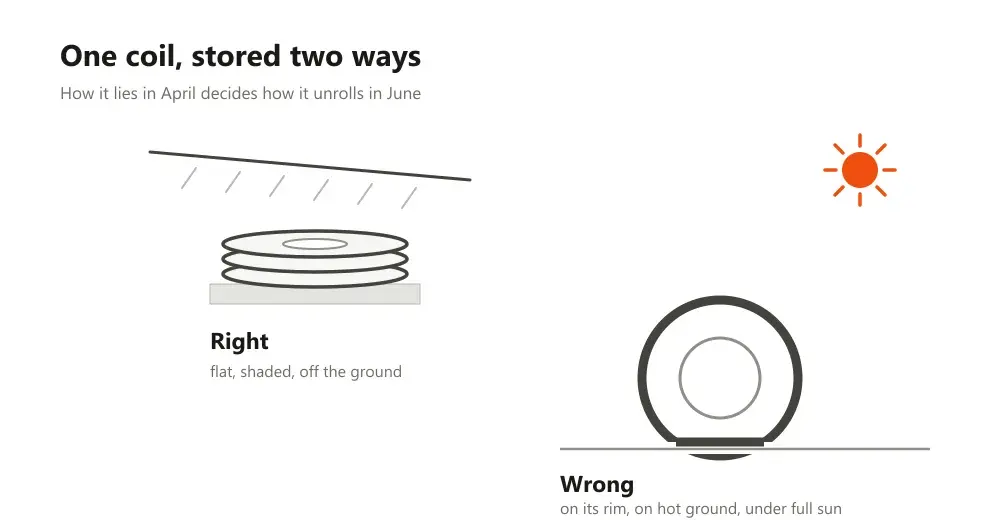
How a coil spends the idle months decides how it comes back out. Four rules cover nearly everything:
Thin-walled pipe forgives bad storage least, which is worth knowing before you buy: a lighter coil of the same length simply has less wall to give. How LDPE coils are sold by weight explains reading that trade-off on a listing.
Flat pipe — lapeta and lay-flat — adds a rule of its own: roll it back flat and straight, with no twist trapped inside the roll. A twist wound in today gets pressed into a hard crease by the layers above it, and that crease weeps under pressure next season. Our lapeta pipes arrive rolled flat from the factory; putting them away the same way takes a minute more per roll.
- Lay coils flat, never leaning on a wall or standing on their rim — upright, the whole weight bears on one small arc and the pipe takes a permanent set
- Keep them under a roof or dense shade, for the same sunlight reasons as above
- Keep them off bare ground — a plinth, planks or a few bricks will do, because summer soil bakes the underside of anything lying on it
- Look them over once a month; rats chew stored plastic, and a gnawed coil announces itself only when pressurised
Close the season properly
Water left standing in an idle line works against it all summer. Silt settles and packs hard, algae grows wherever light reaches the pipe, and dissolved minerals rest against the wall for months. Two short jobs at season end prevent the lot.
Flush first, then drain. Open the far end and let the line run until it comes clear, so the season's sediment leaves the system instead of settling into it. Then let the line empty, lifting it at the low points where water pools. Settled silt matters more than it looks — it is the same load that blocks drip emitters from the far end backwards.
Solvent cement earns its own line here, because most of what farms discard was ruined in storage rather than used up. Once a tin is opened, solvent escapes every time the lid does, and a half-used tin carried across a season is usually jelly by the next join. Buy the size one job will finish, and keep a 59 ml tin — ₹189 — as the standing repair tin. The full range of sizes is under solvent cement.
The two signs a length is finished
Run a dry palm along the pipe. A white, powdery residue — a chalky surface — means sunlight has eaten into the material. The pipe may still hold pressure, but the wall behind that chalk is brittle, and the next knock, pressure spike or rough recoiling can open it.
The second sign is a pale line or crescent at a bend. That whitening is the plastic admitting it has yielded; when the split comes, it follows that mark. A length showing either sign should not anchor another season — cut out the exposed or creased stretches and join fresh pipe in their place, keeping the buried runs. Burial protects, and buried pipe routinely outlives everything above ground.
Small habits against a real bill
Everything above is cheap: shade, a plinth, an elbow at the awkward corner, ten minutes with the far end open in the closing week of the season. Set that against replacing a coil mid-season — plus the watering days lost while you arrange it — and the habits win by a distance. Skipping maintenance sits on our list of common irrigation mistakes precisely because it is the quietest failure of the lot.
If you are patching up an older system and want a short, honest repair list — couplers, elbows, a small cement tin — tell us what you are running and we will keep it to what you actually need. For dealer or estate quantities, the bulk enquiry form reaches us directly.
Keep reading
Why drip emitters block, and what actually clears them
Grit, scale or slime — why drip emitters block depends on your water. How to tell the three apart, and the flush habit that keeps a line clear.
GuidesHow to check irrigation pipe quality before you pay
How to check irrigation pipe quality with five checks at the counter or on the truck: wall, weight, printing, flex and finish.
GuidesSix common irrigation mistakes, and how to fix them
The six common irrigation mistakes we see most on Telangana and Andhra farms, and the practical fix for each — from schedules to system choice.