Lapeta pipe for sugarcane: sizes, grades and pitfalls
Choosing lapeta pipe for sugarcane — which bores fit furrow watering, what the rolls cost, and how one survives an 18-month crop and its ratoon.
2 October 2026 · 4 min read · REDYPLAST
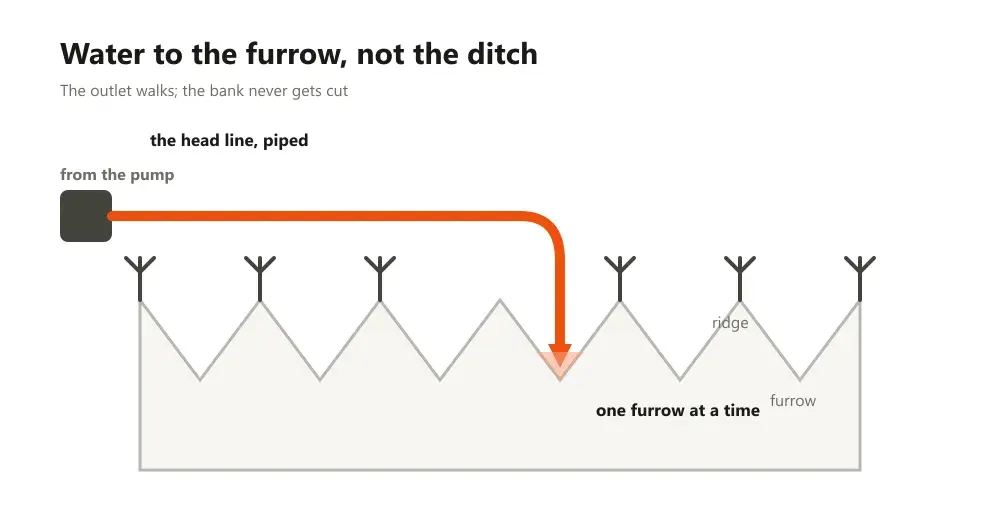
Lapeta pipe for sugarcane earns its keep at the furrow head: cane in Telangana and Andhra is watered down furrows, and the roll's job is carrying bore or canal water to the head of whichever furrow is drinking, with none of it lost on the way. Below are the bores that fit cane's water, what the rolls cost at our counter, and what an eighteen-month crop does to a pipe that shorter crops never manage.
Where the pipe fits a cane field
A cane field's traditional head channel is an open earthen ditch running the top of the furrows, and it leaks twice — into its own bed, and every time a farmer cuts its bank to let a furrow drink and patches it after. A flat roll laid along the same line replaces both losses: walk the outlet from furrow to furrow instead of cutting soil, and the water arrives where the cut used to be.
The furrows themselves reward that discipline. Watering alternate furrows instead of every one is a standard cane recommendation that saves a large share of the water on suitable soils, and it only works if you can direct the full flow furrow by furrow — which is exactly what a movable pipe outlet does and a leaking ditch does not.
Canal-fed fields add a clock to the problem. A water turn arrives on the schedule the outlet keeps, not the one the farmer would choose, and often at night. A roll that lays out along the head line in minutes means the turn is spent watering furrows, not repairing a channel in the dark before the water can even start.
Lapeta pipe for sugarcane runs on the big bores
Cane's water arrives big — canal outlets, heavy diesel pumps, high-yielding bores — and the pipe must swallow it. This is the crop the large tarpaulin bores exist for:
Cane boundaries are long, so the 150 metre rolls matter here more than anywhere: one length covers a head line that would take two shorter rolls and a joint, and every joint is the place a head line chooses to fail during a water turn. Match the bore to the pump or outlet flange first, and order by the inch and millimetre on the product page when a fitting has to mate.
- **5 and 6 inch tarpaulin** where a canal outlet or a big diesel pump feeds the field. Choking that flow through a narrow roll wastes the head you paid for.
- **4 inch tarpaulin** as the workhorse on strong borewells, especially where one roll walks between fields.
- **3 inch** — tarpaulin or LDPE — only where the source is a modest bore; on cane acreage it is usually the second roll, not the first.
The rolls a cane season uses
At 3 inch the choice is mostly price and preference — the plain LDPE roll works out around ₹24 a metre against tarpaulin's ₹43.50 — while past 4 inch there is no choice to make: only tarpaulin goes there.
From the lapeta and LDPE listings, MRP with tax inside:
The same four wall families serve every flooded crop, and the grade-by-grade rundown in the paddy guide applies here unchanged — including the warning that these conveyance rolls are general goods at 18% GST, not the 5% micro-irrigation rate.
- Tarpaulin 6 inch: ₹10,125 for 150 m, ₹8,100 for 120 m — about ₹67.50 a metre.
- Tarpaulin 5 inch: ₹8,991 for 150 m. Tarpaulin 4 inch: ₹7,920 for 150 m.
- Tarpaulin 3 inch: ₹6,525 for the 150 m roll.
- Plain LDPE 3 inch: ₹4,320 for the 30 kg, 180 m roll — about ₹24 a metre — or ₹3,600 for 150 m.
- Double layer 3 inch: ₹2,970 for 105 m.
Eighteen months, a ratoon, and what they do to a roll
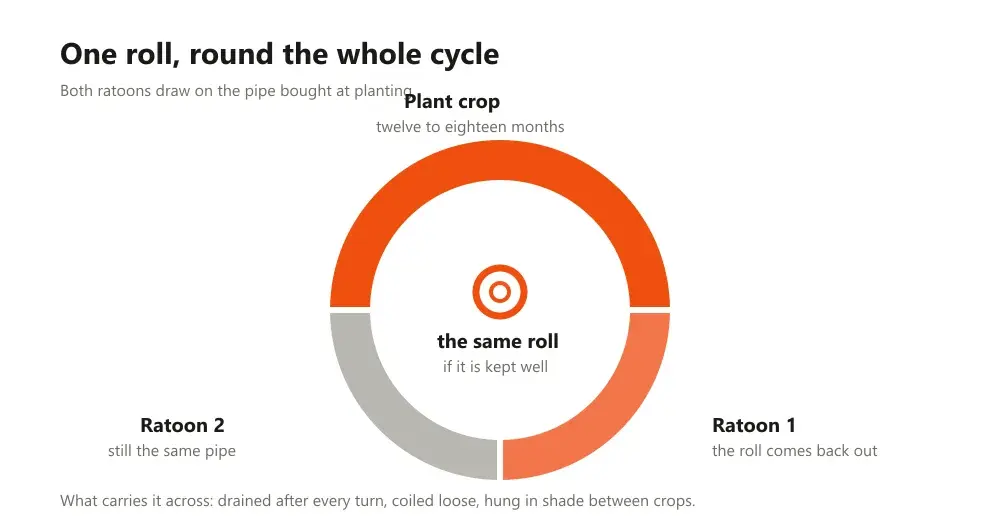
A paddy roll works in bursts and rests between seasons. A cane roll is on duty for twelve to eighteen months, then the ratoon crop asks it to do it again — and cane adds hazards of its own:
Do that much and the ratoon inherits a working roll; skip it and the second crop starts with a pipe bill.
- **Trash.** After harvest the field is carpeted in dry cane leaf, and dragging a filled roll across it grinds the wall against some of the most abrasive litter farming produces. Carry the roll around the trash lines, not through them.
- **Rats.** Trash-mulched cane fields hold rodents, and a roll stored in a corner of the field shed feeds them all off-season. Hang it, and check it before the ratoon's first watering — not during.
- **Sun, multiplied.** A long season means many more afternoons a lazy habit leaves the roll filled and baking on the head line. Drain it and coil it in shade after each turn; [the pipe-life guide](/blog/making-your-pipe-last) is written for exactly this discipline.
- **The same crease, hundreds of times.** Fold a roll at one point every watering for eighteen months and the wall fails there first. Roll it up loosely and alternate ends.
The drip question cane must answer
The two also coexist. Farms that convert to drip keep a conveyance roll for the nursery, for tank filling and for the odd rescue watering — so the roll bought this season is not money the drip decision throws away.
Unlike paddy, cane has a real choice to make. Drip suits sugarcane well — the case is made honestly here — and a grower planning the next planting should read it before buying anything. Lapeta is the tool for the field that floods today: it costs a fraction of a system, moves with the water turn, and wastes nothing while the bigger decision is pending.
Buying it for your field
Three measurements settle the order: the pump or outlet size, the head-line length to the farthest furrow, and whether the roll must cross harvested trash to get there. The sugarcane crop page keeps the agronomy beside the parts, and for a canal-fed or multi-field setup, send the measurements and we will size the bore and lengths against your water before anything ships.
Where these numbers come from
- ICAR (opens in a new tab)
Indian Council of Agricultural Research — crop agronomy and regional package-of-practices.
- TNAU Agritech Portal (opens in a new tab)
Crop-wise spacing, water requirement and drip layout references for southern India.
Keep reading
Drip for sugarcane: built to outlast the ratoons
Drip for sugarcane stays buried for years, not months. The wall that survives ratoons, the paired-row lever, and what the water bill says.
GuidesLapeta pipe for paddy: sizes, grades and pitfalls
Which lapeta pipe suits paddy — tarpaulin or LDPE, 3 to 6 inch — with real roll prices and the pitfalls that kill a roll in its first season.
GuidesDrip irrigation layout for one acre of chilli, worked
A drip irrigation layout for one acre of chilli at 60 cm rows, fully counted — 105 laterals, seven coils of tape, valves, pump hours and the total.