Drip emitter spacing for sugarcane on alluvial soil: wide pairs
Drip emitter spacing for sugarcane on alluvial soil lets a pair of rows share one lateral, and the silt holds days of water. The pair, the minutes, the stop.
8 November 2026 · 5 min read · REDYPLAST
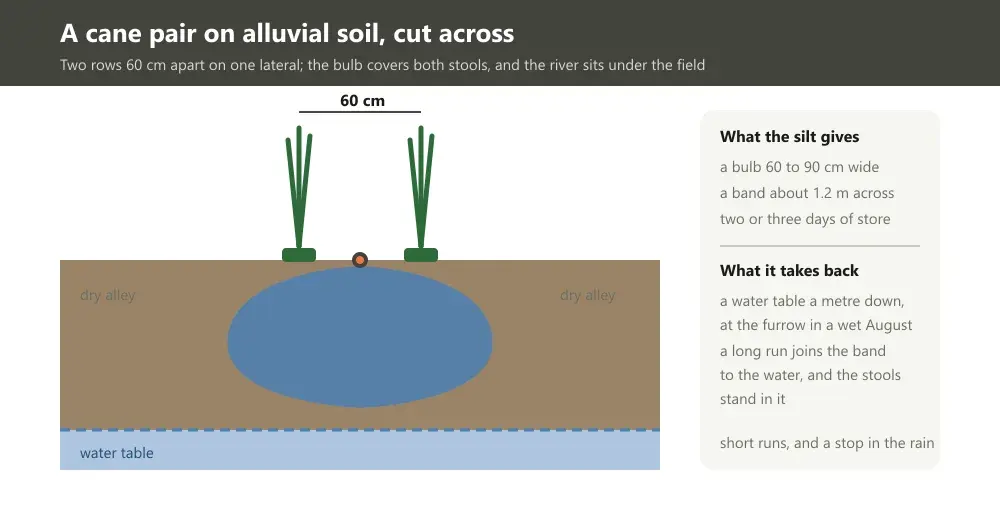
Drip emitter spacing for sugarcane on alluvial soil is the easy case for the paired-row layout: the bulb under a 4 litre dripper spreads 60 to 90 cm across on this silt, so two cane rows 60 cm apart share one lateral with water to spare, and the 40 cm drippers every inline pipe we list carries merge into a band that covers both stools.
What drip emitter spacing for sugarcane on alluvial soil changes is the clock rather than the pipe, because the soil holds two or three days of crop water and the river under the field rises every monsoon.
Delta and riverbank cane is grown on deep alluvium along the Godavari and Krishna, often on fields that flood in a wet August. This guide covers the wide bulb and the pair it allows, the minutes per day across the cane year, the alternate-day rhythm the soil's storage permits, and the monsoon stop that is the reverse of the rule on lighter ground.
The wide bulb and the water table
Alluvial soil is deep, stone-free silt loam that moves water sideways as readily as down. A dripper's bulb is 60 to 90 cm across, neighbours at 40 cm merge into a continuous band, and the root zone holds two or three days of crop water once it is filled. Cane roots feed across the whole band and down a metre into soil that is wet all the way, which is why delta cane yields as it does.
The hazard is below. The water table under riverbank fields can stand a metre down in the dry months and come up to the surface in the low patches during the monsoon.
Cane tolerates a wet week better than most crops, but a stool standing in water for a fortnight loses roots, tillers slow, and the red rot and wilt that follow waterlogging start in the low spots. The sugarcane crop page says a borewell has to meet the grand-growth peak rather than the yearly average; on alluvium the drainage matters as much.
- Bulb: 60 to 90 cm across, merging along and across the row.
- Reach across the row: 35 cm or more each side of the lateral.
- Storage: two or three days; alternate-day runs through most of the year.
- Drainage: good on the levee, slow on the low ground and in the monsoon.
Drip emitter spacing for sugarcane on alluvial soil, across the field
Along the furrow the 40 cm spacing makes a band and every sett has water. Across the field, the wide bulb is the saving: cane planted in pairs 60 cm apart with the lateral between them and 1.8 metres between pairs is the standard alluvial layout, about 2,250 metres of lateral on an acre against about 2,700 for wide single rows at 1.5 metres, the plan the estimator works on.
The pair need not hug the lateral as it must on red soil; 60 cm is comfortable, and some growers run 75 cm pairs on the heavier phases.
The limit is the other way round from red soil. On a heavy alluvial phase with a high water table, one lateral per pair at 1.8 metres puts enough water into a band 1.2 metres wide that the inter-pair alley stays dry only if the runs are kept short; run long and the whole field wets through to the water table.
The cane conversion guide prices the pair against single rows, and the cane drip guide covers the wall thickness a lateral needs to stay down through the ratoons. The lateral is 16 mm inline from the drip range.
The minutes, and the days between them
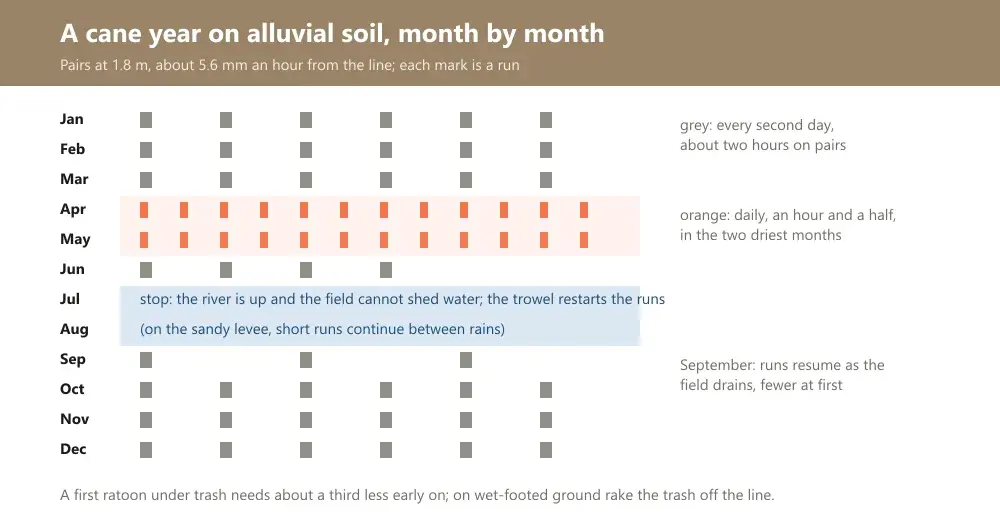
On pairs at 1.8 metres a metre of lateral with 10 litres an hour serves 1.8 square metres, so the line applies about 5.6 mm an hour. An acre of pairs is about 2,250 metres of lateral drinking 22,500 litres an hour, so the 9.5 mm peak is just under two hours and the 4.5 mm end of the range about 55 minutes. Single rows at 1.5 metres apply about 6.7 mm an hour and take about an hour and a half and 45 minutes.
The soil's storage then sets the rhythm. Through most of the year the run goes every second day and is doubled, about two hours on pairs, because the band holds it and the stool draws on it for two days. In April and May, when evaporation peaks and the air is driest, the run turns daily and single, about an hour and a half on a delta field, so the surface never dries between runs.
On the low ground with the water table near, the doubled alternate-day run is split into two days instead, because a two hour run on a wet-footed field reaches the water table.
Cane at full cover uses about 4.5 to 9.5 mm a day, the top of it a hot-month figure for the driest district, which on one acre is roughly 18,200 to 38,400 litres at the root, or about 20,200 to 42,700 litres from the pump once drip's losses are allowed for; the water requirement calculator gives the figure for your own acreage.
The monsoon stop, and the ratoon
On alluvial cane the monsoon is a stop, not a schedule. When the rain comes weekly and the water table is at the furrow, the drip runs add water a field cannot shed, and the correct setting is off until the field has drained to a hand's depth; the trowel decides when the runs resume, not the calendar. This is the reverse of red soil, where the band dries by the second dry day and the pump stays in the rhythm.
After harvest the stubble shoots under the same laterals and the trash blanket keeps the band moist, which on alluvium cuts the ratoon's early runs by a third but also slows the surface drying on low ground. On wet-footed patches, rake the trash off the lateral line for the first weeks of the ratoon so the band can breathe, and keep it on the high ground where it earns its keep. Burning the trash burns the lateral, on any soil.
- Long daily runs through the year: a field wet to the water table, slow tillering, rot in the low spots.
- Running through a wet August: water the field cannot shed; stop until the trowel says moist.
- Trash left thick on wet-footed ground in the first ratoon weeks: a band that never dries.
- The check: a trowel a hand deep beside the stool the morning after a run; moist and crumbling is right, shining is wet feet.
The figures are a starting point
The 4.5 to 9.5 mm a day and the bulb widths are published agronomic ranges, not measurements from your field, and alluvial ground runs from sandy levee to heavy backswamp within one village; the sandier the phase, the closer the schedule moves to daily and the less the monsoon stop applies. Treat an hour and a half daily on pairs as the May schedule and two hours every second day as the rest, and let the trowel correct both.
The same crop on the opposite soil is worked in the red-loam cane guide, and the same soil under banana in the alluvial banana guide. A blocked dripper hides in the band for weeks on this soil; the blocked-line guide covers flushing. If you want the pair layout and the shifts sized to your field and bore, send us the row plan, the acreage, the bore yield and whether the field floods and we will say how many coils and how many runs a week it needs.
Where these numbers come from
- FAO Irrigation and Drainage Paper 56 (opens in a new tab)
The reference method for crop evapotranspiration and crop coefficients that daily water figures derive from.
- ICAR (opens in a new tab)
Indian Council of Agricultural Research — crop agronomy and regional package-of-practices.
- TNAU Agritech Portal (opens in a new tab)
Crop-wise spacing, water requirement and drip layout references for southern India.
Keep reading
Drip emitter spacing for sugarcane on red loam, and the minutes
Drip emitter spacing for sugarcane on red loam settles the paired-row question, since the bulb is narrow. The pair that works, the minutes by phase, the ratoon.
GuidesDrip emitter spacing for garden and orchard on alluvial soil
Drip emitter spacing for garden and orchard on alluvial soil needs fewer columns per tree, as the bulbs merge into one patch. The patch, the hours, the mound.
GuidesDrip emitter spacing for chilli on alluvial soil: the wide bulb
Drip emitter spacing for chilli on alluvial soil lets one lateral serve a pair of rows, since the bulb is wide. The pair, the minutes, the wet-feet mistake.