Drip for sugarcane: built to outlast the ratoons
Sugarcane keeps its drip pipe in the ground for years, not months. The wall that survives ratoons, the paired-row lever, and what the water bill says.
13 September 2026 · 3 min read · REDYPLAST
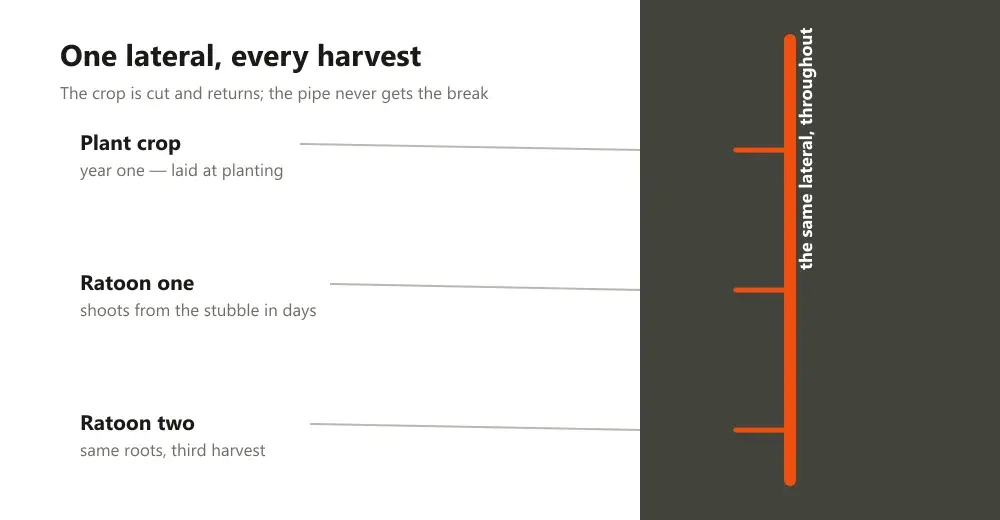
Buying drip for sugarcane means buying pipe for a field that will not be empty again for years. A cane planting is cut and regrows — the plant crop, then a ratoon, often another — and the lateral laid at planting must serve every one of those harvests, because there is no practical moment to replace it while stubble is shooting.
That single fact settles most of the choices below, and it turns one grade of pipe from an extravagance into the cheapest option on the shelf.
One planting, several harvests
So the lateral's working life is not "a season". It is the whole cycle: plant crop plus every ratoon you intend to take, years of sun, traffic and trash, without a maintenance window longer than a fortnight. Buy for that life, or plan to abandon a ratoon while you re-pipe — nobody does the second thing on purpose.
Other crops hand your pipe an off-season. Cotton's laterals work hard but the field clears within the year; chilli's tape is rolled up between plantings and stored in the shade. Cane offers no such courtesy — the harvest gangs leave stubble, the stubble shoots within days, and the ratoon wants water while the trash is still lying in the alleys.
Drip for sugarcane: the wall is the whole decision
Run the grades against the cycle and the ranking inverts from every annual crop's logic:
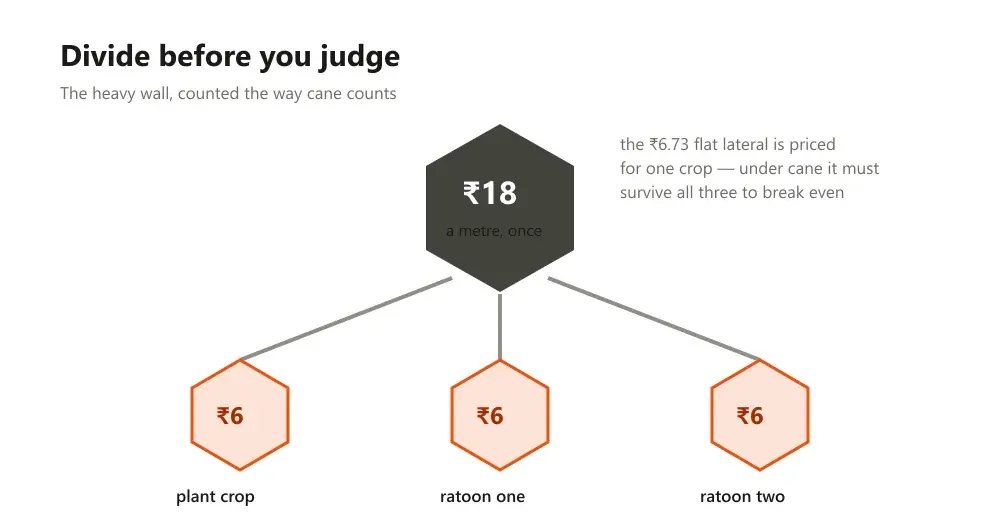
- Round inline, heavy wall — ₹18 a metre. Across a plant crop and two ratoons that is ₹6 per metre per harvest, and the pipe was built for exactly this duty.
- Flat lateral, 0.4 mm — ₹6.73 a metre. Honest for a single-cycle intention, but it is being asked to survive cane traffic for the full cycle to beat the heavy pipe's per-harvest cost, and that is a bet against the harvest gang's boots.
- Thin ₹3.96 tape — not a candidate. Under a crop that stands a year before its first cut, it is a lateral chosen to fail mid-crop.
The paired-row lever
Cane planting layout moves the lateral bill more than any grade decision. Planted in paired rows — two cane lines sharing one wide alley — a single lateral laid between the pair can water both, and the coil count drops by nearly half against one-line-per-row on the same population.
Whether your layout supports that depends on the pairing width, the soil's sideways wetting and the emitter choice — it is a design question, not a rule of thumb. Our own crop page says it plainly: tell us the layout and we will check the sizing. Send the row plan across before the coils are counted, because this is the cheapest moment the system will ever have.
Total demand, not peak day
Cane's water question is different in kind from the crops around it. Elsewhere we talk about the peak day; cane is defined by the season's total — a heavy, steady draw that runs for months on end. A bore that manages the hottest week can still fail the marathon, so size the source for the whole cycle's volume, not the worst afternoon.
The water requirement calculator puts figures on the draw, and the borewell arithmetic shows how supply sets the area you can honestly plant. The consolation is monthly and real: drip's saving on cane is mostly a pumping-hours saving, and on a crop that irrigates most weeks of the year, the electricity and diesel it does not burn is a line of profit that repeats every bill.
Trash, traffic and the months after harvest
Harvest is the lateral's dangerous season. Cutting gangs walk every row, cane is dragged out by the tonne, and the trash blanket that follows buries the lines — good shade against the sun, and a perfect hiding place for damage.
One practice decides the whole design before habits enter it: what happens to the trash. Left as a blanket, it is drip's best friend — under trash the lateral's water barely evaporates, the line works shaded all year, and you have quietly bought the most water-efficient pairing cane knows.
Burned before the ratoon, the same trash is the lateral's execution — no surface pipe survives a field fire. If burning is your practice, say so at design time, because it changes where and how the laterals must live.
Three habits then carry the pipe through to the next ratoon:
- Mark the lateral positions at the row ends before the first harvest, so nobody drags a load along an invisible line.
- Walk the block after every harvest with the pump running, before the trash settles — a crushed or cut lateral announces itself in minutes and hides for months.
- Flush the lines as the ratoon irrigation begins; a year of standing crop feeds sediment to the far ends, and [a blocked emitter is a private drought](/blog/why-your-drip-line-keeps-blocking). The filter this depends on is, as ever, not something we stock — budget it beside the pipe.
The cane order, in short
Heavy-wall 16 mm laterals by measured rows from the drip range, one ₹6 takeup and end cap per line, joiners in the shed for harvest-season repairs, and a mainline sized to the pump. The sugarcane crop page keeps the profile beside the products — and if the plan involves paired rows or a ratoon count you have not settled, ask us first. Pipe bought for the whole cycle is bought once; pipe bought for a season is bought again at the worst possible time.
Where these numbers come from
- ICAR (opens in a new tab)
Indian Council of Agricultural Research — crop agronomy and regional package-of-practices.
- TNAU Agritech Portal (opens in a new tab)
Crop-wise spacing, water requirement and drip layout references for southern India.
Keep reading
Drip for banana: sizes, grades and the two pitfalls
Which drip laterals suit a banana crop, why the heavy wall earns its keep over a year in the ground, and the two mistakes banana buyers repeat.
GuidesDrip for orchard rows: sizes, grades and the pitfalls
Orchard trees take the least drip pipe of any planting — if the system is built for the mature canopy. Sizes, the online-emitter choice, and two pitfalls.
GuidesDrip for chilli: sizes, grades and the two pitfalls
Chilli needs more lateral per acre than almost any drip crop. The grades that fit a single season, the metres to expect, and the two buying mistakes.