Drip irrigation layout for one acre of sugarcane, worked
A drip irrigation layout for one acre of sugarcane at 1.2 metre rows, counted: 53 laterals, seven coils, the head, the June pump hours and a bill of ₹36,963.
11 November 2026 · 3 min read · REDYPLAST
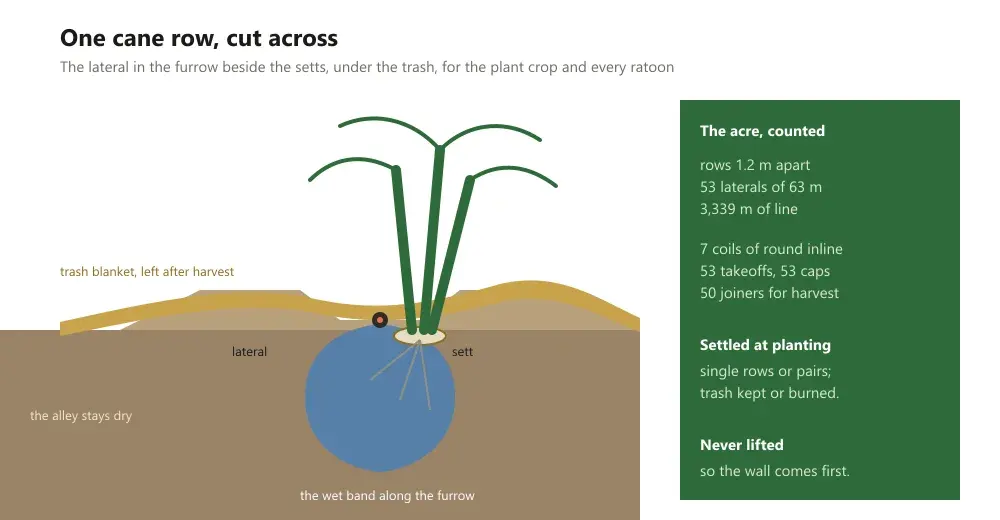
The drip irrigation layout for one acre of sugarcane that most growers need is a simple one: cane in single rows 1.2 metres apart, a lateral in every furrow, and a hose along the head of the field to feed them. Counted out, that is 53 laterals and 3,339 metres of drip line, and ₹36,963 of the parts we sell, at MRP with the tax already in.
What makes a drip irrigation layout for one acre of sugarcane its own problem is time. A cotton or chilli field gets its pipe back every year; a cane field does not, because the stubble shoots within days of the harvest and the lateral laid at planting has to water the plant crop and each ratoon after it. So this page starts with two choices that cannot be undone, then counts the pipe, checks the pump against June, and adds the bill.
The field, and two choices made before planting
Take an acre as 64 metres by 63. With the rows running the 63 metre length and 1.2 metres between them, 53 rows fit across the 64 metre width. One lateral to a row gives 53 runs of 63 metres. The pump is at a corner, and the supply hose lies along the 64 metre side where the rows begin.
The first choice is the row plan. Single rows are used here because they suit every soil; pairs, which cut the pipe by a third, are priced in the last section. The second is the trash. This sheet takes it as left on the ground after cutting, since a surface lateral does not survive a burned field; if you burn, say so before anything is laid, and read what the cane drip guide says it changes.
A pipe that is never lifted
The dripper is the same on every inline line in the drip range: 4 litres an hour, one every 40 cm. Along a cane furrow those drippers wet an unbroken strip, and setts dropped anywhere on it find moisture. The question that matters for cane is how long the pipe lasts under trash, boots and a loaded lorry.
For that reason the sheet is built on round inline pipe, listed for 1 to 2 kg/cm² and sold in 500 metre coils at ₹4,482. The acre takes seven coils, ₹31,374, and leaves 161 metres over for the first day's cuts. Lay it in the bottom of the furrow, next to the setts, so the young roots grow into the wet strip from the start.
Two other pipes could be put in its place. A heavier round inline comes in 400 metre coils at ₹7,200, nine coils and ₹64,800 for this acre, and the listing shows if it is in stock. The 0.4 mm flat lateral at ₹3,366 a coil would cost ₹23,562 for seven. It is a fair pipe for a crop that is lifted each season, and the cane conversion guide is frank that under cane it is a gamble.
From the pump to the first furrow
Two things the system cannot run without are missing from our shelves and so from this sheet: the filter, and the valves that open and close each block. Both are bought elsewhere and both belong in your budget.
The supply hose is 3 inch LDPE: a 15 kg coil, 90 metres, ₹2,160, enough for the 64 metre side and the short run back to the pump. Keep it off the line the harvest lorry takes. Where each lateral meets the hose there is a takeoff, and at each lateral's far end a cap, both ₹6, 53 of each. The sheet also carries fifty ₹6 joiners, a larger number than other crops get, because cutting cane breaks pipe and the ratoon is already growing when it does.
Three parts stand at the pump. A 2 inch ball-type non-return valve, ₹1,440, keeps the hose full when the motor stops. A 2 inch connector, ₹558, joins the pump's steel to the plastic. A 250 ml tin of solvent cement is ₹495.
June is the design month
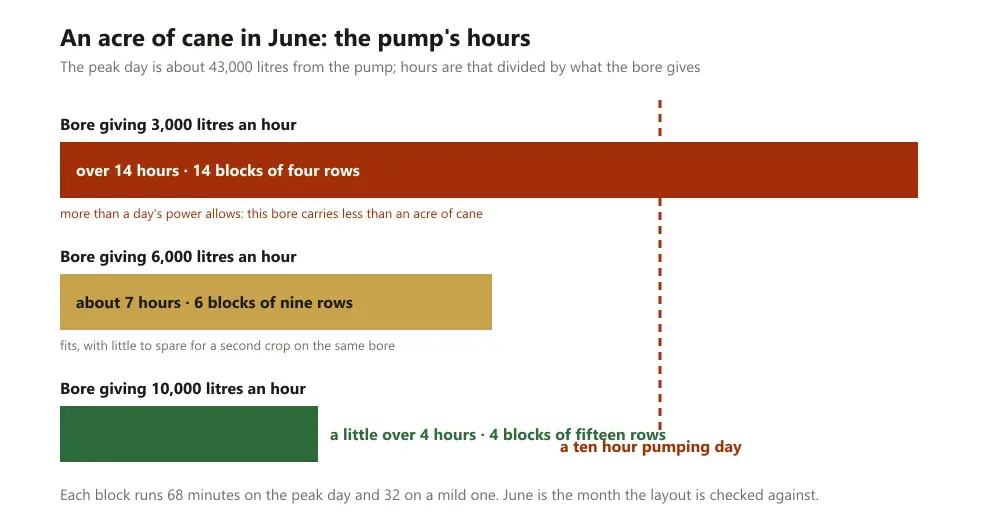
No bore can open every row together, since 53 rows of these drippers would draw some 33,400 litres an hour. A single row draws 630. Divide what the bore gives by 630 and you have the rows it can water at one time: fifteen from a 10,000 litre bore, nine from 6,000, four from 3,000. The 53 rows then fall into four, six or fourteen blocks.
With laterals 1.2 metres apart the strip receives roughly 8 mm in an hour. A block is therefore open for about half an hour when the day's need is 4.5 mm, and for 68 minutes when it is 9.5.
Through its June to October peak a full canopy of cane takes 4.5 to 9.5 mm of water a day. For an acre that means 18,000 to 38,000 litres reaching the roots and, after drip's losses, 20,000 to 43,000 litres leaving the pump; put your own acreage into the water requirement calculator for the figure that applies to you.
Multiply out the hottest day and the bore decides everything. The 10,000 litre bore finishes in a little over four hours and the 6,000 in about seven. The 3,000 litre bore would need more than fourteen, which no power supply gives it, so it should be planted to less than an acre of cane; the borewell guide shows how much less.
What the acre costs, line by line
These are MRP figures, per coil or per piece, and the tax is inside them.
Not included, and not small: the filter, the block valves, the pump with its starter and cable, any trenching, the labour and the freight. Note also that the small fittings above are counted singly, while the conversion guide prices them as full boxes of a hundred, which is how they are packed; the two bills differ for that reason and no other.
- Seven 500 m coils of round inline lateral, ₹4,482 each: ₹31,374.
- 53 takeoffs, ₹6 each: ₹318.
- 53 end caps, ₹6 each: ₹318.
- 50 joiners, ₹6 each: ₹300.
- One 90 m coil of 3 inch LDPE hose: ₹2,160.
- One 2 inch non-return valve: ₹1,440.
- One 2 inch connector: ₹558.
- One tin of solvent cement: ₹495.
- All together: ₹36,963.
Pairs, a lighter wall, or a smaller bore
Changing the wall moves the total up or down by the amounts given earlier, and is a judgement about how many harvests the pipe must see. A smaller bore changes nothing on the bill and everything in the field: more blocks, more valves, and in June perhaps fewer rows than an acre.
Pairing the rows is the largest saving on offer. Two cane rows share one lateral, the laterals sit 1.8 metres apart, and the acre needs 36 runs, 2,268 metres, five coils: ₹22,410 of pipe and ₹27,795 in all. The catch is the soil. Water has to travel sideways from one line to two rows, and on a light soil that works only when the pair is planted close, as the guides for red loam and sandy loam explain.
The water figures here are published ranges and the plan is for counting pipe; it is not a pressure design. To have one made, tell us the two sides of the field, the row plan, what happens to the trash and what the bore yields. To try other spacings yourself, use the system estimator, and see the sugarcane crop page for the crop's side of it.
Where these numbers come from
- FAO Irrigation and Drainage Paper 56 (opens in a new tab)
The reference method for crop evapotranspiration and crop coefficients that daily water figures derive from.
- ICAR (opens in a new tab)
Indian Council of Agricultural Research — crop agronomy and regional package-of-practices.
- TNAU Agritech Portal (opens in a new tab)
Crop-wise spacing, water requirement and drip layout references for southern India.
Keep reading
Drip irrigation layout for one acre of cotton at 90 cm rows
A drip irrigation layout for one acre of cotton at 90 cm rows, counted: 71 laterals, nine coils, the head, the blocks your bore can run, and a bill of ₹35,919.
GuidesDrip emitter spacing for sugarcane on alluvial soil: wide pairs
Drip emitter spacing for sugarcane on alluvial soil lets a pair of rows share one lateral, and the silt holds days of water. The pair, the minutes, the stop.
GuidesDrip emitter spacing for sugarcane on red loam, and the minutes
Drip emitter spacing for sugarcane on red loam settles the paired-row question, since the bulb is narrow. The pair that works, the minutes by phase, the ratoon.