Lay flat tube for cotton: width, rolls and the holes you punch
A lay flat tube for cotton is the sub-main you roll out at sowing and lift after the last picking. Which width, how 60 metre rolls fit, and two mistakes.
26 November 2026 · 4 min read · REDYPLAST
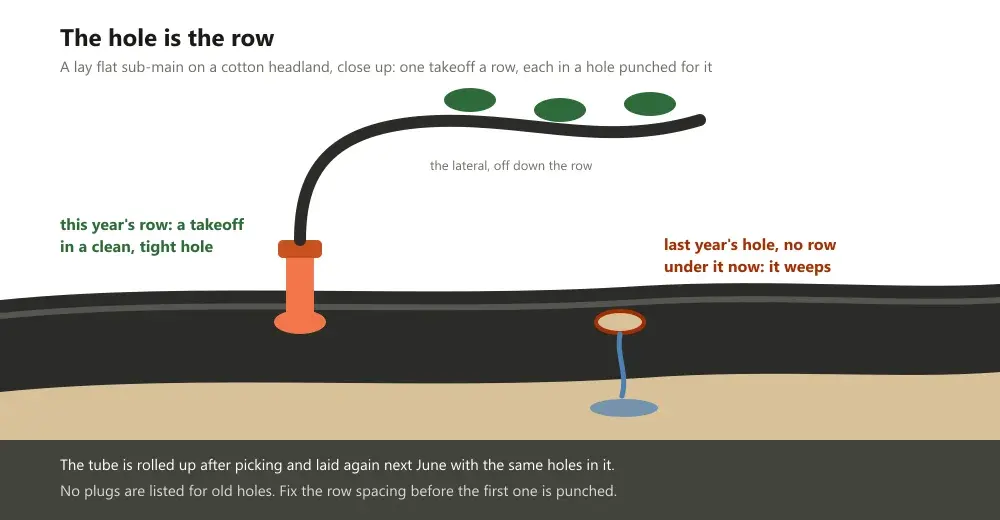
A lay flat tube for cotton is the sub-main along the head of the field: it lies on the surface, takes one takeoff for every row, and feeds the laterals the water the pump sends it. Cotton makes one thing different from an orchard or a banana garden. The crop is annual, so the tube is rolled out at sowing, lifted after the last picking, and laid again next June with the same holes in it.
That is what decides how to buy a lay flat tube for cotton. The width is the easy part; the 60 metre roll and the holes you punch are where the two repeated mistakes are made. This page covers the job, the three widths and what they cost, the roll against your head line, and the row spacing the tube will hold you to.
Lay flat tube for cotton: the job on the headland
Cotton rows end at a headland, 53 of them on a square acre at 1.2 metres and 71 at 0.9, and the one-acre layout sheet counts a takeoff for each. The sub-main is the pipe those takeoffs sit in.
A lay flat tube does the job without a trench: it follows the headland as it is, each takeoff, ₹6 a piece and sold in a minimum of 100, is pushed into a hole punched where its row happens to be, and after picking the tube drains, rolls up and goes to the shed.
It is not the pipe from the bore to the field. That run is a conveyance hose, and the lapeta guide for cotton covers it.
- Bore to field: conveyance hose.
- Along the headland, a takeoff a row: lay flat tube.
- Down the rows: drip lateral.
Which width: 63, 75 or 90 mm
Each width is a 60 metre roll, at MRP with tax inside:
The cheaper alternative is the 3 inch LDPE hose, ₹2,160 for 90 metres, about ₹24 a metre, which the cotton layout sheet uses as its spine. Both are flexible and both lie on the surface. What the lay flat tube's price buys is the wall, a full millimetre against 0.6, and on cotton that matters more than on a crop that stays put: this tube is rolled, carried, unrolled and re-fitted every year, and the holes have to hold a takeoff each time.
The lay flat range is one tube in three widths. Every width has the same black, UV-stabilised wall of 1,000 microns, a full millimetre, and the same listed 2 to 4 kg/cm², so there is no grade to choose and nothing on the listing is a quality tier. The decision is width.
For the bores most cotton fields run on, the 63 mm carries one block's water with room to spare. The 75 mm is headroom, for a larger pump or a field run as fewer, bigger blocks. The 90 mm is for big water on one long line. Order by the millimetre on the listing, because every takeoff punched into the tube has to mate with that width.
- 63 mm: ₹3,843 a roll, about ₹64 a metre.
- 75 mm: ₹4,140 a roll, about ₹69 a metre.
- 90 mm: ₹4,860 a roll, about ₹81 a metre.
The first mistake: the roll against the headland
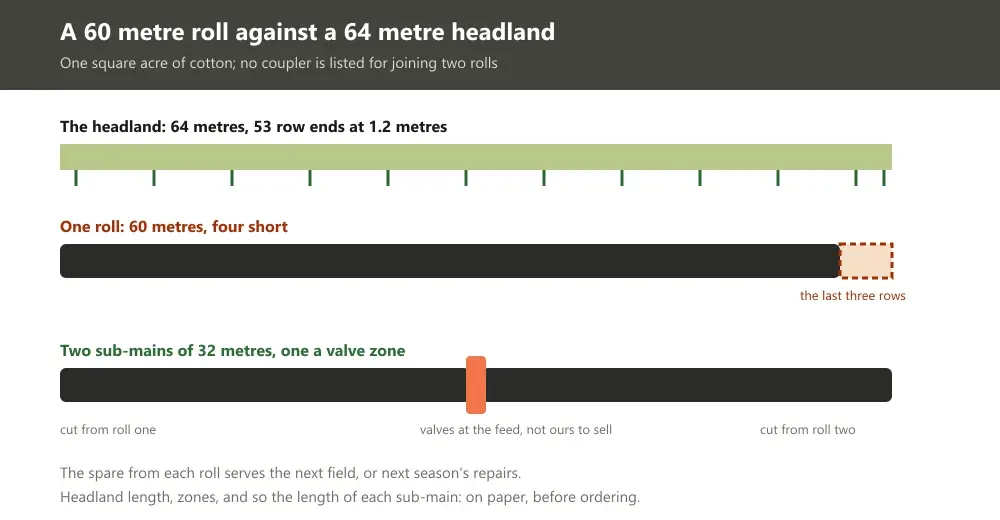
The roll is 60 metres and we list no coupler for joining two. A square acre's headland is 64 metres, four more than a roll, so the order that looks obvious, one roll for one acre, stops short of the last three rows.
The cleaner plan is the one the pump already asks for. A cotton acre is watered in blocks, because no farm bore runs every row at once, and each block is a valve zone; give each zone or pair of zones its own shorter sub-main, cut from the roll, and nothing needs joining. Two sub-mains of 32 metres serve the 64 metre headland from two rolls, with the rest of each roll kept for the next field or the next season's repairs.
Each sub-main still has to meet the supply hose at its feed end. Ask us how that end is made before ordering: no end fitting or coupler for the tube is confirmed on the listing.
Work it out on paper before ordering: the headland's length, the number of zones, and so the length of each sub-main. A plan that needs one line longer than 60 metres means a join, and that is something to settle with us before the roll ships, not at the field end of a tube that stopped short.
The second mistake: the holes are the row spacing
Every takeoff sits in a hole punched for it, and a hole cannot be moved. A tube punched this June for rows at 1.2 metres has 53 holes at 1.2 metres for the rest of its life. Sow at 0.9 metres next year and the holes fall between the rows; we list no plugs for the old holes and no dedicated punch, so ask when ordering and bring the takeoff you will fit.
So the row spacing is decided for the tube, not for the season. Fix it before the first hole is punched, mark the tube's field end and pump end so it goes back the same way round, and peg the first hole against the first row when it is relaid. Growers who change spacing with the variety or the seed drill should say so when they buy, because a second tube for the second spacing is cheaper than a headland of weeping holes.
The other habits that shorten a tube are the same on any crop, and cotton's calendar makes them easy to forget.
- One clean hole a row, never widened: a tight hole is what seals.
- Drain it before moving it; a charged 75 mm roll holds about a quarter of a tonne of water.
- Clear stones and last year's stalks from the headland before it goes down.
- Keep carts and bullocks off it while it is charged; cross it drained, or lift it.
- Open the far end and flush at the start of the season and after any repair upstream.
- After picking: drain, roll loosely, [store off the ground in shade](/blog/making-your-pipe-last), away from the shed's rats.
Buying it for your field
Three numbers settle the order: the headland's length in metres, the number of rows it serves at the spacing you will keep, and how the field is cut into zones. The cotton crop page keeps the agronomy beside the parts, and the system estimator counts the laterals, takeoffs and end caps; the sub-main itself is sized from your measurements, not from a form.
The width guidance here is a working rule, not a pressure calculation for your pump. For a large pump, a long headland or a field that is not a rectangle, send us the headland's length, the row spacing, the zones and what the bore yields and we will say which width and how many rolls before anything ships.
Keep reading
Drip irrigation cost for five acres of cotton, itemised
Drip irrigation cost for five acres of cotton is ₹1,36,551 at MRP for the parts we sell, about ₹27,310 an acre. The bill, and three choices that move it.
GuidesDrip irrigation layout for two acres of cotton: 142 rows
A drip irrigation layout for two acres of cotton at 90 cm rows: 142 laterals of 63 m, twenty coils, one hose along the head, and blocks the bore can run.
GuidesDrip irrigation layout for one acre of cotton at 90 cm rows
A drip irrigation layout for one acre of cotton at 90 cm rows, counted: 71 laterals, nine coils, the head, the blocks your bore can run, and a bill of ₹35,919.