Drip irrigation layout for one acre of cotton at 90 cm rows
A drip irrigation layout for one acre of cotton at 90 cm rows, counted: 71 laterals, nine coils, the head, the blocks your bore can run, and a bill of ₹35,919.
10 November 2026 · 3 min read · REDYPLAST
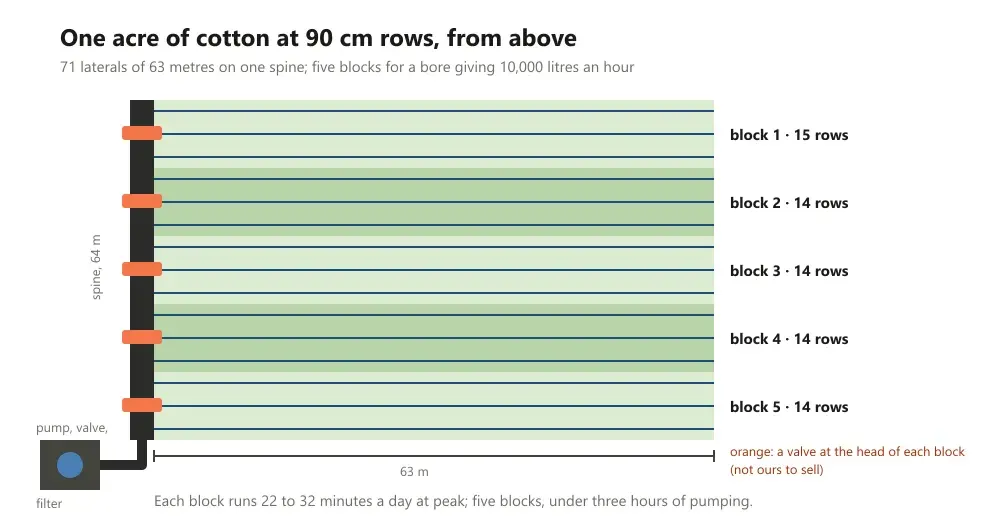
A drip irrigation layout for one acre of cotton at 90 cm rows is 71 laterals of 63 metres on one spine, 4,473 metres of line in all, with the rows cut into blocks the bore can run one at a time. The parts we sell for it come to ₹35,919 at MRP, tax inside.
This is the drip irrigation layout for one acre of cotton worked as one sheet: the assumptions, the lateral and its dripper, the spine and head, the pump's duty, and the bill at the end. Every count can be redone for your own field, and the last section says which numbers move when it differs.
What the sheet assumes
A square acre, 64 metres by 63, on a workable slope. Cotton sown at 0.9 metres between rows, the rows running the 63 metre way. Across 64 metres that is 71 rows, so 71 laterals of 63 metres: 4,473 metres of drip line. The pump stands at a corner and the spine runs along the 64 metre end.
Row spacing is the assumption that matters. The same acre at 1.2 metres is 53 laterals and 3,339 metres, which is the layout behind the published one-acre bill; at 0.9 it is a third more pipe. The cotton crop page says to measure the rows you actually plant before ordering.
The lateral and its dripper
What is left to choose is the wall. Cotton stands from June to the last picking and is walked through all season, so this sheet uses the 0.4 mm wall, rated 1 to 3.5 kg/cm², on 500 metre coils at ₹3,366. Nine coils are 4,500 metres for ₹30,294, with 27 metres spare.
Twenty-seven metres is no margin. If your rows run a metre longer than 63, or the first day costs a few cuts, the tenth coil is the insurance; measure before deciding.
The lateral is 16 mm inline pipe from the drip range, and the emitter question is already settled by the listing: every line carries a 4 litre an hour dripper every 40 cm. That puts a dripper within a hand of any plant sown at 30 to 45 cm along the row, and it gives 10 litres an hour from every metre of line, which is the number the pump section needs.
Spine, head and the filter
The filter is the part this sheet cannot price, because we do not stock filters, and the system needs one: a screen or disc filter sized to the bore's flow, with a sand filter ahead of it on tank or canal water. The block valves in the next section are not ours either.
One 3 inch LDPE coil, 15 kg and 90 metres at ₹2,160, runs the 64 metre end with the stub to the pump. Each lateral joins it through a ₹6 takeoff and ends in a ₹6 cap: 71 of each, counted in pieces, not boxes.
At the head sit the 2 inch ball-type non-return valve at ₹1,440, which stops the spine draining back down the bore at every shutdown, the 2 inch steel-to-plastic connector at ₹558, and a ₹495 tin of solvent cement for the joints.
Pump duty: rows at once, and hours a day
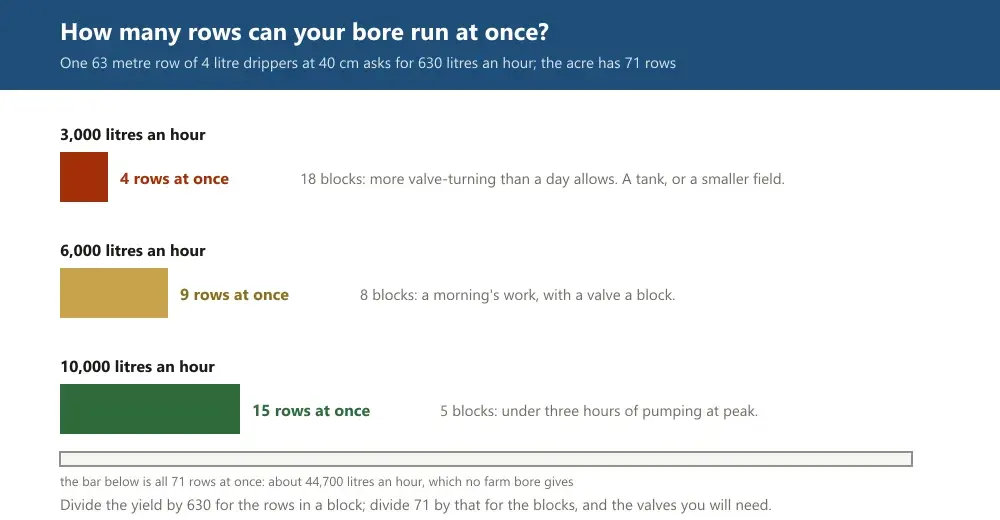
All 71 rows running together would ask for about 44,700 litres an hour, and no farm bore gives that, so the acre is watered in blocks. Each row needs 630 litres an hour.
Time follows from the same figures. On 90 cm rows the line applies about 11 mm an hour, so a block runs 22 to 32 minutes for the day's 4 to 6 mm. The pump's day is the litres divided by the yield: under three hours on the 10,000 litre bore at peak, and six to nine hours on the 3,000.
Cotton at full cover uses 4 to 6 mm a day through its September to November peak, which on one acre is about 16,000 to 24,000 litres at the root, or 18,000 to 27,000 litres from the pump once drip's losses are allowed for. The water requirement calculator reworks that for your acreage.
A bore giving 10,000 litres an hour runs 15 rows at once, which is five blocks; one giving 6,000 runs nine rows, eight blocks; one giving 3,000 runs four rows, and eighteen blocks is more valve-turning than a day allows, so a small bore wants a storage tank or a smaller field. The borewell guide works that decision.
The bill of materials
Every price is MRP for one piece or one coil, tax included.
Outside the column: the filter, the block valves, the pump and its cable, trenching, labour and freight.
- Drip lateral, 16 mm inline, 0.4 mm wall: 9 coils of 500 m at ₹3,366, ₹30,294.
- Poly takeoff, 16 mm: 71 at ₹6, ₹426.
- Poly end cap, 16 mm: 71 at ₹6, ₹426.
- Poly joiner, 16 mm: 20 at ₹6, ₹120.
- LDPE spine, 3 inch, 15 kg coil of 90 m: ₹2,160.
- Non-return valve, CI 2 inch: ₹1,440.
- Steel-to-plastic connector, 2 inch: ₹558.
- Solvent cement, 250 ml tin: ₹495.
- Total: ₹35,919.
Which numbers move when your field does
The wall moves the bill most. The 0.2 mm lateral comes on 1,000 metre coils at ₹3,960; five coils cover this acre for ₹19,800 and bring the total to ₹25,425. On a crop that stands this long it is a bet on buying once, and the cotton conversion guide sets out when it is still the right one.
The planting moves it next. Paired rows, two lines of cotton 45 cm apart around one lateral with 1.8 metres between pairs, need 36 laterals in place of 71: five coils, and a bill of ₹22,035. That is decided at sowing, and it works only where the soil spreads water far enough to reach both rows, which the soil guides for black soil and red loam settle.
The bore moves the layout without touching the bill: it sets the blocks, and with them the valves you buy elsewhere. The 4 to 6 mm a day is a published range, not a reading from your field, and this sheet is a working plan for counting pipe, not a pressure design. For that, send us the field's two sides, the row spacing and what the bore yields, or put your own numbers through the system estimator.
Where these numbers come from
- FAO Irrigation and Drainage Paper 56 (opens in a new tab)
The reference method for crop evapotranspiration and crop coefficients that daily water figures derive from.
- ICAR (opens in a new tab)
Indian Council of Agricultural Research — crop agronomy and regional package-of-practices.
- TNAU Agritech Portal (opens in a new tab)
Crop-wise spacing, water requirement and drip layout references for southern India.
Keep reading
Drip emitter spacing for cotton on alluvial soil: pairs on ridges
Drip emitter spacing for cotton on alluvial soil lets a pair of rows share a lateral on a ridge, as the bulb is wide. The pair, the minutes, the wet-feet rule.
GuidesDrip emitter spacing for cotton on red loam: the dry inter-row
Drip emitter spacing for cotton on red loam keeps the water in a band under the plant line and the inter-row dry. The band, the minutes, the monsoon break.
GuidesDrip irrigation with hard water for cotton: what scale does
Drip irrigation with hard water for cotton loses the far end by flowering, as chalk forms where water dries. What the filter cannot stop, and the flushing.