Drip irrigation layout for two acres of cotton: 142 rows
A drip irrigation layout for two acres of cotton at 90 cm rows: 142 laterals of 63 m, twenty coils, one hose along the head, and blocks the bore can run.
20 November 2026 · 4 min read · REDYPLAST
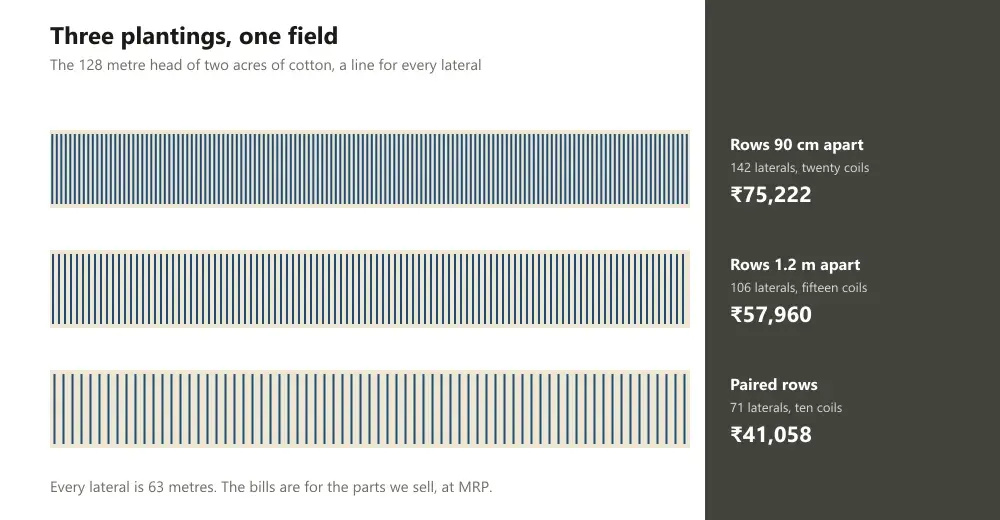
A drip irrigation layout for two acres of cotton at 90 cm rows is 142 laterals of 63 metres off one 3 inch hose, watered a block at a time. At MRP the parts we sell for it cost ₹75,222 with tax inside.
That is the closest planting and the dearest. The same drip irrigation layout for two acres of cotton costs ₹57,960 at 1.2 metre rows and ₹41,058 in paired rows, so the largest decision on this sheet is taken at sowing. The one acre sheet works this planting on half the ground.
The field, and the three plantings
Take the two acres as one field, 128 metres along the head and 63 metres deep, with the bore at a corner. The hose lies along the head and every row runs away from it. A field that is long and narrow instead puts the hose across its middle and feeds each row both ways, for the same number of laterals.
What changes the number is the planting.
Pairing halves the pipe, and the one acre sheet gives the condition: it works only where the soil spreads water far enough to reach both rows. The black soil guide and the red loam guide settle that. This sheet works the 90 cm case.
- Rows 90 cm apart, a lateral to each: 142 laterals, 8,946 metres.
- Rows 1.2 metres apart: 106 laterals, 6,678 metres.
- Paired rows, two lines 45 cm apart around one lateral with 1.8 metres between pairs: 71 laterals, 4,473 metres.
The lateral: twenty coils, not eighteen
Eighteen coils are 9,000 metres, 54 more than the rows need, but they cut badly. Each coil yields seven 63 metre laterals and an offcut of about 59 metres, so eighteen coils make 126 whole laterals and leave sixteen rows to be pieced together. Twenty coils make 140 whole ones and two pieced.
This sheet bills twenty. The one acre sheet bills nine and calls the tenth coil the insurance; twenty for two acres is that insurance, bought.
The pipe is the 0.4 mm flat lateral, 16 mm, its drippers 4 litres an hour at 40 cm, sold as 500 metre coils at ₹3,366. Cotton stands from June to the last picking and is walked through all season, which is why the one acre sheet chooses this wall over thin tape.
Drip irrigation layout for two acres of cotton: blocks and hours
A 63 metre lateral takes roughly 630 litres an hour. All 142 would want about 89,500, far beyond a farm bore, so the rows are opened in blocks. Cotton at full cover uses 4 to 6 mm of water a day, which on two acres is 36,000 to 54,000 litres from the pump.
At this spacing the line puts down about 11 mm an hour. Allowing for drip's losses, each block is open for 24 to 36 minutes; the one acre sheet's 22 to 32 is the same watering before those losses are added. How many blocks there are is the bore's decision:
Something has to open and shut each block. A hand-turned tap on every takeoff does it with the one hose. A valve for each block does it with less walking, but then a main has to run beside the head and the hose is cut into a closed piece per block, about 120 metres of extra hose, which means a second 150 metre coil. Taps and block valves are both bought elsewhere; we stock neither.
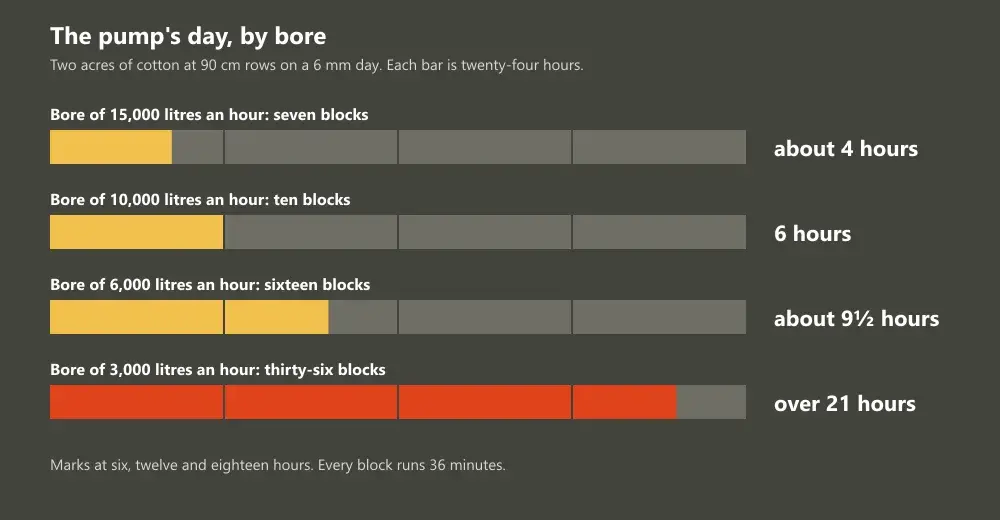
The borewell guide works its example on six pumping hours. Against that, only the 10,000 litre bore finishes a 6 mm day; the 6,000 litre bore needs nine and a half, so it suits this planting only where the supply allows a long day. The one acre sheet already calls eighteen blocks on a 3,000 litre bore more valve-turning than a day allows, and thirty-six settles it: on that bore, two acres at 90 cm want a storage tank or a smaller planting.
- 15,000 litres an hour opens 23 rows: seven blocks, about four hours on a 6 mm day.
- 10,000 opens 15 rows: ten blocks, six hours.
- 6,000 opens nine rows: sixteen blocks, about nine and a half hours.
- 3,000 opens four rows: thirty-six blocks, over twenty-one hours.
The bill of materials
All prices are MRP and include tax. The ₹6 fittings have a minimum order of 100 pieces; the takeoffs and end caps here are past it, at 142 each.
Per acre that is about ₹37,610. Two of the published one acre bills would be ₹71,838; this one is higher because it buys the two extra coils and a full hundred joiners, though it leaves the ₹495 tin of cement with the pump-stand parts. On eighteen coils it is ₹68,490.
The other plantings follow from their coils: fifteen at 1.2 metre rows, ₹57,960 in all, and ten in paired rows, ₹41,058; with only 71 laterals, the takeoffs and end caps are bought at the minimum of 100 each. Expect a different figure from the system estimator, which lays cotton at 1.2 metres on a square field and prices round inline pipe.
- Lateral, 0.4 mm, 500 m coils: 20 at ₹3,366, ₹67,320.
- [Takeoffs](/products/poly-takeup-virgin-16-mm), 16 mm: 142 at ₹6, ₹852.
- [End caps](/products/poly-end-cap-virgin-16-mm), 16 mm: 142 at ₹6, ₹852.
- Joiners, 16 mm, for the pieced rows and for mends: the minimum 100, ₹600.
- LDPE hose, 3 inch, one 150 m coil, covering the 128 m head and the run to the pump: ₹3,600.
- [Non-return valve](/products/socketed-nrv-ball-type-ci-2), 2 inch: ₹1,440.
- Steel-to-plastic connector, 2 inch: ₹558.
- Total: ₹75,222.
What cotton adds: the first flush and the last lift
The cotton drip guide describes the failure particular to this crop. The system usually goes in dry, weeks before the first real irrigation, and the installing puts soil inside new pipe. Before that first irrigation, open every lateral's end, run the pump until each line flushes clear, then cap. On two acres that is 142 ends. Do a few rows at a time, fewer than a running block, because an open end passes far more water than its drippers do.
After the last picking the laterals are lifted. Our advice is to flush them once more first, roll them without sharp folds and store them in shade off the ground.
Outside the total
A working field needs more than this list. First is the filter: the one acre sheet names a screen or disc filter sized to the bore's flow, with a sand filter ahead of it on tank or canal water, and we do not stock filters. The taps or block valves come next, with their tees, and a second 150 metre coil of hose at ₹3,600 if the blocks are valved.
At the pump, something must join a 2 inch delivery to a 3 inch hose. We list no reducer for that, so raise it with us before the hose is sent. The bends, nipples and solvent cement of the pump stand are priced in the pump-to-lateral guide. The pump itself, trenching, labour and freight complete the list.
Before the order
Measure the rows as you will sow them, because 90 cm against 1.2 metres is a third more pipe. The cotton crop page has the crop's side.
The water range is worked from published crop coefficients for a full canopy and is not a reading from your field. Nor is this a pressure design; it is a count of parts. Tell us the field's two sides, the spacing you will sow and what the bore gives and we will redo the sheet for it. The drip range has the lateral and fittings, and the LDPE range the hose.
Where these numbers come from
- FAO Irrigation and Drainage Paper 56 (opens in a new tab)
The reference method for crop evapotranspiration and crop coefficients that daily water figures derive from.
- FAO Land and Water (opens in a new tab)
Irrigation water management guidance, including scheduling and application efficiency.
- ICAR (opens in a new tab)
Indian Council of Agricultural Research — crop agronomy and regional package-of-practices.
- TNAU Agritech Portal (opens in a new tab)
Crop-wise spacing, water requirement and drip layout references for southern India.
Keep reading
Drip irrigation layout for one acre of cotton at 90 cm rows
A drip irrigation layout for one acre of cotton at 90 cm rows, counted: 71 laterals, nine coils, the head, the blocks your bore can run, and a bill of ₹35,919.
GuidesDrip irrigation layout for one acre of sugarcane, worked
A drip irrigation layout for one acre of sugarcane at 1.2 metre rows, counted: 53 laterals, seven coils, the head, the June pump hours and a bill of ₹36,963.
GuidesDrip laterals lifting off the ground: heat, wind or the crop
Drip laterals lifting off the ground are usually growing in the afternoon heat, blowing about empty, or lifted by the crop. Four causes, a test for each.