Lapeta pipe for cotton: sizes, grades and pitfalls
Choosing a lapeta pipe for cotton — the sizes and budget grades that fit two protective waterings a season, with prices and storage pitfalls.
4 October 2026 · 4 min read · REDYPLAST
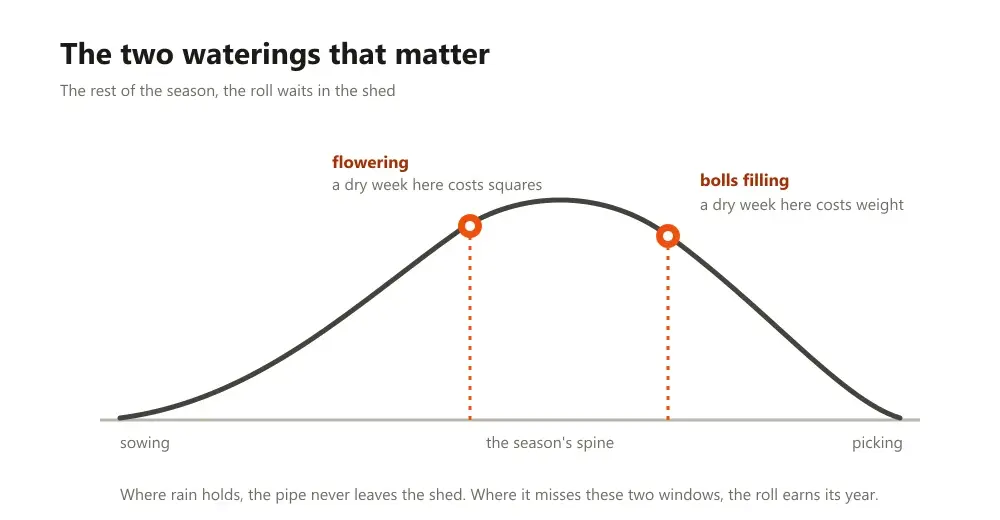
A lapeta pipe for cotton is bought for a different life than the same roll on paddy or cane: most cotton here grows on rain, and the pipe exists for the two protective waterings that rescue a season when the rain misses its cue. This guide covers the sizes and grades that fit that occasional duty, what the rolls cost, and the pitfalls particular to a pipe that spends ten months of the year waiting.
The two waterings that pay for the roll
Cotton forgives a dry week at most stages and punishes it at two: flowering, and the weeks the bolls fill. Those are the moisture windows the extension advice marks as critical, and a single protective watering inside each is the standard rescue where a bore or a shared pump exists.
The catch is that an occasional watering wastes more of itself than a regular one. An earthen channel used weekly stays settled; a channel cut twice a year is dry, cracked and thirsty, and drinks the first stretch of every rescue turn into its own bed. A flat roll unrolled from the delivery pipe to the furrow head delivers the first watering, not the third.
What one rescue turn can move
Be honest about the scale before buying anything. Cotton in its boll weeks draws 4 to 6 mm a day — on an acre, that is sixteen to twenty-four thousand litres of demand every single day, and few bores rescue all of it. What a protective watering buys is days: enough moisture in the root zone to carry the crop across the gap until the rain returns.
That is why the turn's discipline matters more than its volume. Water alternate furrows and the same pumping hours reach twice the rows; put the roll's outlet at the head of each furrow in turn instead of flooding from one corner, and the water goes where the roots are instead of where the slope says. The water requirement calculator turns your own bore and acres into honest hours before the dry week arrives.
Which lapeta pipe for cotton: buy for the duty
A paddy roll works in weekly turns and a cane roll serves an eighteen-month crop. A cotton roll works a handful of days a year — and the wall, not the colour, decides whether it survives the waiting:
The thin 0.30 mm walls carry the weight guide's own warning — they puncture more easily and take storage worse — so their saving is real only for a roll that lives gently. Three inch matches most cotton borewells; the grade-by-grade walk-through in the paddy guide covers the whole family if your case is not here.
- **Plain LDPE black, 3 inch — 0.60 mm wall, ₹24 a metre.** The thickest wall in the 3 inch family, and the one the catalogue itself pitches for temporary duty. For a roll that waits ten months, gets lent out and crosses stubble on the way home, this is the pick.
- **Matty yellow, 3 inch — 0.30 mm wall, about ₹26 a metre.** Half the wall at a slightly dearer rate; buy it for the light weight and metre marking its listing touts, not for savings.
- **Premium black, 3 inch — 0.30 mm wall, ₹22 a metre.** The cheapest rate on the list, aimed by its own listing at high-flow delivery work.
- **For the shared big pump** that waters several farms' cotton in the same dry fortnight: 4 inch matty yellow is the budget bore, and 4 inch tarpaulin buys tear resistance for the roll that tours farms.
Rolls and prices
The smallest roll on this list is ₹720. Set that against what the dry fortnight it answers does to a cotton season, and the roll is the cheapest insurance on the farm — provided it still holds water when the fortnight arrives, which is what the next section is about.
From the LDPE and lapeta listings, MRP with tax inside:
- Plain LDPE 3 inch: six lengths from ₹720 for 30 m to ₹4,320 for 180 m; ₹2,160 buys the 90 m roll.
- Matty yellow 3 inch: ₹1,170 for 45 m, ₹2,340 for 90 m, ₹3,150 for 120 m.
- Premium black 3 inch: ₹1,980 for 90 m, ₹2,970 for 135 m.
- Matty yellow 4 inch: ₹3,582 for 120 m. Tarpaulin 4 inch: ₹6,336 for the same length.
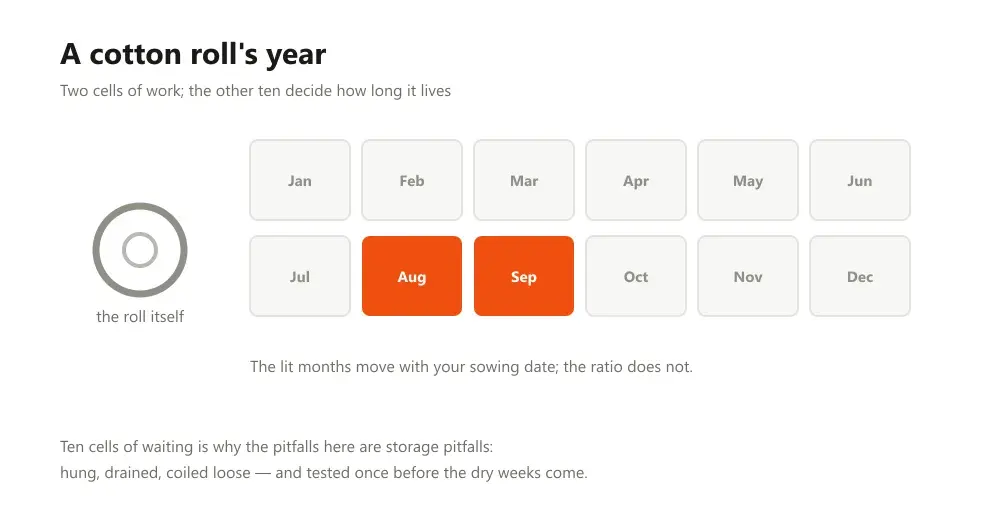
Pitfalls for a roll that mostly waits
Paddy wears rolls out in the field. Cotton kills them in the shed:
- **The year in the heap.** Ten months of storage for every few days of use means storage habits, not field habits, decide the roll's life. Drained, coiled loose, flat on planks in shade — [the pipe-life guide](/blog/making-your-pipe-last) is short and this is its ideal reader.
- **Creases that set.** A roll folded tight in the same place all year whitens and weakens along those folds, and opens with cracks exactly when the rescue week needs it whole.
- **Rats in the quiet.** A shed nobody disturbs for a season is a shed rodents own. Keep the coil off the floor on planks; check it monthly, not on watering day.
- **The lending circuit.** The roll that rescues one farm's cotton usually rescues three — and comes home having been dragged over every stubble field on the way. Lend it with its one rule attached: carry, never drag.
- **The test nobody runs.** Unroll it and fill it once in June or July, before the crop can need it. A pinhole found in June is a patch; the same pinhole found mid-rescue is a lost day in the exact week the crop cannot spare one.
When the roll should retire
The roll does not become waste in that future either; it keeps filling tanks and watering the odd corner a system never reaches.
If the bore waters the cotton every single year — not just the rescue years — the arithmetic has already flipped, and the drip case for cotton is worth the read: no field crop pays a system back faster. The two purchases are not rivals so much as answers to different rain: the ₹720 roll insures the year the monsoon stumbles, while the full cotton drip acre runs about ₹29,133 in parts at 1.2 metre rows and earns it back by watering every year, dry or not.
Either way, size the decision on your own numbers: the cotton crop page keeps the agronomy beside the parts, and for a shared-pump group buying one big roll between farms, send the details and we will size the bore and length against the pump that will actually push through it.
Where these numbers come from
- ICAR (opens in a new tab)
Indian Council of Agricultural Research — crop agronomy and regional package-of-practices.
- TNAU Agritech Portal (opens in a new tab)
Crop-wise spacing, water requirement and drip layout references for southern India.
Keep reading
Lapeta pipe for paddy: sizes, grades and pitfalls
Which lapeta pipe suits paddy — tarpaulin or LDPE, 3 to 6 inch — with real roll prices and the pitfalls that kill a roll in its first season.
GuidesLapeta pipe for sugarcane: sizes, grades and pitfalls
Choosing lapeta pipe for sugarcane — which bores fit furrow watering, what the rolls cost, and how one survives an 18-month crop and its ratoon.
GuidesDrip for cotton: when it pays, and the pitfalls
Drip for cotton pays back fastest of any field crop. When that's true, which lateral grades survive the season, and the pitfalls cotton buyers keep hitting.