Drip emitter spacing for orchard on sandy loam, by root depth
Drip emitter spacing for orchard on sandy loam depends on how deep the tree roots. Mango takes a few long runs on sand; citrus and guava take many short ones.
19 November 2026 · 4 min read · REDYPLAST
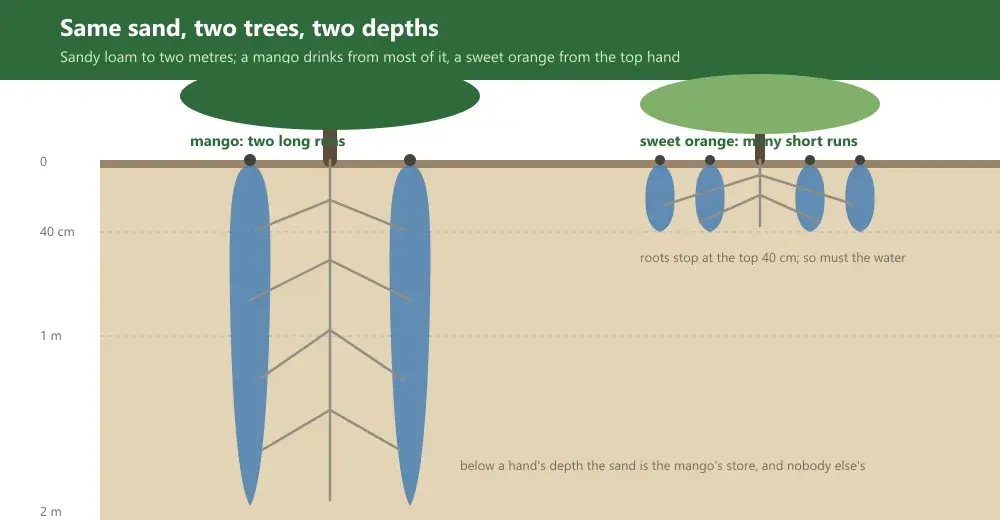
Drip emitter spacing for orchard on sandy loam starts the same for every tree, two columns at the sapling growing to a ring under the bearing canopy, because the wet column under a 4 litre dripper on this soil is 35 to 50 cm across and stays separate from its neighbour when the columns are set 60 to 90 cm apart.
Where drip emitter spacing for orchard on sandy loam parts company with itself is the run: a mango roots two metres into sand and can take its day's water in two long runs, while a sweet orange feeds from the top 40 cm and must have the same litres in many short ones.
Sandy loam carries orchards across the Nalgonda sweet orange belt and the lighter mango and guava ground of Rangareddy and Anantapur, often on the same farm. This guide covers the column, the two root habits, the litres, and the one-valve orchard.
The column, and the two root habits
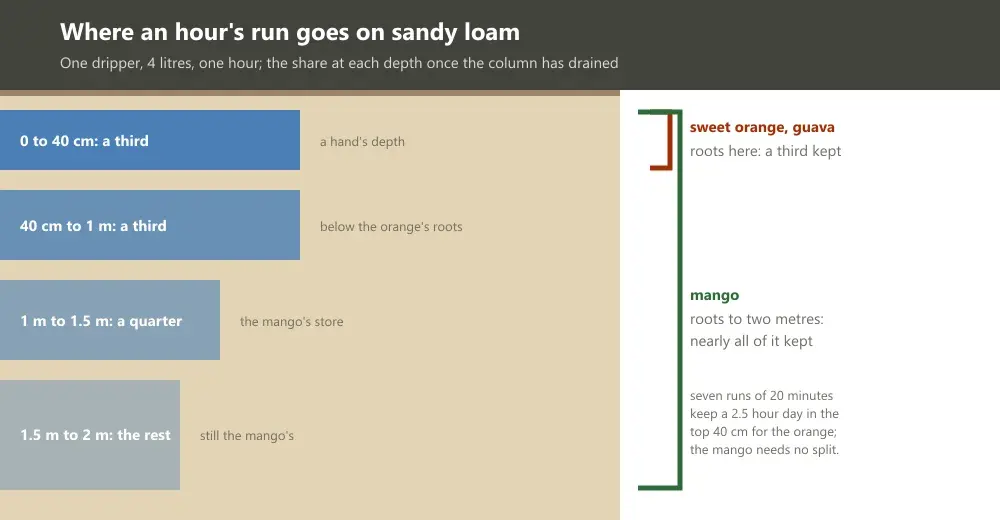
Under a dripper on sandy loam the wet zone is a column 35 to 50 cm across that goes straight down; what it keeps in the top 40 cm is about 20 minutes of a dripper's output, which is a few hours of a shallow-rooted tree's water; the rest of a long run is at a metre within the hour. Two columns 60 cm apart stay two columns.
A mango is built for sand. Its taproot and sinker roots follow water down a metre and a half or two, and the surplus that drains past a hand's depth is not lost to it; a long run on a bearing mango banks water where the tree will find it on a hot afternoon.
Citrus is not, and guava sits nearer to it than to the mango. Their feeding roots are mostly in the top 40 cm, and on sand that zone is a few hours' supply that empties by evening.
The garden and orchard crop page says build for the mature canopy; on sandy loam, build also for the depth the tree will drink from.
- Column: 35 to 50 cm across, deep, separate when set 60 to 90 cm apart.
- Store: a few hours in the top 40 cm; more below for the trees that can reach it.
- Mango: roots to two metres, so a long run is banked, not lost.
- Citrus and guava: feeding roots mostly near the surface, taken here as the top 40 cm, so a long run is lost after the first 20 minutes.
Drip emitter spacing for orchard on sandy loam, ring by ring
On sand every step is worth taking early, because a column that no root has reached is water to the subsoil.
The citrus ring on sand wants more columns than the mango ring under the same canopy, twelve to sixteen against eight to ten, because more drippers shorten a run without shortening the water.
The lateral runs along the tree row, one per row at the 3 to 5 metres the crop page plans for, though mango is often wider, and the columns on it multiply with the tree: two at 30 cm from the trunk in the first year, four at 60 to 80 cm by the third, six under the canopy edge by the fifth, and eight to twelve in a ring at the drip line of a bearing tree.
The plain online lateral with emitters from elsewhere pushed in where each column stands is the pattern the orchard drip guide leans to for trees, and the 40 cm inline pipe laid as a loop round each tree gives a tighter ring in which the columns merge, lengthened as the canopy grows. Separate columns 60 to 90 cm apart need the plain online lateral, with drippers bought elsewhere. Both pipes come from the drip range; we do not sell the drippers.
The litres for a bearing tree, by habit
Per bearing tree at 4 by 4 metres that is about 45 litres a day from the pump in a mild month and 140 in May.
A mango on ten columns, 40 litres an hour, takes May's 140 litres in three and a half hours, and on sand that goes in as two runs of about an hour and three quarters each; the second half of each run passes a hand's depth and is still in the mango's reach. In the mild months one run every second day is enough.
A sweet orange on fourteen columns, 56 litres an hour, takes the same 140 litres in two and a half hours, and on sand that must go in as seven or eight runs of about 20 minutes, because its roots stop at 40 cm and a column holds about 20 minutes of a dripper's output above that depth. The citrus is watered the way a vegetable is, every day, in parts.
Orchard trees on a closed canopy use 2.5 to 8 mm a day across the year, which on one acre is roughly 10,000 to 32,000 litres at the root, or about 11,000 to 36,000 litres from the pump once drip's losses are allowed for; the water requirement calculator gives the figure for your own acreage and treats the orchard as a full canopy, so a young planting needs less.
The one-valve orchard
The orchard that fails on sandy loam is the mixed one on a single valve: a block of mango and a block of mosambi on one main, watered together. Run it the mango's way, two long runs a day, and the citrus is dry by three in the afternoon and shedding fruit in June. Run it the citrus way and the mango's deep store is never filled, and the valve-turner is at it all day.
The fix is a valve per block and a schedule per block, which the orchard conversion guide prices as items from elsewhere, since we stock neither the valve nor the timer. A mulch of pruned wood and leaves under the citrus canopy holds the top 40 cm longer than anything the schedule can do, and on sand it is worth a run a day.
A blocked column on this soil shows within a day as one side of a canopy flagging; the blocked-line guide covers flushing, and the filter it depends on is not ours to sell.
- Mango watered in six short runs: the deep store never filled, a tree that wilts at noon in May.
- Citrus watered in two long runs: dry by three o'clock, fruit shed in June.
- The check: a trowel a hand deep under the canopy edge at noon; for citrus moist there is right, for mango moist at a forearm's depth is what matters.
The figures are a starting point
Only the 2.5 to 8 mm a day, on a full canopy, is a published range. The column widths, the root depths and the 20-minute hold are working rules, to be checked with the trowel test above, and the per-tree litres move with canopy size and age. Treat two runs on ten columns for a bearing mango, and seven or eight on fourteen for a bearing orange, as May's first schedule and let the trowel move it.
The same soil for a smaller crop is in the sandy-loam pomegranate guide, and the same trees on heavier ground in the red-loam orchard guide and the alluvial orchard guide. For the column count and the runs sized to your trees and bore, send us the tree spacing, the species, the planting years and the acreage and we will say how many columns each tree needs and how many runs each block must have.
Where these numbers come from
- FAO Irrigation and Drainage Paper 56 (opens in a new tab)
The reference method for crop evapotranspiration and crop coefficients that daily water figures derive from.
- ICAR (opens in a new tab)
Indian Council of Agricultural Research — crop agronomy and regional package-of-practices.
- TNAU Agritech Portal (opens in a new tab)
Crop-wise spacing, water requirement and drip layout references for southern India.
Keep reading
Drip emitter spacing for garden and orchard on red loam, by tree
Drip emitter spacing for garden and orchard on red loam grows with the tree, since each dripper wets its own column. The ring by age, the hours, the pockets.
GuidesDrip emitter spacing for garden and orchard on alluvial soil
Drip emitter spacing for garden and orchard on alluvial soil needs fewer columns per tree, as the bulbs merge into one patch. The patch, the hours, the mound.
GuidesDrip emitter spacing for pomegranate on sandy loam, in short runs
Drip emitter spacing for pomegranate on sandy loam is a ring of narrow columns that empty by evening. The ring per bush, the short runs, fertigation on sand.