Drip emitter spacing for pomegranate on sandy loam, in short runs
Drip emitter spacing for pomegranate on sandy loam is a ring of narrow columns that empty by evening. The ring per bush, the short runs, fertigation on sand.
13 November 2026 · 5 min read · REDYPLAST
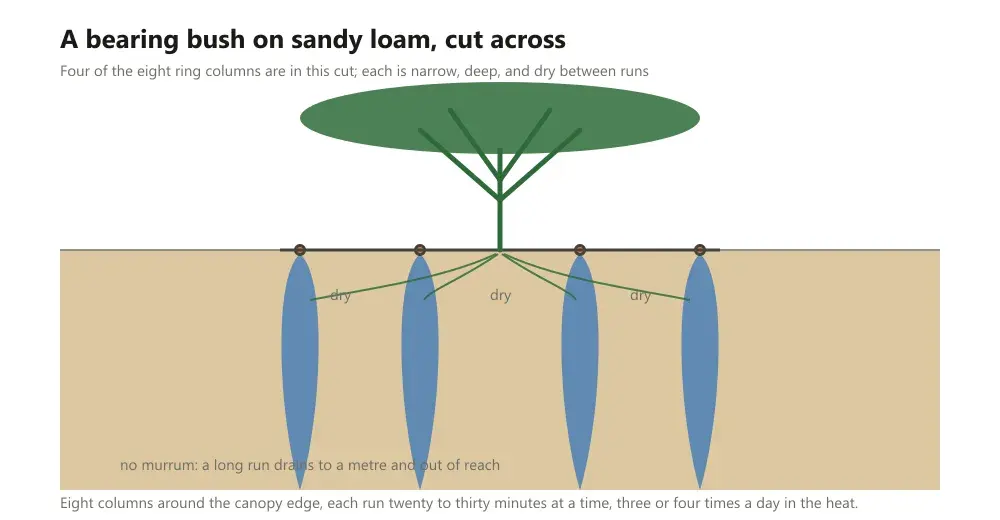
Drip emitter spacing for pomegranate on sandy loam is counted in columns around each bush, as it is on red soil, but the columns here are narrower, drain to depth faster, and are empty by evening, so the ring is built from more of them and run in short bursts rather than one long watering.
Drip emitter spacing for pomegranate on sandy loam therefore starts with the same two columns at a sapling and ends with eight around a bearing bush, each run for twenty minutes at a time, three or four times a day in the hot months.
Sandy loam carries a good part of the Anantapur and Ballari pomegranate belt, and holds water for no longer than a day. This guide covers the column on sand, the ring by age, the minutes per run from the calculator's full-cover figures, and the two things sand does that red loam does not: it leaches the fertigation, and it ends the bahar rest in days.
The column on sandy loam: narrow, deep, gone by evening
Under a 4 litre dripper on sandy loam the wet zone is a column 35 to 50 cm across that goes straight down; there is no murrum to stop it, so a long run sends water a metre deep and out of reach. The column holds about a day of a bush's water in the top half metre, and on a hot afternoon the surface of it is dry by four o'clock.
Two columns 60 cm apart stay two columns, and the sand between them is as dry as the alley.
A bearing pomegranate feeds from a circle a metre or more from the stem, so the ring must stand under the canopy edge with enough columns to deliver the day's water in runs the column can hold. The pomegranate drip guide calls steadiness fruit-grade insurance; on sand it comes from the number of runs, not their length.
- Column: 35 to 50 cm across, deep rather than wide, no merging at 60 cm.
- Holding: about a day in the root zone; a long run drains past it within the hour.
- Reach: about 20 cm each side of a dripper; the ring must sit where the roots are.
- Surface: dry by mid-afternoon in the hot months, so the last run is late.
Drip emitter spacing for pomegranate on sandy loam: the ring by age
The lateral runs along the row at the 3 to 4.5 metre spacing, and what stands on it at each bush grows with the bush. A sapling takes two columns 30 cm from the stem, on opposite sides. By the third year four at 50 to 60 cm.
A bearing bush takes eight in a ring at 60 to 90 cm from the stem, two more than the same bush on red loam, because the sand column is narrower and the day's water has to arrive through more of them in a short run.
The plain online lateral with emitters from elsewhere pushed in where each column should stand is the honest way to build a ring that grows; a loop of the 40 cm inline pipe around each bush gives a ring too, five columns per two metres of loop, lengthened as the canopy widens.
Both laterals are 16 mm from the drip range; the emitters for the online pattern are not ours to sell, and nothing goes between bushes on this soil, where a column with no roots over it is water sent to depth.
Minutes per run, not hours per day
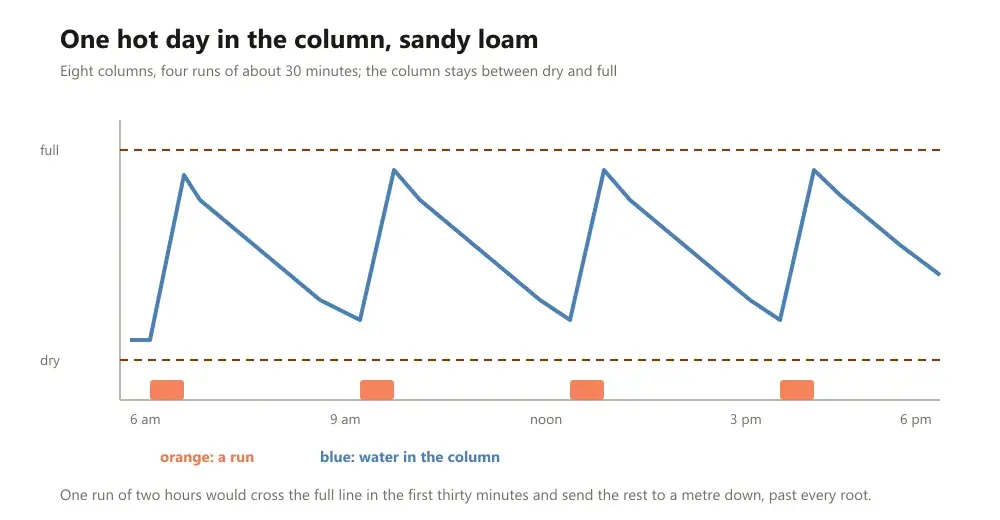
Eight columns give 32 litres an hour, so the hottest day is about two and a quarter hours of running and a mild one about an hour. On sandy loam none of it is given in one piece: a column holds roughly fifteen to twenty minutes of a dripper's output before the rest drains past the roots.
So the hot day's water goes in as four runs of 30 to 35 minutes spread from early morning to late afternoon, and the mild day as two or three of 20. On two columns the same bush would need nine hours, the sapling's ration left on a bearing bush, and the sand simply takes it.
The runs go in every day through the bearing months, because the store is a day; a skipped day shows as flagging leaves by the next afternoon and, weeks on, as fruit that cracks when the water returns.
Pomegranate at full cover uses 2.5 to 6 mm a day, which on one acre is roughly 10,000 to 24,000 litres at the root, or about 11,000 to 27,000 litres from the pump once drip's losses are allowed for; the water requirement calculator gives the figure for your own acreage. Per bush at 3.75 by 3 metres that is about 30 litres a day from the pump in a mild month and up to 75 in the hottest weeks.
Fertigation on sand, and the bahar
Fertigation is where sand charges for its drainage. Nitrogen and potash injected at the start of a long run go down with the water that drains past the roots, and a grower who fertigates generously on sandy loam and runs for an hour feeds the subsoil.
The dose goes into the middle of a short run, with plain water before and after, and the pump off while the column still holds it; the venturi or dosing unit that injects it is not something we stock, and the pattern is the same whichever unit you buy.
The bahar rest is the easy part on this soil and the dangerous part comes after. Close the valve and the columns are dry in days, sooner than on red loam; the bush rests on time.
The restart is a ramp of short runs lengthening over two or three weeks, never a full day's water on day one into dry sand, which swells the fruit faster than the skin stretches. A valve per block, from elsewhere, is what lets a rested block and a bearing block share one pump. The pomegranate conversion guide prices the valves as items from elsewhere.
A blocked column shows on sand within a day as one side of a bush flagging; the blocked-line guide covers flushing, and the filter it depends on is not something we stock.
- Two columns on a bearing bush: nine hours the sand cannot hold, small fruit, split skins after rain.
- One long run a day: the second half to depth, the fertigation with it.
- A full-day restart after the rest: cracked fruit in the first set.
- The check: a trowel at a hand's depth under the canopy edge the morning after the last run; moist is right, dry is a run too few, wet at depth and dry on top is a run too long.
The figures are a starting point
The 2.5 to 6 mm a day and the column widths are published agronomic ranges, not measurements from your orchard, and sandy loams run from nearly sand to nearly loam within one village; the sandier the phase, the more runs and the shorter each one. Treat four runs of half an hour on eight columns as the hottest-month schedule for a bearing bush and let the trowel correct it.
The same crop on red soil is worked in the red-loam pomegranate guide, and the same soil under beds in the sandy-loam vegetables guide.
If you want the ring and the runs sized to your orchard's age and bore, send us the bush spacing, the planting year, the acreage and the bore yield and we will say how many columns each bush needs now and how many runs a day the pump must give.
Where these numbers come from
- FAO Irrigation and Drainage Paper 56 (opens in a new tab)
The reference method for crop evapotranspiration and crop coefficients that daily water figures derive from.
- ICAR (opens in a new tab)
Indian Council of Agricultural Research — crop agronomy and regional package-of-practices.
- TNAU Agritech Portal (opens in a new tab)
Crop-wise spacing, water requirement and drip layout references for southern India.
Keep reading
Drip emitter spacing for pomegranate on red loam, per bush
Drip emitter spacing for pomegranate on red loam is counted per bush, since each dripper wets its own column. The count by age, the hours a day, and the bahar.
GuidesDrip emitter spacing for vegetables on sandy loam, bed by bed
Drip emitter spacing for vegetables on sandy loam decides whether one lateral can serve a two-row bed. The beds that work, the minutes a day, the leaching trap.
GuidesDrip emitter spacing for garden and orchard on red loam, by tree
Drip emitter spacing for garden and orchard on red loam grows with the tree, since each dripper wets its own column. The ring by age, the hours, the pockets.