Drip for orchard rows: sizes, grades and the pitfalls
Orchard trees take the least drip pipe of any planting — if the system is built for the mature canopy. Sizes, the online-emitter choice, and two pitfalls.
13 September 2026 · 3 min read · REDYPLAST
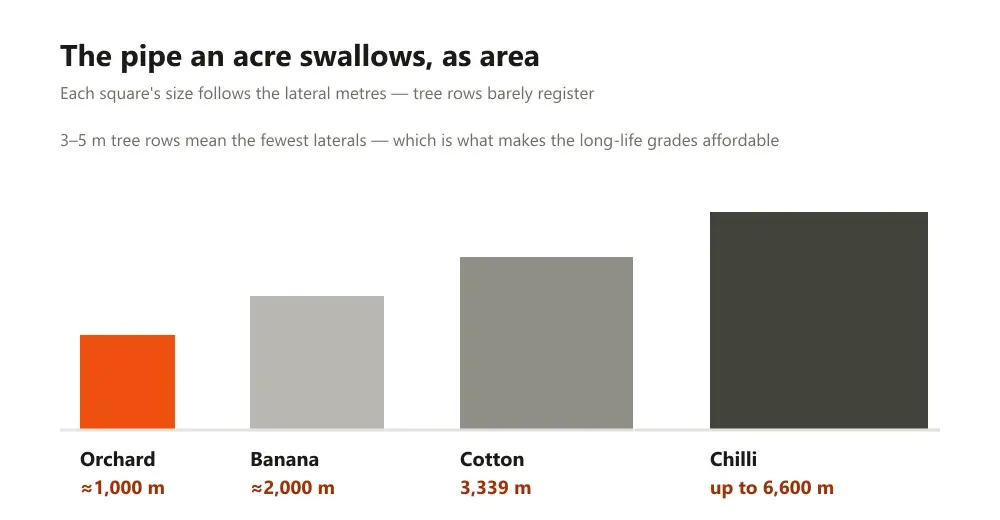
Planning drip for orchard rows starts from a happy fact: trees at 3 to 5 metre spacing need less lateral than any other planting — somewhere between 800 and 1,300 metres per acre, against the several thousand a row crop swallows. The unhappy fact follows immediately: an orchard stands for decades, and most orchard drip is bought as if for one season.
This guide covers the metres, the grades that suit a permanent planting, why tree crops lean on online emitters, and the two mistakes that surface years after the bill was paid.
The smallest pipe bill in the catalogue
That small denominator changes which grade is affordable. The heavy-wall round lateral at ₹18 a metre — an extravagance across a vegetable field — costs about ₹18,000 for the whole orchard acre, bought once for a planting that will outlive the receipt. The standard round inline at ₹8.96 a metre is the budget line; either way, orchard economics point at pipe that stays down for years, not tape that lifts.
Run the row arithmetic on a square acre, roughly 63 metres a side. At 4 metre spacing that is about 16 tree rows — call it 1,000 metres of lateral. Compare the 3,339 metres one acre of cotton lays, and the orchard's structural advantage is plain: a quarter to a third of the pipe for the same ground.
What they point away from is the ₹3.96 thin tape. Under a permanent planting it is the wrong life-span entirely — the pipe-longevity rules apply with decades in view, and a buried or mulch-shaded heavy line is the version of drip that quietly lasts.
Water the trunk, not the interval
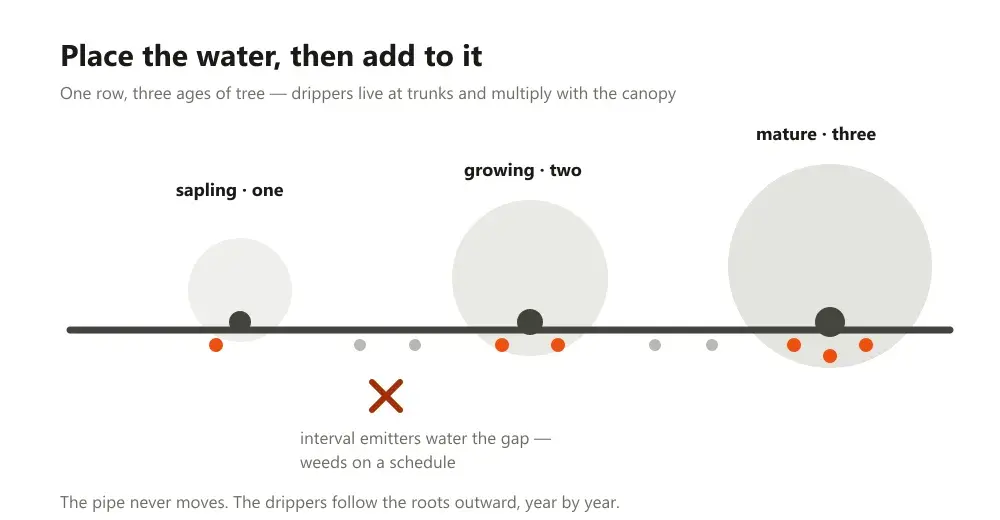
Here is the decision unique to tree crops. Inline laterals carry emitters at a fixed interval — made for row crops where plants sit shoulder to shoulder. Put that logic under trees 4 metres apart and most drops land on the empty ground between trunks, watering weeds on a schedule.
Tree plantings instead run plain-walled lateral with emitters placed at each tree — the online pattern — so the water lands on root zones and nowhere else. Our drip range carries the online-style Ultraflow lateral (₹7,200 for a 400 metre roll) alongside the inline coils; the loose punch-in drippers themselves are not something we stock, so plan that line of the order separately and honestly.
Build for the canopy the sapling will become
A sapling drinks at a bucket's scale; the tree it becomes drinks at a different one, from a root zone metres wide. Orchard drip is therefore never finished at installation — drippers get added and moved outward as canopies widen, which is exactly why the online pattern suits trees: the pipe stays, the emitters multiply.
Plan for that growth on day one. Leave slack in the lateral runs, keep a stock of ₹6 joiners for extensions and repairs, and expect some mature rows to justify a second line down the row in later years. None of this is expensive; all of it is cheap only if it was expected.
Valve the ages apart while you are at it. A block planted in instalments holds five-year trees and five-month trees at once, and they cannot share a run time — one drowns while the other sips. A ball valve at the head of each planting-year's rows lets every age drink on its own clock from the same main.
Mulched basins — standard orchard practice — double drip's value and hide its faults in the same stroke. Under mulch, almost nothing evaporates; under mulch, a blocked dripper or a chewed line also stays invisible until the tree shows it. Lift the mulch at a few trees per row once a month while the pump runs, and let the wet rings tell you the truth.
The mainline pitfall that surfaces in year three
Orchards get planted in instalments — a few rows this year, more as money and saplings allow. The laterals extend row by row beautifully. The mainline does not: it was trenched and sized on day one, and every future row must breathe through it.
So size the main for the full planting map, not the first instalment — the sizing guide covers matching bore to pump and area, and the step from a smaller to a larger main costs little while the trench is open. Undersize it and year three's new rows arrive to a system that cannot feed them; the repair is a second trench through an established orchard, at exactly the price nobody budgeted.
The same forward view applies to water: a young block sips, a mature one does not, and the water requirement calculator will show the gap between the orchard you have and the one you are growing toward. Check the bore can carry the destination, or plan the blocks and valves for watering in shifts from the start.
The short version, and the next step
Our garden and orchard crop page holds the profile beside the products. If your planting map is drawn — even roughly — send it across and we will size the main for the orchard you intend, not just the rows you are planting this year.
- 800–1,300 metres of lateral per acre — the least in farming — so buy the long-life grade the small bill finally affords
- Emitters at trunks, not intervals: online-pattern lateral, drippers added as canopies grow, and we say plainly the loose drippers are bought elsewhere
- Size the mainline for the finished orchard on day one; extend laterals row by row behind it
- Keep water at the roots honest with [clean lines and scheduled flushing](/blog/why-your-drip-line-keeps-blocking) — a blocked emitter under mulch hides for months
Keep reading
Drip for chilli: sizes, grades and the two pitfalls
Chilli needs more lateral per acre than almost any drip crop. The grades that fit a single season, the metres to expect, and the two buying mistakes.
GuidesHow to size a drip irrigation system in two numbers
Our estimator sizes a drip system from just crop and acres. Here is what it assumes, which numbers to check on your own field, and when to trust the result.
GuidesDrip for groundnut? Usually not — and what fits instead
Asked for drip for groundnut, we usually talk you out of it. The arithmetic that says so, the rain pipe that fits, and the one case drip still earns.