Is a rain irrigation system right for your farm?
A rain irrigation system is a pump, a main and rain pipe laterals working as one chain. Where it wins, what it trades away, and how to stage the buy.
27 December 2025 · 4 min read · REDYPLAST
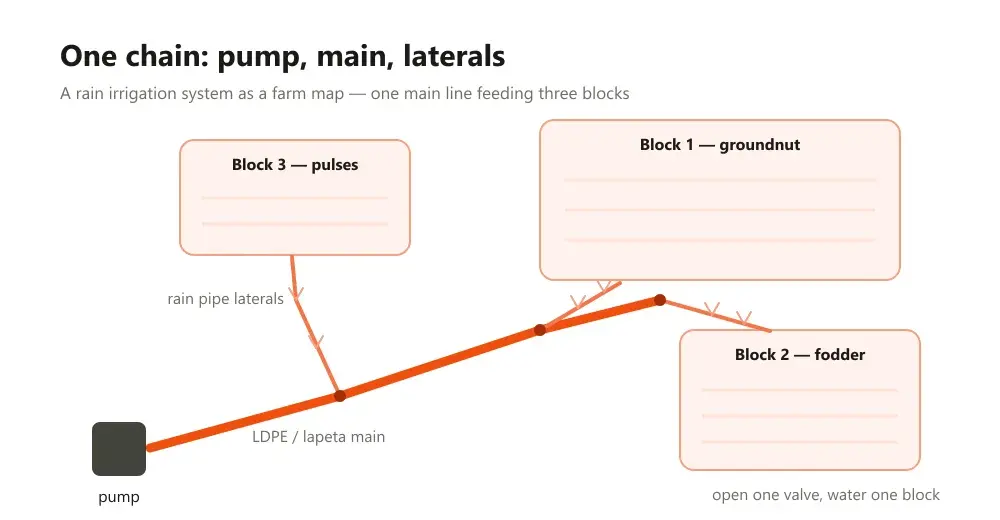
A rain irrigation system is a chain — a pump, an LDPE or lapeta main, and rain pipe laterals — and the chain is what you are really buying, not any single roll. Whether a rain irrigation system suits your farm comes down to three things: how the land is blocked out, how dependable your power supply is, and how clean your water runs.
Think in chains, not rolls
The pump sets the pressure and the flow. The main carries that flow out to each block without bleeding pressure on the way. The laterals turn whatever arrives into a fine, even shower over the crop. If any one link is undersized — a weak pump, a narrow main, laterals run too far — the whole field reads it as poor coverage at the far end, and no single replacement part fixes it.
Its natural home is mixed, close-sown cropping and monsoon-gap watering — carrying a kharif stand through the dry fortnight that turns up most seasons, on land where laying drip across every acre is hard to justify.
What rain pipe itself is, what a roll does well and where the shower method stops making sense are covered in rain pipe irrigation benefits — start there if the product is new to you. This piece asks the next question: does the whole chain earn its place on your farm?
Where a rain irrigation system wins
Labour is the plainest win. Flood irrigation is a person in the field for hours, opening and closing channels and chasing water that wants to go somewhere else. With the chain laid, irrigation is opening a valve, and shifting laterals to the next block is a carrying job one person finishes quickly.
Germination is the second. A gentle overhead shower wets the whole seedbed evenly, so a close-sown block emerges together instead of in stripes that trace the old flood channels. For groundnut, maize, millets and fodder, an even stand in week two is worth more than most corrections you can make later.
The third is flexibility across mixed blocks. One main can serve a fodder block, a pulse block and a vegetable block on entirely different schedules — open the valve to the block that needs water and leave the others shut. Flood cannot split a farm that cleanly, and drip ties each lateral to one row layout for the whole season.
The trade-offs, stated plainly
Power comes first. No pump means no pressure and no shower, so a supply of a few uncertain night hours leaves the system idle exactly when the crop is thirstiest. Be honest about your real pumping window before you price anything, because the chain has no answer to a dead line.
Wet foliage is a cost some crops pay. Overhead watering in a humid spell raises fungal pressure on crops like chilli and tomato. Most close-sown field crops shrug it off, but know which kind you grow before you commit a block to it.
Finally, the punched holes want clean-ish water. They block the way drip emitters do, only more slowly, so a silty borewell or an open tank needs screening at the intake. We say this plainly because we do not stock filters — budget for screening elsewhere before you budget for pipe with us.
Evaporation is real. An overhead shower gives hot wind a share of every litre, and drip will always beat it on that count. If water — not labour — is your scarcest input, read drip, sprinkler or rain pipe by crop before deciding; it weighs the methods crop by crop.
Crops that sit well under a shower
Where it does not fit: orchards and widely spaced, high-value rows, where most of the shower lands on the bare ground between plants. That territory belongs to drip, and no roll price makes wasted coverage cheap.
Wind deserves a mention here too. A fine shower drifts, so a block that catches a steady afternoon wind will water its downwind edge more generously than its upwind one. Where the wind is constant rather than occasional, give that block to drip or keep it on flood, and lay the shower on sheltered ground.
The natural list is the close-sown list: groundnut, maize, millets, pulses, green fodder and dense-sown vegetables.
Stage the buy, main first
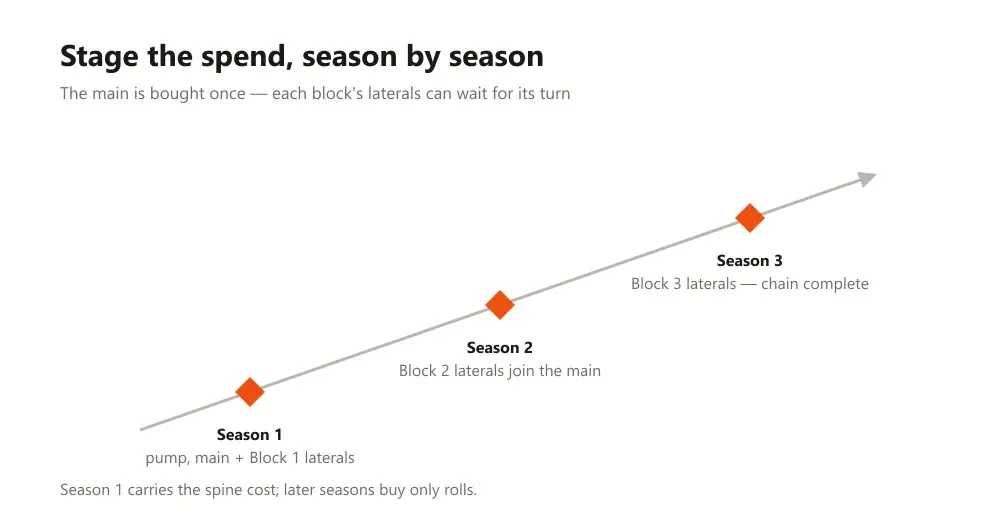
You do not have to equip the whole farm in one season, and usually you should not. The main is the spine: size it once for the flow and the distance your farthest block needs, and buy it once. Laterals belong to blocks, and each block's rolls can wait their turn.
Staging has a quieter benefit too. The first season teaches you what pressure your pump really delivers at the far block, and you size the second season's laterals to that fact instead of to a guess made standing in the shop.
The tax treatment happens to reward this order. Mains — LDPE and lapeta pipe — carry 18% GST inside their printed price, while rain pipe laterals are micro-irrigation and carry 5%. A 3-inch LDPE lapeta main runs ₹24 a metre; rain pipe rolls run ₹1,140 for 20 mm × 200 m, ₹1,320 for 40 mm × 100 m and ₹3,780 for 63 mm × 100 m. Once the spine exists, bringing one more block online is a modest, predictable spend.
Run it by the soil, not the calendar
Re-tune the pressure every season. Blocks get reshaped, laterals get added, holes wear a little wider — and last season's valve setting now over-drives the layout, turning a fine shower into a jet that flattens seedlings. Ten minutes at the season's first watering, walking out to the farthest lateral and adjusting until the spray is even, resets the whole chain.
A fixed every-third-day habit is the fastest way to waste what the system saves. Check moisture at root depth — a handful of soil from below the surface tells you more than the calendar does — and water the block that reads dry, not the one whose turn it is. The water requirement calculator gives the crop's daily need by stage, which is the number to schedule against.
Talk the chain through before you buy
A field sketch settles most of this faster than reading ever will. Send us your block sizes, the pump's horsepower and outlet size, the distance to the farthest block and your honest power hours, and we will spec the main, the laterals and the fittings as one chain — including telling you plainly if a block or two would be better served by drip. The bulk enquiry form is the quickest way to get a priced list back.
Keep reading
Drip, sprinkler or rain pipe: a decision guide by crop
Row spacing, water source and budget decide which of the three methods fits. Here is the reasoning, crop by crop, with what each one costs.
IrrigationRain pipe irrigation benefits, and where they stop
Rain pipe irrigation benefits, priced per roll — why a fine shower on a small pump suits close-sown crops, and the fields where it fails.
IrrigationYour borewell decides your acreage, not your field
A 3,000 lph bore running six hours waters about one acre of cotton on drip. Here is the arithmetic, and what to do when the field is bigger than the water.