Drip emitter spacing for vegetables on sandy loam, bed by bed
Drip emitter spacing for vegetables on sandy loam decides whether one lateral can serve a two-row bed. The beds that work, the minutes a day, the leaching trap.
30 October 2026 · 5 min read · REDYPLAST
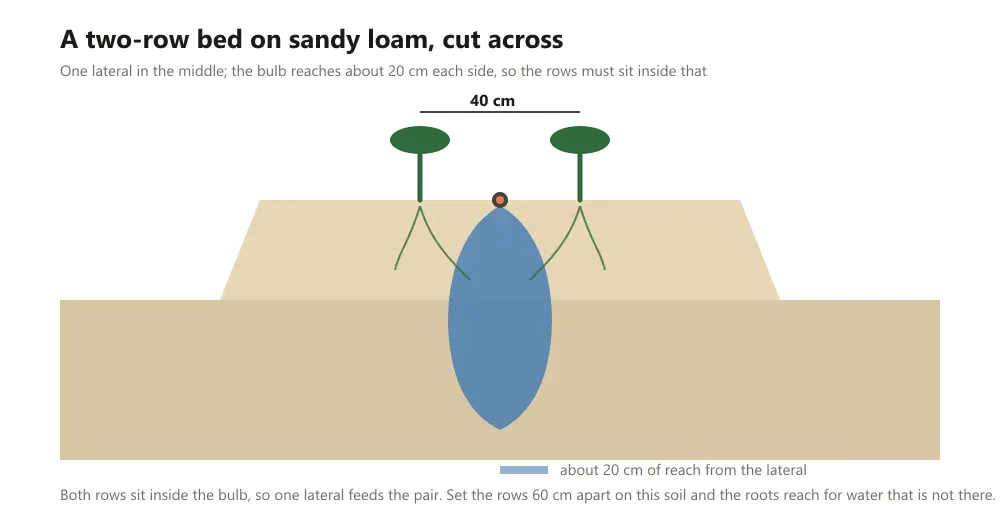
Drip emitter spacing for vegetables on sandy loam comes down to one measurement: how far the wet bulb reaches sideways from the lateral, which on this soil is about 20 cm each way, so a single lateral can serve two plant rows only if they sit within that reach. Get drip emitter spacing for vegetables on sandy loam wrong and the bed looks fine from the path while the outer plants in every pair run dry by the afternoon.
Sandy loam is the soil of many vegetable belts because it drains, warms early and lifts clean, and those same properties make it the quickest soil to dry under drip. This guide covers how it moves water, which bed layouts one lateral can carry, the minutes per day from the calculator's figures, and the mistake sandy loam punishes hardest, which is the long run that carries the fertiliser past the roots.
How sandy loam moves water
Sandy loam has enough sand that water runs down through it quickly and enough fine material that it holds a little on the way. Under a dripper the bulb is a narrow column, roughly 35 to 50 cm across at its widest and deeper than it is wide, and the soil stores about a day of crop water in the shallow root zone a vegetable uses. There is little sideways pull to join two bulbs or to carry water to a plant set off the line.
The upside is control. Water goes where the dripper puts it and nowhere else, the bed surface dries between runs so damping-off and weeds are checked, and a raised bed on this soil never waterlogs. The downside is the same fact read the other way: anything the dripper puts in beyond what the root zone holds is gone within the hour, and dissolved fertiliser goes with it.
- Narrow bulb: 35 to 50 cm across, so about 20 cm of reach each side of the lateral.
- Fast drainage: surplus leaves the root zone in under an hour, taking nutrients.
- Low storage: about a day, so the schedule is daily, in short runs.
- Dry surface between runs: good against disease and weeds, bad for seed germinating off the line.
Drip emitter spacing for vegetables on sandy loam, by bed
Along the lateral the question is settled by the listing: every inline pipe we sell carries a 4 litre per hour dripper every 40 cm, and on sandy loam those bulbs just meet, so a plant set at 30 to 45 cm along the row is never more than a hand from a dripper. Transplant into the wet spots after a first run, as on any light soil, and the in-row spacing looks after itself.
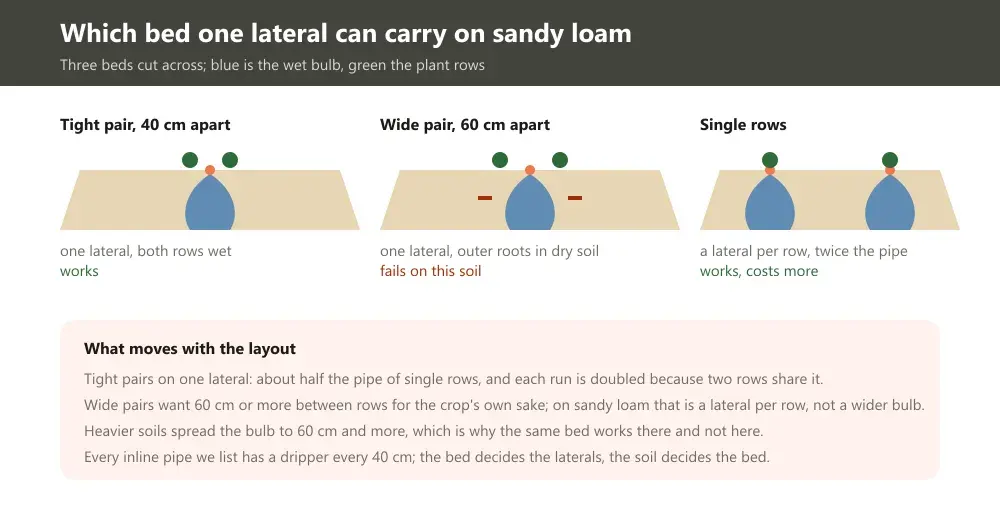
Across the bed is where sandy loam changes the plan. A common vegetable bed is 90 to 120 cm wide with two plant rows and one lateral down the middle; on heavier soil that works with the rows 50 or 60 cm apart.
On sandy loam the rows must sit within about 20 cm of the lateral each side, which means a pair no more than 40 cm apart with the lateral between them. Tomato, chilli and brinjal at that pair spacing are fine; cabbage or cauliflower wanting 60 cm between rows need a lateral per row on this soil.
So the rule is one lateral per bed only when the pair is tight, and one lateral per row otherwise, and the pipe count follows. On the raised beds the vegetables crop page describes, 1.2 metres wide with a 30 cm path, one lateral to a bed is about 2,700 metres an acre; a lateral on each of the bed's two rows doubles that to about 5,400. The vegetables drip guide explains why thin tape from the drip range suits beds that are relaid every crop.
The run time, in minutes
The line applies it more slowly on a shared lateral. A dripper every 40 cm at 4 litres an hour puts 10 litres an hour onto each metre of lateral, and with beds 1.5 metres apart that metre serves a square metre and a half, so the application rate is about 6.7 mm an hour. An acre is about 2,700 metres of lateral drinking about 27,000 litres an hour.
So a hot day's 29,200 litres from the pump is a little over an hour of running, and a mild day's 15,700 about 35 minutes. Give each row its own lateral and the line applies twice as fast, so those become a little over half an hour and under twenty minutes.
On sandy loam those minutes go in every day and never all at once, because a bulb on this soil takes about twenty minutes before it starts to drain. A shared lateral's hour goes in as three runs and its 35 minutes as two; a lateral per row needs two runs on a hot day and one on a mild one.
The soil's one-day store means a skipped day shows as wilting by the next afternoon, and the short runs mean nothing is pushed below the shallow roots a vegetable keeps.
Vegetables at full cover use about 3.5 to 6.5 mm a day, which on one acre is roughly 14,200 to 26,300 litres at the root, or about 15,700 to 29,200 litres from the pump once drip's losses are allowed for; the water requirement calculator gives the figure for your own acreage and crop.
The mistake sandy loam punishes: the long run
Growers who learned drip on a heavier soil water for an hour and feel they have done the job properly. On sandy loam the first twenty minutes fill the root zone and the remaining forty carry water, and whatever fertiliser was injected with it, straight down past the roots into the subsoil.
The plants show nothing that day; what they show over the season is a crop that was fed and fertigated generously and still came up short, because most of the nitrogen left before the roots met it.
The remedy is to give the fertiliser in the middle of a short run, not at the start of a long one: a few minutes of plain water, the injection, then a few minutes of plain water to clear the lines, and the pump off while the root zone is still holding what arrived. The venturi or dosing unit that does the injecting is not something we stock, and the pattern is the same whichever unit you buy.
A blocked dripper on sandy loam shows within a day as one wilting plant, which at least makes it easy to find; the blocked-line guide covers flushing, and the filter it depends on is not something we stock.
- Long runs: water and nitrogen past the roots within the hour, a well-fed crop that still falls short.
- Fertigation at the start of a run: the same loss, with the dose carried furthest.
- The check: a trowel at a hand's depth beside the plant the morning after; moist is right, wet below the roots and dry above is a run too long.
The figures are a starting point
The 3.5 to 6.5 mm a day and the bulb widths are published agronomic ranges, not measurements from your field, and sandy loams vary from nearly sand to nearly loam within one village. Treat twenty-minute runs as the first week's schedule, let the trowel correct it, and expect to add a run in the hot weeks. The same arithmetic on other soils is worked in the red-loam chilli guide and the black-soil cotton guide.
If you want the lateral count worked for your bed widths rather than for an acre, send us the bed width, the row pair spacing and the acreage and we will say whether one lateral per bed will do on your soil, and how many coils that is.
Where these numbers come from
- FAO Irrigation and Drainage Paper 56 (opens in a new tab)
The reference method for crop evapotranspiration and crop coefficients that daily water figures derive from.
- ICAR (opens in a new tab)
Indian Council of Agricultural Research — crop agronomy and regional package-of-practices.
- TNAU Agritech Portal (opens in a new tab)
Crop-wise spacing, water requirement and drip layout references for southern India.
Keep reading
Drip emitter spacing for banana on alluvial soil, and the hours
Drip emitter spacing for banana on alluvial soil is easy; the run time is long. Why the whole row is wetted, the hours a day, and what alluvium punishes.
GuidesDrip emitter spacing for chilli on red loam, and the run time
Drip emitter spacing for chilli on red loam matters, because the wet bulbs barely meet. Where the plants go, the minutes per day, and two schedules that fail.
GuidesDrip emitter spacing for cotton on black cotton soil: run times
Drip emitter spacing for cotton on black cotton soil is the easy part; run time is the hard one. The minutes per day, and how the standard schedule fails.