Drip emitter spacing for chilli on alluvial soil: the wide bulb
Drip emitter spacing for chilli on alluvial soil lets one lateral serve a pair of rows, since the bulb is wide. The pair, the minutes, the wet-feet mistake.
7 November 2026 · 5 min read · REDYPLAST
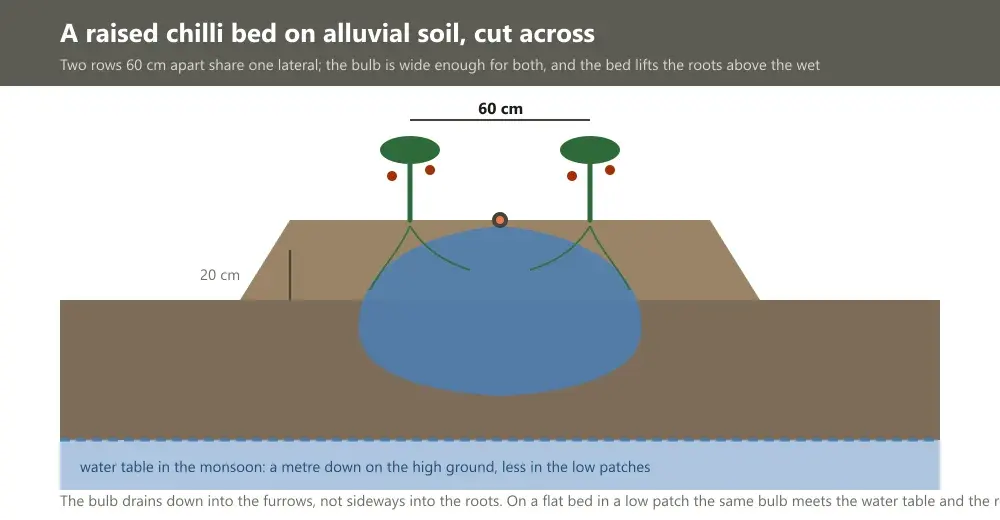
Drip emitter spacing for chilli on alluvial soil is generous in a way red soil never allows: the bulb under a 4 litre dripper spreads 60 to 90 cm across, so the 40 cm drippers every inline pipe we list carries merge into a band wide enough that a pair of chilli rows 60 cm apart can share one lateral between them.
The question drip emitter spacing for chilli on alluvial soil raises is not whether the water reaches the plants but whether it stays too long, because chilli on a low, river-laid field dies of wet feet more often than of thirst.
Alluvial chilli is the crop of the Krishna and Godavari belts, grown on deep silt loams that hold water well and, in the low patches, drain slowly. This guide covers the wide bulb, the paired-row bed it makes possible, the minutes per day from the calculator's figures, and the two schedules that lose a chilli crop on this soil, one by drowning it and one by stressing it at flowering.
The wide bulb, and the water under it
Alluvial soil is deep, stone-free and medium in texture, and water from a dripper moves out as readily as down: the bulb is 60 to 90 cm across and the root zone holds two or three days of crop water once it is full. That storage is the soil's gift; a missed day costs nothing, and the plant's feeding roots find water across the whole bed rather than along a line.
The hazard sits a metre down. Along the rivers the water table rises through the monsoon, the low patches of a field drain slowly after a long run or a heavy rain, and chilli, which carries its feeding roots in the top 30 cm, loses them within days in soil that stays saturated.
The wilts and root rots that take out whole patches of alluvial chilli follow standing water, not drought, and a drip schedule copied from a lighter soil is one of the ways the water comes to stand.
- Bulb: 60 to 90 cm across, so a pair of rows at 60 cm sits inside one band.
- Storage: two or three days in the root zone; alternate-day runs are honest outside the peak.
- Drainage: good on the high ground, slow in the low patches and the monsoon.
- The risk: saturated roots, wilt and rot, from runs the bed cannot shed.
Drip emitter spacing for chilli on alluvial soil, on the bed
Along the lateral the 40 cm spacing is a comfortable match for chilli planted at 40 to 45 cm, and on this soil the plant need not sit exactly at a dripper, because the band is continuous and 60 cm wide. Across the bed is where alluvial soil pays: a raised bed 90 to 120 cm wide carrying two chilli rows 60 cm apart and one lateral down the middle, which halves the pipe against one lateral per row and keeps both rows in the band.
The raised bed is not optional on the low ground. Twenty centimetres of height lifts the root zone above the water that collects after a run or a rain, and lets the bulb drain downward into the furrow between beds rather than sideways into the roots.
The chilli crop page counts one lateral to each pair, and the one-acre chilli layout shows what that does to the coil count. The lateral is 16 mm inline from the drip range, laid on the crown of the bed before transplanting.
The minutes, and the days between
On paired rows at 1.5 metres between lateral lines, a metre of lateral with 10 litres an hour serves a square metre and a half, so the line applies about 6.7 mm an hour. An acre is about 2,700 metres of lateral drinking about 27,000 litres an hour, so a hot day's 27,000 litres from the pump is an hour of running and a mild day's 15,700 about 35 minutes; on single rows at 0.75 metres the rate doubles and the run halves.
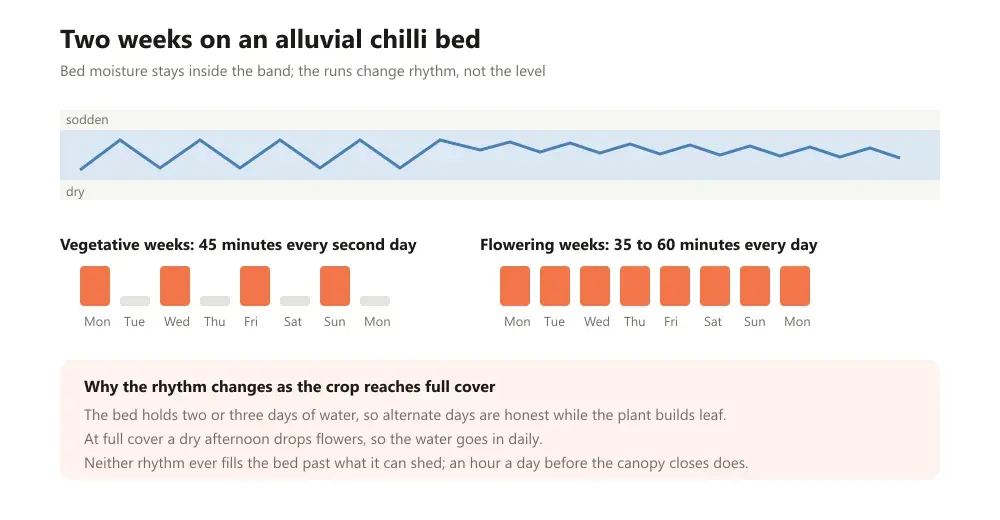
The soil's storage then sets the days. While the plant builds leaf and uses less, a 45 minute run every second day keeps the bed moist without ever saturating it; through flowering and fruit set, at full cover, when a dry afternoon costs flowers, the run goes daily, 35 minutes to an hour, so the bed never swings between saturated and dry.
Chilli at full cover uses about 3.5 to 6 mm a day, which on one acre is roughly 14,200 to 24,300 litres at the root, or about 15,700 to 27,000 litres from the pump once drip's losses are allowed for; the water requirement calculator gives the figure for your own acreage.
The two schedules that lose the crop
The first is the one from a lighter soil: an hour every day from transplanting, because that is what the field next door on red loam is given. Before the canopy closes the crop uses far less than that, so the bed stays full and the rest of every run goes into the subsoil; on the high ground that is only waste, on the low ground it is a water table rising into the roots by the third week, and the wilt follows in the field's low spots.
The second is the opposite and happens in the cool months. A grower trusts the storage, stretches the interval to four or five days, and arrives at flowering with a bed that is dry on the surface and dry at the roots; the catch-up run then saturates it. Chilli drops flowers for a dry day and for a drowned one alike, and both in one week is how a fine stand sets a poor crop.
A blocked dripper shows slowly on this soil, because the band covers for it until a plant falls behind; the blocked-line guide covers flushing, and the filter it depends on is not something we stock.
- Hour-long daily runs before the canopy closes: a bed already full, water to the subsoil, wilt in the low patches.
- Four-day gaps at flowering, then a catch-up run: flowers dropped for the dry day and the wet one both.
- A flat bed on low ground: roots in standing water after every heavy run or rain.
- The check: a trowel at a hand's depth in the bed, mid-way between the rows, the morning after a run; moist and crumbling is right, shining is a run too long, dusty is a gap too wide.
The figures are a starting point
The 3.5 to 6 mm a day and the bulb widths are published agronomic ranges, not measurements from your field, and alluvial ground varies from sandy phases to heavy ones within one village; the sandier the phase, the nearer the schedule moves to daily. Treat 45 minutes every second day as the first fortnight's schedule and let the trowel correct it.
The same crop on the opposite soil is worked in the red-loam chilli guide, and the same soil under a thirstier crop in the banana alluvial guide. If you want the bed layout and the lateral count worked for your field, send us the bed width, the row pair spacing, the acreage and whether the field floods and we will say whether one lateral per pair will do, and how many coils that is.
Where these numbers come from
- FAO Irrigation and Drainage Paper 56 (opens in a new tab)
The reference method for crop evapotranspiration and crop coefficients that daily water figures derive from.
- ICAR (opens in a new tab)
Indian Council of Agricultural Research — crop agronomy and regional package-of-practices.
- TNAU Agritech Portal (opens in a new tab)
Crop-wise spacing, water requirement and drip layout references for southern India.
Keep reading
Drip emitter spacing for vegetables on sandy loam, bed by bed
Drip emitter spacing for vegetables on sandy loam decides whether one lateral can serve a two-row bed. The beds that work, the minutes a day, the leaching trap.
GuidesDrip emitter spacing for banana on alluvial soil, and the hours
Drip emitter spacing for banana on alluvial soil is easy; the run time is long. Why the whole row is wetted, the hours a day, and what alluvium punishes.
GuidesDrip emitter spacing for chilli on red loam, and the run time
Drip emitter spacing for chilli on red loam matters, because the wet bulbs barely meet. Where the plants go, the minutes per day, and two schedules that fail.