Converting cotton from flood to drip: cost and steps
Converting cotton from flood to drip roughly doubles the ground one bore can water. The published acre bill at MRP, the order of work, and who should wait.
16 October 2026 · 5 min read · REDYPLAST
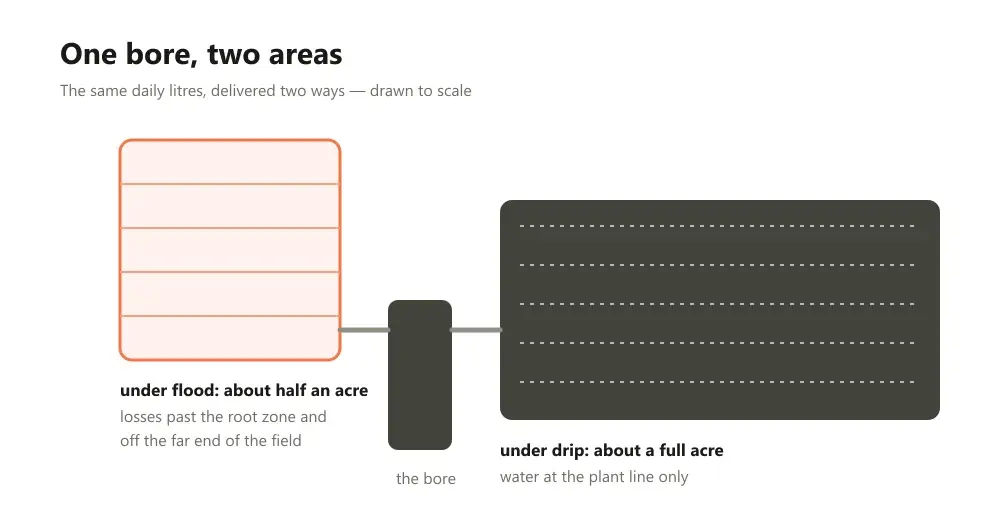
Converting cotton from flood to drip begins with the bore, because that is where the biggest change shows: the water that floods about half an acre of cotton drips about a full acre, from the same bore in the same hours. If your land is bigger than your water, the second half-acre is what you are buying.
The published cotton bill, for one acre at 1.2 metre rows, comes to ₹29,133 at MRP for the parts we sell. The filter, the block valves and the remaining pump-side steel sit outside it.
Converting cotton from flood to drip: start with the bore
Flood sends a good part of every watering past the root zone and off the far end of the field. Drip delivers to the plant line and nowhere else, so the same daily litres reach roughly twice the ground. No water is created — the water flood was losing now reaches the extra acre.
So the first number is the bore's, not the pipe's. Time the pump into a drum of known size early in the pumping day and again after two hours, and count the hours the power honestly allows. Those figures say how many acres can convert before anything is priced.
The borewell guide runs that example end to end — one bore, one set of hours, half an acre under flood against about an acre under drip — and the water requirement estimator gives the daily litres cotton needs on your acreage.
The acre bill, and the wall you choose
Cotton's rows sit 0.9 to 1.2 metres apart, so the lateral count per acre is low, though the lateral is still the biggest line. The published bill is for 1.2 metre rows: 53 laterals on a 64 by 63 metre block. At 0.9 metres the pipe grows by about a third, which moves the total as much as the wall choice does.
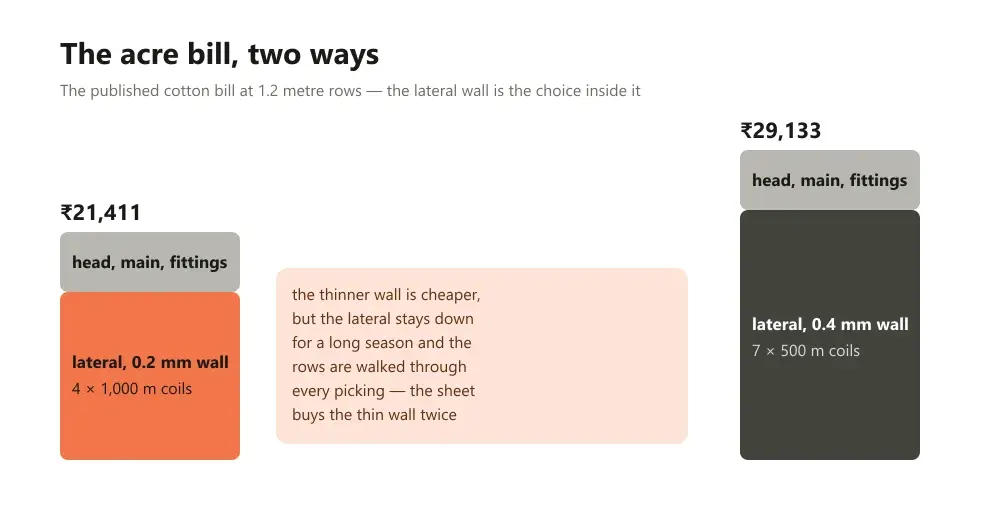
That bill prices the 16 mm lateral with a 0.4 mm wall at ₹3,366 per coil of about 500 metres, seven coils to the acre, and lands the parts we sell at ₹29,133 with tax inside. The head on it is the 2 inch socketed ball-type non-return valve at ₹1,440; the ₹558 steel-to-plastic pump connector in the same size sits outside the bill with the other pump-side steel.
The ₹6 takeoffs, end caps and joiners are counted exactly on the bill; ordered online they round up to 100 pieces each, ₹1,800 rather than ₹756.
The 0.2 mm wall at ₹3,960 per coil of about 1,000 metres brings the same acre to ₹21,411. The published bill calls that thinner wall a bet, and its three-season chart buys it twice; the catalog rates the 0.4 mm lateral for 1 to 3.5 kg/cm² against 1 to 1.5 for the 0.2 mm. On cotton the lateral stays down a long season and is walked through every picking — the case for the heavier wall.
The one-acre cotton bill has every line at our MRP, and the cotton drip guide is the decision guide. Outside both figures: the filter, the block valves, a venturi or dosing unit if you fertigate, a gauge, the pump-side bends and nipples, trenching, labour and freight; of those, we stock the pump-side steel and nothing else.
The order of work, around sowing
The sequence we suggest: head first, built in flow order from the pump: connector, non-return valve, then the filter you buy elsewhere, fitted before any lateral runs — the pump-to-lateral fittings guide walks that chain part by part. Main and sub-main next, laid along the row ends after the last tillage pass, so no implement crosses them.
Laterals go down after sowing, once the plant lines show, unrolled along each row beside the plants; the cotton guide has them in place dry, weeks before the first irrigation. Flush each lateral through its open end before capping, then watch the first run from the valve to the last end cap. A badly seated takeoff usually shows itself on that first run.
- Measure the bore: yield early in the pumping day and after two hours, and the honest pumping hours.
- Draw the layout from measured rows, in blocks the bore can serve inside those hours.
- Build the head from the pump outward — connector, non-return valve, filter — before opening a coil.
- Lay main and sub-main along the row ends after the last tillage; lay laterals after sowing, along the plant lines.
- Flush every lateral open-ended, cap, and watch the first run end to end.
What changes through the season
The labour changes shape. Under flood, someone guides each heavy weekly watering across the field for most of a day. Under drip the same person opens a block valve, moves on to the next, and walks the laterals for a dry emitter or a wet patch — fewer hours, spread across the week.
The scheduling changes too. The cotton guide's rule is to water when the soil a hand's depth down beside the plant line says so, not the calendar, and the weeks that matter most are flowering and boll setting: a dry spell there sheds squares and young bolls, and that yield does not return.
Picking is the quiet gain. A dripped field has dry middles, so pickers and irrigation can share a day. Walk the lines after each picking, because feet and baskets find takeoffs.
Fertigation needs a venturi or a dosing unit, neither of which we stock, and flushing matters more on a long crop — the blocking guide explains why lines close from the far end, and the mistakes guide covers the one that hurts cotton most, going dry at flowering.
The first season's learning curve
A flood farmer reads water on the surface; a drip farmer reads it a hand's depth down. The first weeks go on learning what a watered row looks like when the surface between rows is dust, and on not running longer until it looks wet. Check root depth with a stick before each run.
Then the system's own signs: an emitter row that stays dry, a wet patch where a takeoff has lifted. By the second season they are a five-minute walk, and the wall decision is made on your own evidence.
Who cannot convert, and who should wait
Some fields cannot: cotton with no bore and no tank has nothing for drip to deliver, and a field fed by gravity from a canal needs a pump added first — and canal water carries an organic load that closes the 4 lph emitters unless it is filtered.
Others should wait. A bore so small that even drip's acre is out of reach needs the borewell arithmetic first and may suit a smaller drip block run in shifts. Leased land needs a lease long enough to use the lateral, or laterals you will lift and take. A source carrying sand or silt with no filter budget will spend the first season flushing instead of picking. If paddy follows next season, the laterals are lifted and stored for that year.
PMKSY's Per Drop More Crop support applies to micro-irrigation; what applies to a cotton block changes from one year and district to the next, so ask the horticulture or agriculture office before assuming a rate.
Then ask us for a priced list — yield, hours, acres, row spacing — and we price what we sell at MRP, marking the filter, valves, venturi and gauge as items from elsewhere. The cotton crop page gives the method and row spacing; the drip range lists today's prices.
Where these numbers come from
- ICAR (opens in a new tab)
Indian Council of Agricultural Research — crop agronomy and regional package-of-practices.
- TNAU Agritech Portal (opens in a new tab)
Crop-wise spacing, water requirement and drip layout references for southern India.
- PMKSY — Per Drop More Crop (opens in a new tab)
The central micro-irrigation scheme. Subsidy rates and eligibility are set here, not by suppliers.
- Telangana Horticulture Department (opens in a new tab)
State subsidy administration and the district offices that process micro-irrigation applications.
- FAO Land and Water (opens in a new tab)
Irrigation water management guidance, including scheduling and application efficiency.
Keep reading
Converting banana from flood to drip: cost and steps
Converting banana from flood to drip suits a crop that drinks heavily for a year and suffers with wet roots: the acre bill, the pump check, the steps.
GuidesConverting chilli from flood to drip: cost and steps
Converting chilli from flood to drip: what you keep, what you buy, what it costs at MRP, how the work and the water change, and who should not convert.
GuidesFixing pressure dropping mid-season in a rain pipe system
Pressure dropping mid-season in a rain pipe system means something changed since week one: the bore, the lines, leaks or silt. How to find which, and fix it.