Flood to drip conversion for pomegranate: cost and steps
A flood to drip conversion for pomegranate costs less than most crops because the rows are wide. The acre at MRP two ways, the steps, and who should skip it.
24 October 2026 · 5 min read · REDYPLAST
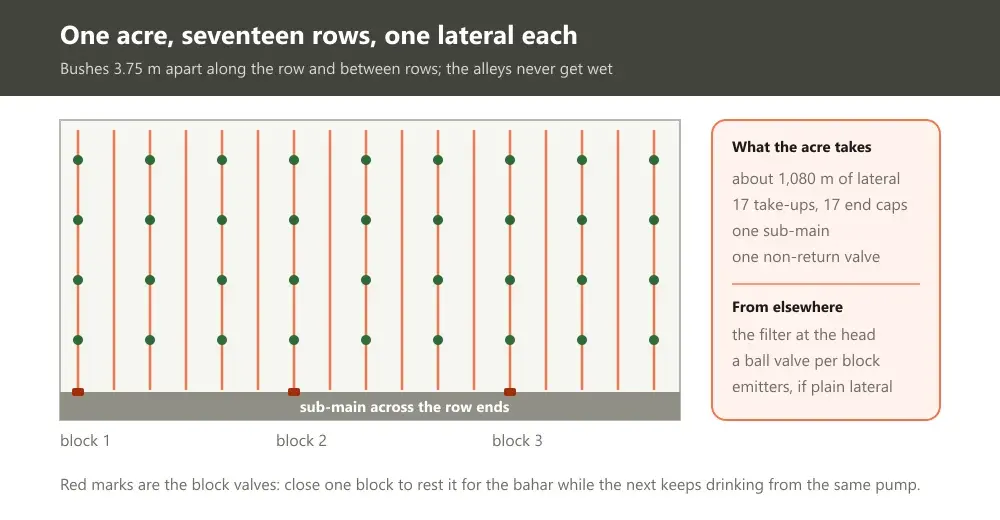
A flood to drip conversion for pomegranate is one of the cheapest conversions a farm can make, because the bushes stand 3 to 4.5 metres apart and an acre needs only about 1,080 metres of lateral in 17 rows. The work in a flood to drip conversion for pomegranate is mostly at the head of the orchard, where the pump meets the first pipe, and in valving the blocks so that each can be rested or watered on its own.
This guide keeps to what we can stand behind: the pipe and fittings priced at MRP from our listing, the steps in the order the orchard needs them, and the farmers who should leave the basins as they are. The agronomy of resting a block for the bahar belongs to your horticulture officer; the plumbing that makes it possible is ours.
Flood to drip conversion for pomegranate: what you keep and what goes in
Under flood, each bush sits in a basin or a ring, and water is let down a channel to fill one basin after another. Under drip, a 16 mm lateral runs the length of each row, water reaches the root zone only, and the channel and the basins are no longer needed, which is why the alleys dry out and stay dry.
You keep the bore or well, the pump, the delivery pipe to the orchard and the valve on it. What goes in is the head, a sub-main across the row ends, one lateral per row, and the small fittings at each lateral's start and tail. Two things we do not stock sit in that list and must be bought elsewhere: the filter at the head, and the ball valves that make block-by-block control possible.
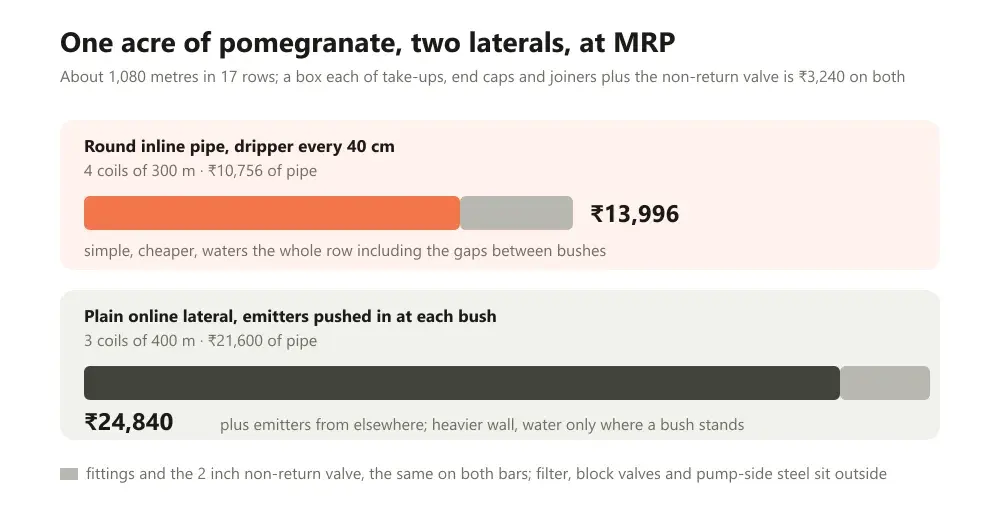
The lateral itself is a choice between two listings. The round inline pipe carries a dripper every 40 cm along its length, so some of its water lands between bushes; it is the simple choice and the cheaper one. The plain online lateral has no drippers, and takes emitters from elsewhere pushed in at each bush; it is heavier, costs more, and puts water only where a plant stands. The pomegranate crop page and the pomegranate drip guide both lean towards the second on a planting that stays for years.
- Keep: bore or well, pump, delivery pipe and its valve.
- Buy from us: non-return valve, sub-main, laterals, take-ups, end caps, joiners.
- Buy elsewhere: the filter, one ball valve per block, and emitters if you choose the plain lateral.
The bill at MRP, two laterals
One acre at 3.75 metres between rows needs about 1,080 metres of lateral in 17 runs. The round inline pipe comes in 300 metre coils at ₹2,689, and four of them cover the acre for ₹10,756 with a little spare. Add a box of 100 take-ups, a box of 100 end caps and a box of 100 joiners, at ₹6 a piece and sold by the hundred, which is ₹1,800, and the 2 inch socketed ball-type non-return valve at ₹1,440. The inline acre is ₹13,996, tax inclusive.
The plain online lateral comes in 400 metre coils at ₹7,200, and three of them cover the same acre for ₹21,600. With the same three boxes and the same valve the online acre is ₹24,840, before the emitters you buy elsewhere. Seventeen rows is well inside a box of 100 take-ups and end caps, so the boxes last several seasons of repairs.
The system estimator builds the inline version from the crop and acreage using 500 metre coils at ₹4,482, counting take-ups, end caps and joiners by the piece rather than by the box, and reports about ₹13,700 for an acre of pomegranate. On an orchard acre the 300 metre coil fits the metres better, which is why the bill above is slightly lower.
The pump side sits outside both bills and is often already owned: a 3 inch LDPE lapeta of 90 metres is ₹2,160 for the run from pump to orchard, and the 3 inch steel connector that joins it to the delivery is ₹1,053. The drip irrigation range lists every item above with any discount running today.
The steps, block by block
An orchard is converted in blocks, not rows, because a block is what you will later rest or water on its own. Decide the blocks before the sub-main goes down, and give each its own valve where it leaves the sub-main.
The pump-end fittings guide takes the first three steps part by part.
- Mark the blocks and the row ends, and settle which rows share a valve.
- Fit the head in order from the pump: steel connector, non-return valve, then the filter from elsewhere.
- Run the sub-main across the row ends and fit a ball valve from elsewhere at the head of each block.
- Punch a take-up for each row, lay the lateral along the bushes with the drippers up, fold and cap the tail.
- Flush every block with the caps off, then close the caps and walk the rows with the pump running; a dry stretch now is a ₹6 joiner.
- Run each block alone and time how long it takes to wet the root zone; write it down, because that number is the orchard's schedule from now on.
Water, labour and the first bahar
Flood taught the orchard to drink by the basin, a lot at once and then nothing for days. Drip delivers a little to every bush, every day the valve is open, and the first season is spent learning to trust soil that looks dry on top while the root zone is wet. The water saving is real, because the alleys and the channel no longer drink, but it is the control that growers end up valuing more.
Pomegranate's fruit splits when moisture swings, and a block that is rested for the bahar must then be brought back evenly. A valve per block makes both possible from one pump; a basin cannot be shut on one bush and left open on the next. Labour moves from opening and closing channels to walking the rows for blocked emitters, and on a crop where one blocked dripper is one bush with cracked fruit, that walk is not optional.
Fertigation rides the same laterals and is where many growers get the second gain, but it needs a venturi or dosing unit we do not stock. The filter is the one item that protects everything else; without it the emitters block within a season, and the flush that the blocked-line guide describes becomes a weekly chore instead of a quarterly one.
Who should not convert
Drip on orchards has drawn Pradhan Mantri Krishi Sinchayee Yojana support under Per Drop More Crop, with the rate and the paperwork varying by state and year; ask the horticulture office before counting on a figure. If you want the bill for your own rows, send us the row spacing, the acreage and your pump and we price what we sell at MRP, marking the filter, the valves and the emitters as items from elsewhere.
- A grower on canal rotation with no pump and no bore; drip needs pressure a canal does not give, and the basins cost nothing.
- Anyone who will not valve the blocks; one valve for the whole orchard waters well and schedules nothing, and the bahar is the reason to convert.
- A planting coming out within two years, because the saving is spread across the years the bushes stand.
- A field without a filter budget, where emitters block in the first season and the crop pays for it in split skins.
Where these numbers come from
- ICAR (opens in a new tab)
Indian Council of Agricultural Research — crop agronomy and regional package-of-practices.
- TNAU Agritech Portal (opens in a new tab)
Crop-wise spacing, water requirement and drip layout references for southern India.
- PMKSY — Per Drop More Crop (opens in a new tab)
The central micro-irrigation scheme. Subsidy rates and eligibility are set here, not by suppliers.
Keep reading
Flood to drip conversion for sugarcane: cost and steps
A flood to drip conversion for sugarcane priced at MRP two ways, single or paired rows, with the work, the pumping change, and who should keep the furrow.
GuidesFlood to drip conversion for vegetables: cost and steps
A flood to drip conversion for vegetables, priced at MRP three ways, with the beds relaid every crop, the water and labour that change, and who should wait.
GuidesConverting chilli from flood to drip: cost and steps
Converting chilli from flood to drip: what you keep, what you buy, what it costs at MRP, how the work and the water change, and who should not convert.