Drip irrigation for kitchen garden beds and terraces
Drip irrigation for kitchen garden pots and beds: the short parts list, what our farm-sized packs mean, and three sensible ways to buy small.
22 January 2026 · 4 min read · REDYPLAST
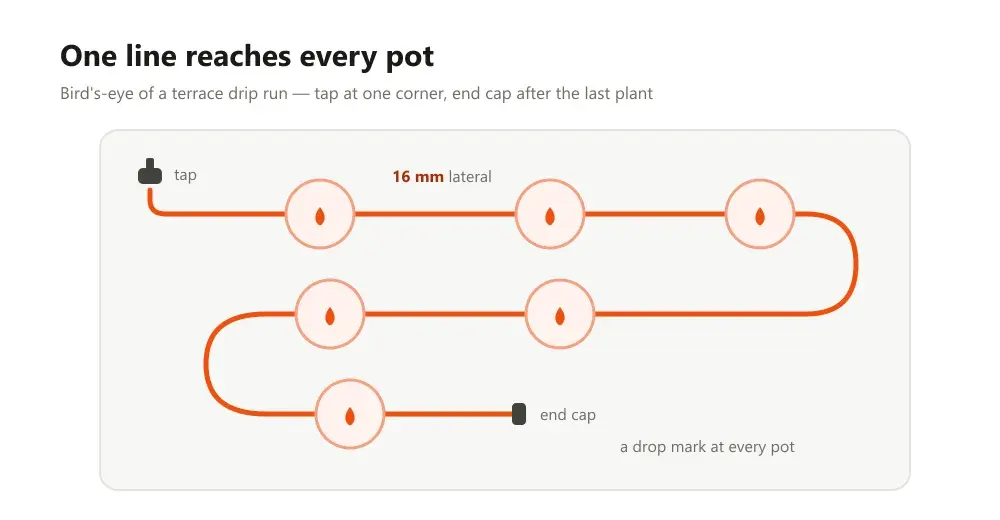
A drip line puts water at the roots of each plant and nowhere else, which is precisely what a terrace, balcony or backyard plot wants. Drip irrigation for kitchen garden beds runs on the same 16 mm pipe and ₹6 fittings we sell to farmers across Telangana — the only real difference is how little of it you need.
That difference is the awkward part, because we are a farm shop and our coils run to hundreds of metres. This guide covers the parts, the layout and the upkeep, then deals squarely with the buying problem — there are three good ways around it, and none involves owning a warehouse.
Drip irrigation for kitchen garden plots: the parts list
Strip away the brochure language and a home system is four things. A supply pipe from your tap or overhead tank to the growing area. A 16 mm lateral — the thin black pipe that actually visits each pot or bed. Outlets that meter water from it, whether moulded drippers or fine punched holes. And the small fittings that hold the run together: a takeoff where the lateral leaves the supply, joiners to mend cuts, and an end cap to close the far end.
The supply run needs no special purchase. A sound garden hose you already own, or any half-inch pipe left over from plumbing work, will happily feed a lateral across ten metres of terrace — the lateral is the part doing the clever work.
Just as important is what we do not carry. There are no filters, timers or pressure regulators on our shelves, and no ready-made mini kits either — we would rather say so plainly than dress a farm coil up as one. The pieces we do stock live under drip irrigation, and each takeoff, joiner and end cap there is ₹6.
The honest part: everything here comes farm-sized
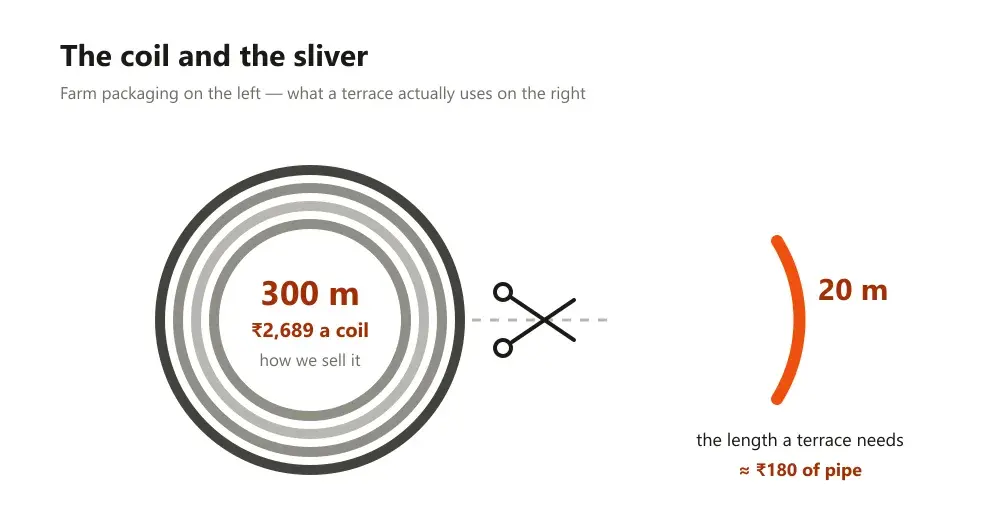
Our shortest lateral coil is 300 metres of round inline pipe at ₹2,689, which works out near ₹9 a metre. The small fittings ship boxed in hundreds, and online they carry a floor of 100 pieces, so the smallest cap order is ₹600. For contrast, a cotton farmer on 1.2-metre rows lays roughly 3,339 metres of lateral in one acre; a terrace with a dozen containers uses perhaps twenty.
Twenty metres is about ₹180 worth of pipe, so the price of drip was never the obstacle — the pack size is. Ordering blind off a listing leaves a gardener owning 280 spare metres and 95 spare caps. To see these quantities doing the job they were packed for, read what one acre of drip costs; the contrast with a home plot is the whole point.
Three sensible ways to buy small
So how does a gardener buy twenty metres from a shop that sells three hundred? Three routes work, and we have watched all three succeed.
- Split a coil. Four or five households on a street can share one ₹2,689 coil and one ₹600 box of caps, and every kitchen garden on that street is equipped for years.
- Buy once and treat it as stock. A coil kept flat in a shaded store room turns every future extension, repair or new bed into an evening's work costing nothing further.
- Ask us directly. Send your plot size through our [enquiry form](/bulk-enquiry) and we will quote a sensible small lot from open stock rather than push a full box at you.
Laying it out so every plant drinks
Start with the plants, not the pipe. Sort pots and beds into thirsty, moderate and dry — a tomato and a succulent sharing one line will never both be happy — and give each group its own run, or at least its own clearly separated stretch of one.
Then route the lateral so it passes within a hand-span of every root zone. Gentle curves are fine; 16 mm pipe rounds a terrace corner without protest, and a loop that doubles back wastes nothing but a metre or two. Fix an outlet at each plant, cap the far end, and open the tap gently.
The final step is the one most people skip: stay for the entire first run and watch every single plant. The far end always tells the truth. If the last pot stays dry, the run is too long or the tap too weak, and shortening a loop today is far easier than diagnosing a wilted plant next month.
Keeping the line clean when we sell no filters
We do not stock filters, and a home line still needs the job done somehow. The substitute is a habit rather than a product: tie a doubled fold of clean cotton cloth over the tap mouth or tank outlet, and rinse it every week or two. Household and tank water carry enough grit and algae to choke a dripper, and cloth catches most of it before the pipe ever sees it.
Keep any storage tank covered and out of direct sun, because warm, lit water grows the slime that blocks outlets fastest. When a dripper chokes anyway, home diagnosis matches field diagnosis exactly — why your drip line keeps blocking walks through the three causes and their fixes.
Small habits that keep it working
Mulch the beds. A few centimetres of straw or dry leaf over the soil holds the drip's moisture where it landed, and pipe running under mulch is shaded from the sunlight that ages it.
Adjust with the season instead of re-laying anything: longer runs in May, shorter in December, and a full pause when the monsoon is doing the watering for you. If you want the tap opened on a schedule, any generic hose timer will drive a drip line — we do not sell timers, so choose one on features, not on our advice.
Twice a season, pull the end cap off and let the line flush at full flow until the water runs clear. It takes a minute, and it clears the sediment that quietly gathers at the far end where you least often look.
Where to go from here
A kitchen garden is the cheapest classroom for learning drip properly, and the lessons transfer both ways — most of the errors in avoid irrigation mistakes show up just as clearly in six pots as in six acres. Prove the layout on a single bed before plumbing the whole terrace.
And if the quantities have you stuck, tell us how big the space is and which plants fill it — through the enquiry form or just contact us — and we will say honestly what to buy, what to share, and what to skip.
Keep reading
Drip for vegetables: tape, joiners and the relay year
Vegetable plots replant two or three times a year, and drip for vegetables has to keep up: thin tape, a box of joiners, and what the spine costs.
GuidesDrip for banana: sizes, grades and the two pitfalls
Which drip laterals suit a banana crop, why the heavy wall earns its keep over a year in the ground, and the two mistakes banana buyers repeat.
GuidesDrip for sugarcane: built to outlast the ratoons
Drip for sugarcane stays buried for years, not months. The wall that survives ratoons, the paired-row lever, and what the water bill says.