Six common irrigation mistakes, and how to fix them
The six common irrigation mistakes we see most on Telangana and Andhra farms, and the practical fix for each — from schedules to system choice.
10 May 2024 · 4 min read · REDYPLAST

Season after season we see the same common irrigation mistakes on farms across Telangana and Andhra Pradesh, and most of them cost yield quietly rather than dramatically. Not one of the six below needs new equipment to put right — each has a correction you can start this week with the pump and pipe you already own. What they do need is a change of habit, which is harder to sell and easier to skip.
Mistake 1: watering to a routine, not the soil
Extra water does not buy extra yield. Once the root zone is full, everything more pushes air out of the soil, and roots sitting in airless ground slow down, stop feeding, and begin to rot. Dissolved fertiliser rides the surplus straight past the roots, so an over-watered field loses nutrition and money together. The tell-tale signs are easy to read: lower leaves yellowing while the top stays green, a green film on the soil surface, and puddles that outlast the morning.
The correction costs nothing. Check the soil before starting the pump — scrape below the crust at the root line, and if it is moist at hand depth, wait a day. For an actual figure to plan around, the water requirement calculator estimates your crop's daily need from its stage and the season, which turns watering from a habit into a decision.
Mistake 2: going dry at flowering
A dry spell hurts differently depending on when it lands. During leafy growth most crops shrug it off and catch up within a week. During flowering and fruit set they do not: cotton sheds squares, chilli drops blossom, groundnut pegs fail to set — and the yield lost in that fortnight never comes back, however generously you water afterwards.
So plan the sensitive windows in advance rather than reacting to them. Note the expected flowering weeks at sowing time, and through them keep moisture steady and the interval short, even when the crop looks comfortable. If the source is tight, shift water away from plots in vegetative growth to cover the ones that are flowering. Waiting for visible thirst is the trap here — a plant wilting at flowering has already paid the price.
Mistake 3: one schedule for two soils
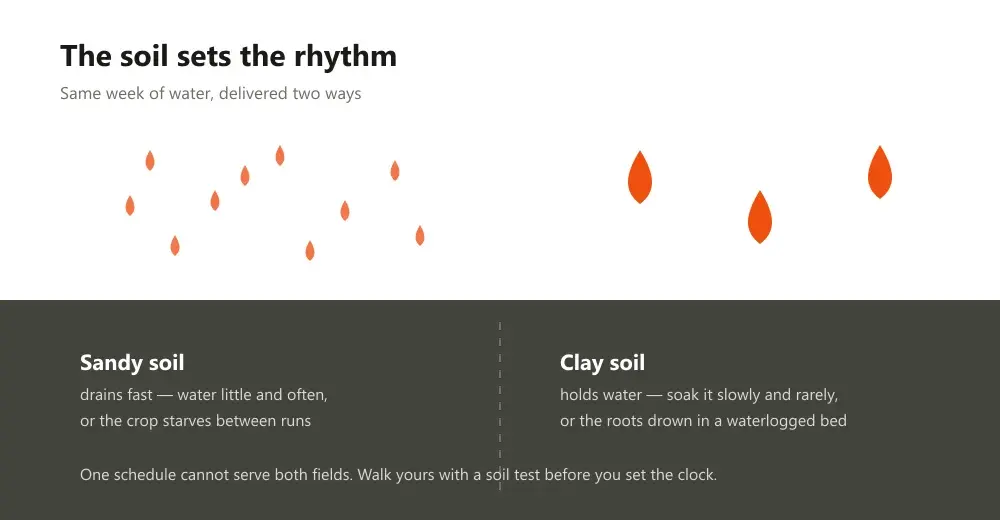
Sandy ground and heavy black soil are opposite problems wearing the same crop. Light soil takes water in fast, holds very little, and is dry again within a day or two — it wants modest amounts at short intervals. Black soil absorbs slowly, stores a great deal, and stays wet for days; pour a sandy-soil schedule onto it and you get standing water, sour roots and cracked crusts when it finally dries.
Plenty of farmers here work both types across different plots, and the mistake is running them off one calendar. Treat them as two schedules: same pump, same mains, different run times and different gaps between runs. It costs a few minutes of valve work and repays it every week of the season.
Mistake 4: no maintenance until something breaks
Irrigation kit rarely fails loudly. It drifts — one emitter blocks, a joint starts weeping, pressure at the far corner sags — and the field goes patchy while the system still looks fine from the pump end. By the time a failure is obvious enough to notice, a season of uneven watering has already gone into the crop. Drift is cheap to catch early and expensive to discover late.
Walk the lines once a month with the pump running and fix what you find the same day. Flush laterals through their end caps until the water runs clear. If your system uses a filter, clean it on schedule — we do not stock filters ourselves, but a fouled screen starves everything downstream of it. Our guides on why drip lines block and making pipe last longer turn all of this into a short, repeatable routine.
Mistake 5: no plan for the water source
Many farms are laid out around the borewell's best month. The planted area matches what the well gives in a good year, and when the water table drops the whole plan drops with it — every acre half-watered instead of some acres watered properly. A bore's yield is not a fixed number; it moves with the season and with the years around it.
Plan around the lean months instead. Size the irrigated area to what the source dependably delivers when it is weakest, and settle the fallback before the season starts: a storage tank or farm pond filled while water is plentiful, a second source, or an arrangement with a neighbouring bore. Deciding which acres get water is far easier in May on paper than in February in a drying field.
Mistake 6: buying the method before measuring the field
This one happens in the shop, not the field. A farmer picks drip because a cousin swears by it, or rain pipe because the roll price looks friendly, and only afterwards discovers the row spacing, the water quality or the wind was wrong for the choice. The equipment gets blamed, but the sequence was the fault.
Measure first. Row spacing, crop, water source and wind between them decide the method — our crop-by-crop comparison walks that decision through drip, sprinkler and rain pipe. Then let the system estimator turn your acreage into a parts list and a cost before any money moves. An hour with a tape measure is cheaper than a season of regret.
What these common irrigation mistakes share
Look back over the six and one pattern shows up everywhere: each substitutes habit for observation. The calendar stands in for the soil, the neighbour's choice stands in for the field's own numbers, and the shop counter stands in for a walk down the lines. The fixes are correspondingly plain:
None of this needs a bigger pump or a new system, which is exactly why these mistakes survive: there is nothing to buy, so nobody sells you the fix. If you suspect one of them is quietly costing you yield and cannot tell which, write to us with your crop, soil and water source and we will help you narrow it down. We have fitted irrigation around Secunderabad since 2007, and advice over the counter has always been free.
- Let soil moisture and crop stage set the schedule, never a fixed routine
- Treat each soil type as its own field with its own timings
- Walk the lines monthly — faults are cheap only while they are small
- Size the plan around the water you dependably have, not the best year
- Measure the field before choosing the method, and price it before buying
Keep reading
Drip for pomegranate: control decides the crop
Drip for pomegranate is less about saving water than commanding it — resting blocks on purpose, ripening fruit without cracks, keeping alleys dry.
GuidesDrip for cotton: when it pays, and the pitfalls
Drip for cotton pays back fastest of any field crop. When that's true, which lateral grades survive the season, and the pitfalls cotton buyers keep hitting.
GuidesDrip vs sprinkler: which one suits your crop?
Drip vs sprinkler comes down to row spacing, water quality and wind. Here is the honest two-way comparison, with real per-acre lateral costs.