Salt crusting at the drip emitter: what the white ring means
Salt crusting at the drip emitter has four causes, and only one is the pipe's. Where the crust sits says which; the bucket test and vinegar test confirm it.
18 November 2026 · 5 min read · REDYPLAST
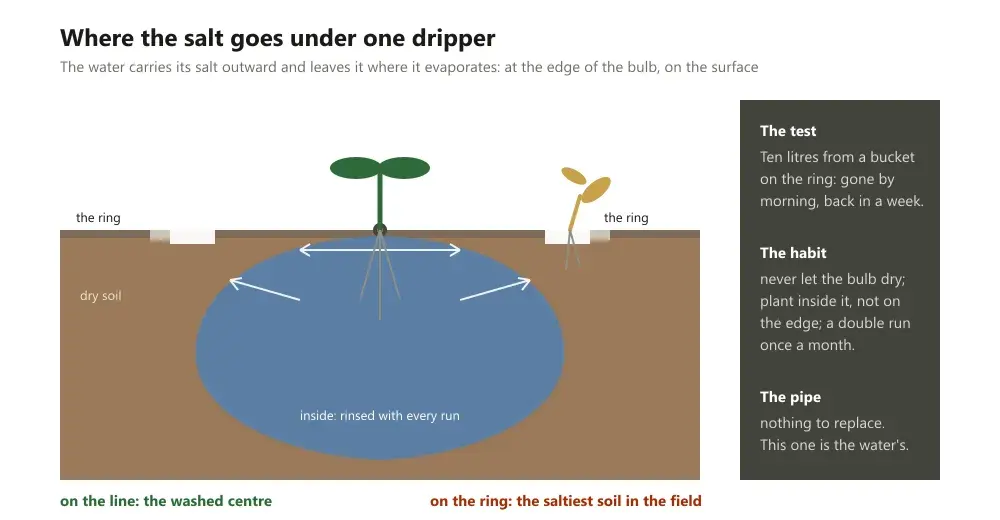
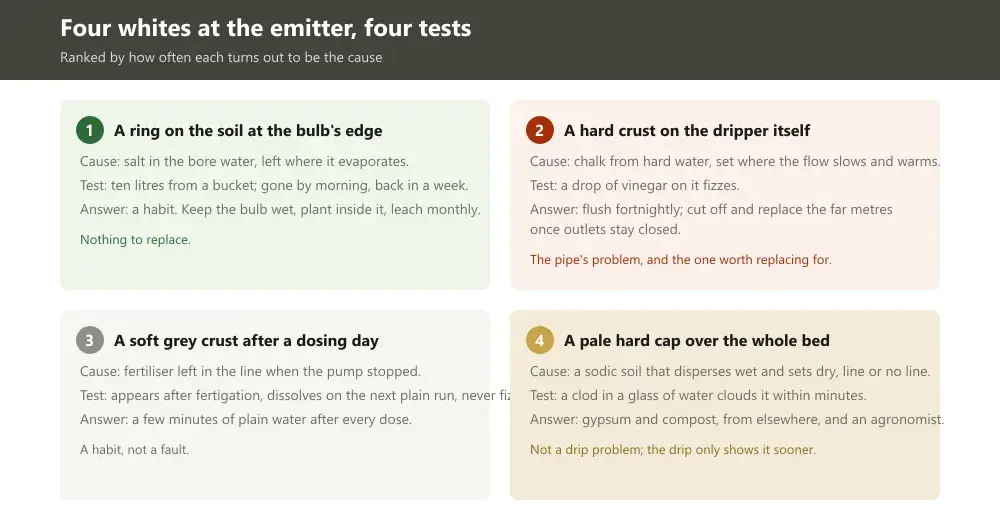
Salt crusting at the drip emitter is four different problems that look alike from standing height, and where the white sits tells them apart: a ring on the soil at the edge of the wet patch is the water's salt, a hard crust on the dripper itself is chalk, a grey crust that comes and goes is fertiliser, and a cap across the whole bed is the soil's own.
Only one of the four is the pipe's problem, and salt crusting at the drip emitter is cured more often by a change of habit than by a new lateral; the laterals, joiners and caps we list come into it only where a dripper has closed for good.
This guide ranks the four by how often they turn out to be the cause, gives the field test for each, and says which are worth repairing, which are worth replacing, and which are not a drip problem at all.
First, look at where the white is
Stand at a dripper after a dry week and look at three places: the soil surface at the edge of the wet patch, the dripper outlet and the pipe around it, and the bed surface a metre away from any line. Salt in the water travels with the water and stays where the water evaporates, so the pattern is the diagnosis.
A white ring on the soil at the edge of the bulb, with clean soil inside it, is the first and commonest cause. A crust on the dripper and the pipe, hard and grey-white, is the second. A soft greyish crust at the outlet that appears after a fertigation day and is gone a week later is the third. A pale, hard, cracked skin over the whole bed, line or no line, is the fourth, and it is not the emitter's doing.
- The ring at the bulb's edge: saline water. Most likely, and not a pipe fault.
- Hard crust on the dripper: hard water, chalk. The pipe's problem, and the one that closes outlets.
- Soft crust after fertigation: fertiliser left in the line. A habit, not a fault.
- A cap over the whole bed: sodic soil. An agronomy problem the drip only reveals.
Salt crusting at the drip emitter, cause by cause
The ring comes from the water. Every bore carries dissolved salt, the salty bores of the Nalgonda and Anantapur uplands carry a good deal, and a dripper deposits all of it: the water moves out from the outlet, wets the bulb, evaporates at the surface, and leaves its salt at the edge where the wetting stopped. Inside the bulb the soil is rinsed with every run; on the ring the salt builds all season.
The test is a bucket. Pour ten litres on the ring, wait a day, and it is gone; a week of runs and it is back. A clod from inside the bulb and one from the ring, each dropped in a glass of water and tasted after an hour, settle it for anyone without an EC meter, which we do not sell. The water requirement calculator gives the day's litres; on salty water the day's litres are also the day's salt.
Chalk is the second cause and the one the hard-water guide is about: calcium bicarbonate comes out of warm, slowing water as a crust at the outlet and inside the far end of the lateral, and a drop of vinegar on it fizzes. The soft grey crust is the third: a fertigation dose left in the line at the end of the run dries in the outlet, dissolves on the next plain run, and never fizzes.
The fourth is the soil. A sodic soil disperses when wet and sets as a hard pale cap when dry, and a clod dropped in a glass clouds the water within minutes. The blocked-line guide covers the flushing that the second and third need and the fourth does not.
Repair, replace, or neither
The ring is not repaired and nothing is replaced for it. It is managed: the bulb is never let dry out between runs, because a drying bulb pulls the salt back inward towards the roots; seedlings and transplants go inside the bulb, never on its edge, where a plant set on the ring sits in the saltiest soil in the field; and once a month a run twice the usual length pushes the ring outward and down below the roots.
The monsoon does the real leaching.
Chalk is repaired while it can be and replaced when it cannot. A fortnightly flush from the end caps clears what has not yet set, and the acid treatment that dissolves set chalk is a dealer's job with chemicals we do not sell.
The fertigation crust is a habit: a few minutes of plain water after every dose, so the line is clear when the pump stops. The sodic cap is for the agronomist, with gypsum and organic matter from elsewhere, and no lateral, dripper or filter changes it.
A dripper that is half closed by August stays half closed; the far ten metres of a chalked lateral are cut off and replaced with new pipe from the drip range, cheaper than a season of dry plants at the far end.
- Ring on the soil: manage, never replace. Keep the bulb wet, plant inside it, leach monthly, let the rains fall on bare ground.
- Chalk on the dripper: flush fortnightly; replace the far metres once outlets stay closed.
- Grey crust after dosing: plain water after every fertigation run.
- Cap over the bed: gypsum and compost from elsewhere; not a pipe problem.
Where the water is salty, the layout changes too
On a bore that leaves a ring, the layout is drawn around it. Rows go on the line, not beside it, so the plants stand in the rinsed centre of the bulb; drippers are spaced to make a continuous band along the row, because a band has two edges and separate bulbs have a ring each; and the lateral count is never cut by sharing one line between two wide rows, which puts both rows near an edge.
A thicker-walled lateral tolerates the extra flushing and the longer monthly leaching runs, and the end caps at the headland are what make the flush a habit rather than a chore. The litres and the shifts for a leaching run are the ordinary day's figures doubled, so the pump and the bore must have the hours to spare on the day it is done.
Water above about 2 dS/m of conductivity is the point at which the ring appears within a season on most soils and sensitive crops begin to pay for it; a dealer or the agriculture office can test a sample, and the result decides whether the field should be in a salt-tolerant crop at all. That decision is agronomic.
The figures are a starting point
The conductivity threshold and the leaching rule of thumb are published ranges rather than readings from your bore, and the same water leaves a ring on a light soil a year before it shows on a heavy one. Treat a monthly double run and a bulb kept wet as the first season's habit on any bore that tastes of salt, and let the ring's return tell you whether it is enough.
If you want the laterals, caps and the layout worked for a salty bore, send us the bore's test result if you have one, the crop, the row spacing and the acreage and we will say how the lines should be laid and what the leaching day asks of the pump.
Where these numbers come from
- FAO Land and Water (opens in a new tab)
Irrigation water management guidance, including scheduling and application efficiency.
- ICAR (opens in a new tab)
Indian Council of Agricultural Research — crop agronomy and regional package-of-practices.
- TNAU Agritech Portal (opens in a new tab)
Crop-wise spacing, water requirement and drip layout references for southern India.
Keep reading
Drip laterals lifting off the ground: heat, wind or the crop
Drip laterals lifting off the ground are usually growing in the afternoon heat, blowing about empty, or lifted by the crop. Four causes, a test for each.
GuidesDrip emitter spacing for cotton on sandy loam, root first
Drip emitter spacing for cotton on sandy loam puts the lateral on the plant line and the taproot down the column. Reach, root-first opening, split runs.
GuidesSprinklers throwing unevenly: six causes, ranked, with tests
Sprinklers throwing unevenly are usually short of pressure, leaking at a coupler, or worn at the nozzle. Six causes in order, with a field test for each.