Sprinklers throwing unevenly: six causes, ranked, with tests
Sprinklers throwing unevenly are usually short of pressure, leaking at a coupler, or worn at the nozzle. Six causes in order, with a field test for each.
14 November 2026 · 4 min read · REDYPLAST
Sprinklers throwing unevenly have six usual causes, and three of them account for most fields: too little pressure at the nozzle, water lost at a leaking coupler before it gets there, and a nozzle worn or half blocked. The other three are an arm that does not turn steadily, a riser that leans, and lines set too far apart for the pressure they have.
Each leaves its own pattern on the ground, so sprinklers throwing unevenly can be diagnosed in one walk with the pump running, a few empty tins and no gauge. This guide takes the six in order of likelihood, gives the test for each, and says which are a washer, which are a nozzle, and which are the layout.
We list the wearing parts of a sprinkler set, the impact nozzles, washers, latch clamps and foot bottoms; the risers and the quick-coupled mainline are not ours, and neither is a pressure gauge.
Sprinklers throwing unevenly: read the pattern first
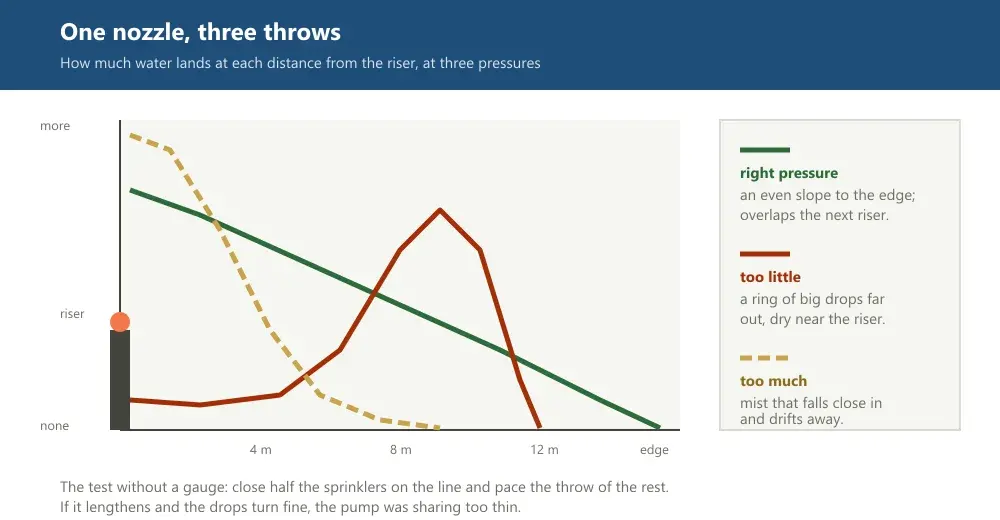
Run the set for twenty minutes and look at the ground round three or four sprinklers. An impact nozzle at the right pressure lays water in an even slope, most near the riser and thinning to the edge of its throw, and the next sprinkler's slope overlaps it into a level bed.
A ring of heavy drops far out with a nearly dry circle round the riser is too little pressure: the jet is not breaking up. A soaked patch near the riser and a fine mist that drifts away is too much. One sprinkler unlike its neighbours is that sprinkler's own fault, a nozzle or an arm. Sprinklers weakening steadily down the line are losing water on the way, and dry strips between two good lines are spacing.
- A ring far out, dry near the riser, on every sprinkler: low pressure.
- Weak throw that worsens toward the far end: leaks at couplers.
- One odd sprinkler among good ones: its nozzle or its arm.
- A wedge of wet and a wedge of dry round one riser: the arm is sticking.
- Far on one side, short on the other: the riser leans.
- Dry strips between lines that each throw well: the lines are too far apart.
The three that are usually it
Low pressure is first. The nozzles we list work between 0.5 and 3.0 kg/cm², and a pump asked to run more sprinklers than it can feed drops every one of them toward the bottom of that range. The test needs no gauge: close half the sprinklers on the line and pace the throw of the rest. If it lengthens by a few metres and the drops turn fine, the pump was sharing too thin, and the cure is fewer sprinklers a shift, not new parts.
The nozzle is third. Sandy water wears the hole oval and a leaf or a grain of grit half closes it, and either way one sprinkler throws short or lopsided beside good neighbours. The test is a swap: exchange its nozzle with the next riser's. If the fault moves with the nozzle, the nozzle is replaced; if it stays, look at the arm and the riser.
Leaks are second, and they are the cheap fix. Walk the mainline and the laterals with the pump on; every coupler should be dry, and each one that sprays is pressure the far end never sees. A hardened or missing washer is the usual cause, and the nylon threaded washer is ₹45 a piece in 75 mm and ₹54 in 90 mm. A latch that no longer pulls the joint tight is the other; the latch clamp is ₹81, or ₹99 with a spring.
The three that are sometimes it
The impact arm is fourth. It should strike and return in a steady beat and carry the head round about once or twice a minute; an arm with a weak spring or grit in the bearing stalls over one sector and hurries past another, and the ground shows a wet wedge and a dry one. Wash the bearing in clean water and watch a full turn. If the beat is still uneven the head has worn, and it is replaced as a unit.
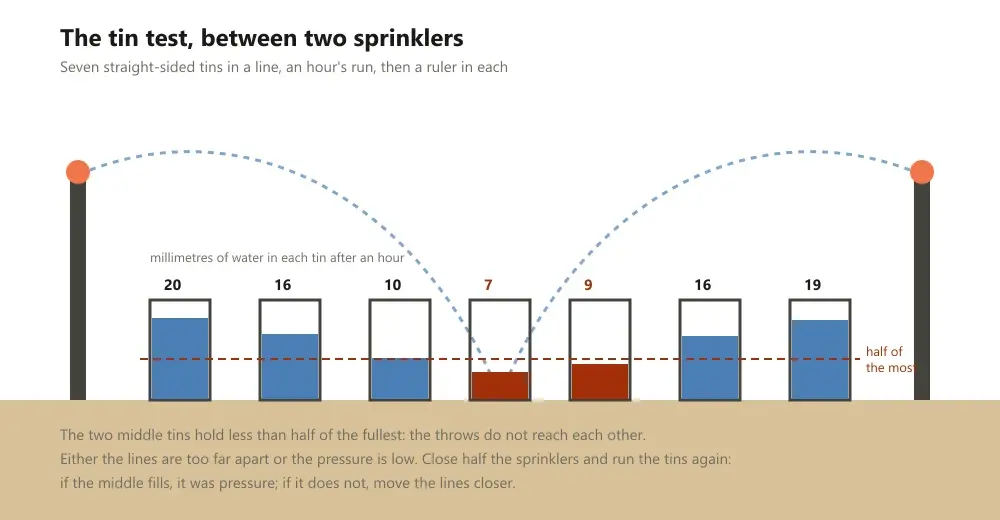
Spacing is sixth, and it is the one no part cures. Each sprinkler's throw must reach most of the way to the next riser, so the thin edge of one slope lies over the thick middle of the other. Lines pulled wider apart to cover more ground per shift leave a dry strip between them, and a steady wind narrows the throw across it and widens the strip. The tin test above settles it in an hour.
The riser is fifth. A riser that leans throws far downhill of its lean and short on the other side, and one that stands lower than the crop has its jet cut off by the leaves nearest it. Stand at the end of the line and sight along the risers; the foot bottom with iron clamp, ₹306 a piece, is what holds one upright on soft ground.
Repair, or replace
Most of this is repair, and most of the repair is small. Washers and latches are replaced the day they leak, a box of each kept at the pump house, because a set that is tight at every coupler often needs nothing else. A blocked nozzle is cleared with a soft twig, never a nail, which scores the hole and makes the wear worse.
A worn nozzle is replaced, and the material is the choice. The PVC nozzle is ₹216 in black and ₹306 in white, the aluminium ₹666, and the brass ₹1,206, each a 3/4 inch impact nozzle for the same riser; brass keeps its hole longest on sandy water, and plastic is the economical choice on clean water or for a set that is lent and borrowed. The listing shows what is in stock on the day, across the sprinkler range.
- Leaking coupler: a washer or a latch, the same day.
- One odd sprinkler: swap nozzles to find it, then replace the nozzle or the head.
- Leaning riser: a foot bottom, and a look at the ground it stands on.
- Every sprinkler ringed and dry near the riser: fewer sprinklers a shift; no part fixes a pump shared too thin.
- Dry strips between good lines: move the lines closer, and water at dawn before the wind.
When the set is the wrong tool
A set that passes every test and still leaves a crop uneven is sometimes the wrong system for the field: a small bore that cannot hold pressure, a windy slope, or a row crop that wants its water at the root. The drip against sprinkler guide covers that choice, and it is better made before a second set of nozzles is bought than after.
The tests and the half-as-much rule for the tins are working rules rather than measurements from your field. If you want the wearing parts counted for a set, or a second opinion on whether the pump can carry it, send us the number of sprinklers, the pipe size, the pump and what the tins showed and we will say what to replace and how many sprinklers a shift the pump should run.
Keep reading
Fixing pressure dropping mid-season in a rain pipe system
Pressure dropping mid-season in a rain pipe system means something changed since week one: the bore, the lines, leaks or silt. How to find which, and fix it.
GuidesFixing uneven flow at the far end in a rain pipe system
Uneven flow at the far end of a rain pipe has three usual causes. Here they are in order of likelihood, with a field test and an honest fix for each.
GuidesRats chewing drip lateral pipe: thirst, cover or the shed
Rats chewing drip lateral pipe do it for water, for cover, or in the shed, and each leaves its own mark. Read it, then choose a joiner or a new length.