Drip laterals lifting off the ground: heat, wind or the crop
Drip laterals lifting off the ground are usually growing in the afternoon heat, blowing about empty, or lifted by the crop. Four causes, a test for each.
15 November 2026 · 5 min read · REDYPLAST
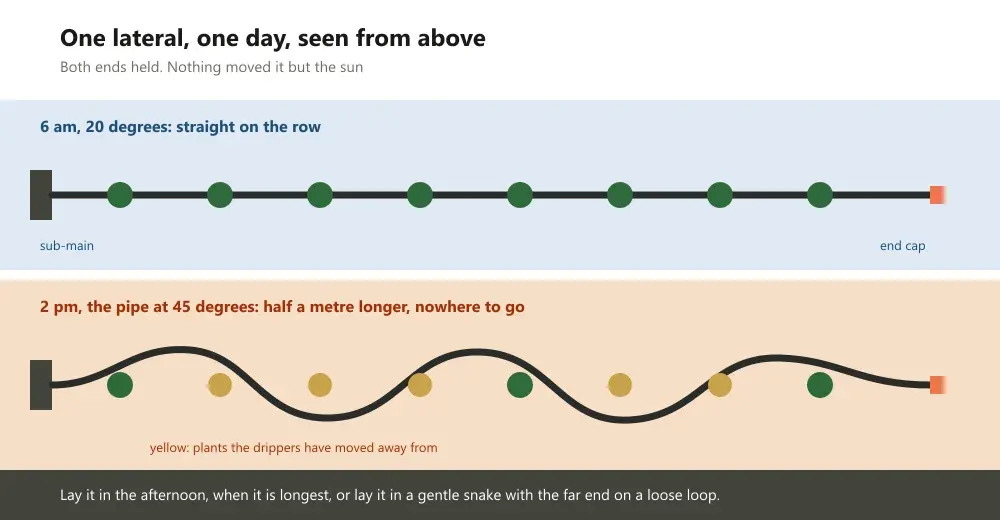
Drip laterals lifting off the ground have four usual causes, and the commonest is not a fault at all: polyethylene lengthens as it warms, so a line laid straight and tight in the cool of the morning humps and snakes off its row by afternoon. The others are wind on an empty tape, a crop growing up under the line, and the twist a coil keeps when it is pulled off the wrong way.
It matters because the dripper moves with the pipe. Drip laterals lifting off the ground put water where the plant is not, and on a light soil a dripper a hand's width off the row is a dry plant. This guide ranks the four, gives the test for each, and says what is relaid, what is repaired with a ₹6 fitting, and what little is ever replaced.
Drip laterals lifting off the ground: look twice in one day
The test that separates the causes costs two walks. Look at the same lateral at six in the morning and again at two in the afternoon, and look at a still day and a windy one.
A line that lies flat and straight at dawn and stands in humps or wanders off the row after midday is heat. A line that is on the row when it is running and off it the next morning, after a night's wind, was blown while it was empty. A line that sits higher each week, threaded through stems, is being lifted by the crop. And a line that has stood in even loops since the day it was laid, hot or cold, still has the coil in it.
- Flat at dawn, humped and wandering by afternoon: heat.
- Moved after a windy night, on bare beds, thin tape: wind on an empty line.
- Higher every week, tangled in stems or weeds: the crop.
- Even loops from the first day, the same at any hour: coil twist.
Heat: the line is longer after lunch
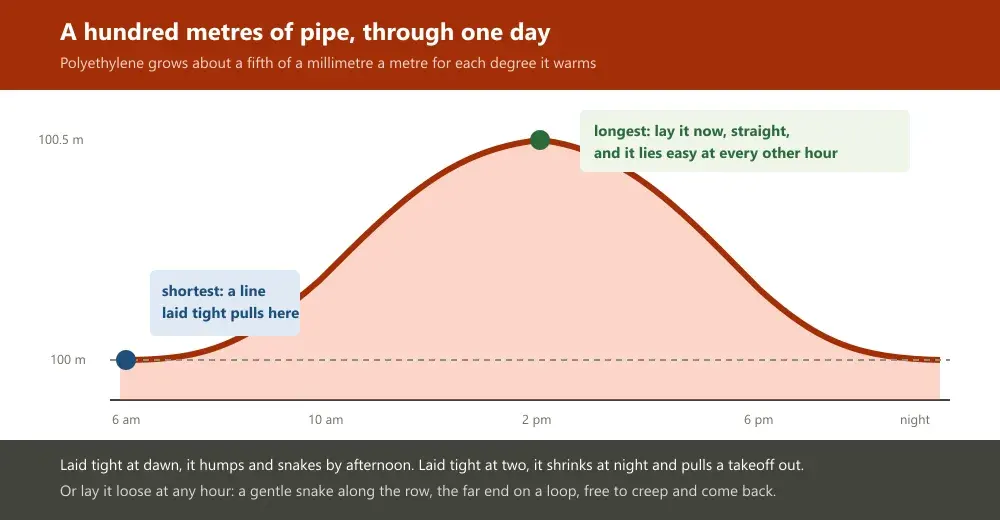
Polyethylene grows by about a fifth of a millimetre in every metre for each degree it warms. That sounds like nothing, and across a hundred-metre lateral between a 20 degree dawn and a black pipe at 45 or 50 in the April sun it is half a metre or more of extra pipe, with both ends held. The line can only go sideways or up.
The cure is in the laying, and nothing is bought for it. Lay laterals in the warm part of the day, when they are at their longest, or lay them in a gentle snake along the row with a hand's width of wander every few metres, so the line has slack to take up as it cools and room to give as it warms. The far end is held by its cap on a loose loop round a stick, never tied back tight to a peg.
The reverse fault is the costly one. A lateral pulled straight at two in the afternoon shrinks by the same half metre at night, and what gives is the weakest joint: the takeoff pulls out of the sub-main, or the end cap comes off. A takeoff found lying beside its hole on a cold morning was pulled, not pushed, and the line needs slack, not a tighter fit.
Wind, the crop and the coil
Wind is second, and it is a thin-tape problem. A 0.2 mm flat tape weighs very little when it is empty, and on a bare bed before the crop covers it a night's wind rolls it off the crown or flips it over.
It is held with a handful of soil across it every three or four metres, or under the mulch where there is one, or with wire pins from elsewhere, because we stock no pegs. A tape that keeps flipping is laid dripper side up and pinned at the flips.
The crop is third. Cane shoots come up under a lateral and carry it with them, a gourd vine or a weed grows through and over it, and a banana sucker lifts it off the mound. The test is that the line is in the plants, not on the soil.
The cure is timing: weed and earth up first, then lay or relay the line, and in a crop that will bury the bed, set the lateral where the stems will not be, in the furrow or a hand to one side of the row.
The coil is fourth and it is made on the first day. Round inline pipe pulled off the side of a coil lying flat keeps one twist for every turn, and it lies in the field as a row of loops with the drippers facing every way. Unroll with the coil upright and turning, on a stick through its middle, so the pipe comes off straight; leave it in the sun for an hour to relax before connecting; and turn it dripper side up as the caps go on.
Relay, repair, or replace
Almost all of this is relaying, and it costs an hour. A heat-snaked or wind-blown line is lifted back onto the row in the afternoon, with slack left in it, and that is the whole job.
Repair is for what the movement broke. A takeoff pulled out is pushed back, and one that has split is replaced with a 16 mm takeoff at ₹6. A sharp kink where a hump folded stays a weak, narrow place for the life of the pipe: cut a hand's width out and put in a joiner, also ₹6. An end cap lost overnight is the same ₹6, and worth keeping a few of in the pump house, because a line without one runs its water out of the end.
Replacement is rare. A length is replaced when it has kinked in so many places that the joiners themselves start to cost pressure, which the rat-damage guide puts at about ten in a hundred metres, or when a twisted line has aged so stiff that it will not lie flat however it is turned. New lengths come from the drip range; the round inline pipe lies heavier and moves less than the thin tape, and is the one to choose for a windy, bare field.
- Heat or wind moved it: relay in the afternoon, with slack. Nothing to buy.
- Takeoff pulled or split, cap lost, one sharp kink: a ₹6 fitting each.
- Kinked every few metres, or too stiff to lie flat: replace the length.
- Thin tape that will not stay on a windy bed: soil across it, or the heavier pipe next time.
The rules of thumb are a starting point
The fifth of a millimetre a metre for each degree is the usual figure for polyethylene pipe, and the half metre on a hundred-metre line follows from it; your own line, in your own sun, will tell you more than the arithmetic. If the far end creeps past its stick by afternoon and back by dawn, the line is free to move, which is what you want.
The leaking-joints guide covers the takeoffs and caps themselves. If you want the fittings and the pipe counted for a field that will not lie still, send us the row length, the number of rows, the pipe you have and what the two walks showed and we will say what to keep in the pump house and which line to lay next.
Keep reading
Rats chewing drip lateral pipe: thirst, cover or the shed
Rats chewing drip lateral pipe do it for water, for cover, or in the shed, and each leaves its own mark. Read it, then choose a joiner or a new length.
GuidesFixing laterals lifting off the ground in a rain pipe system
Laterals lifting off the ground in a rain pipe system can be a flat hose rolling as it fills, or moving in the wind. Three causes, each with its test and fix.
GuidesSprinklers throwing unevenly: six causes, ranked, with tests
Sprinklers throwing unevenly are usually short of pressure, leaking at a coupler, or worn at the nozzle. Six causes in order, with a field test for each.