Drip emitter spacing for cotton on sandy loam, root first
Drip emitter spacing for cotton on sandy loam puts the lateral on the plant line and the taproot down the column. Reach, root-first opening, split runs.
15 November 2026 · 5 min read · REDYPLAST
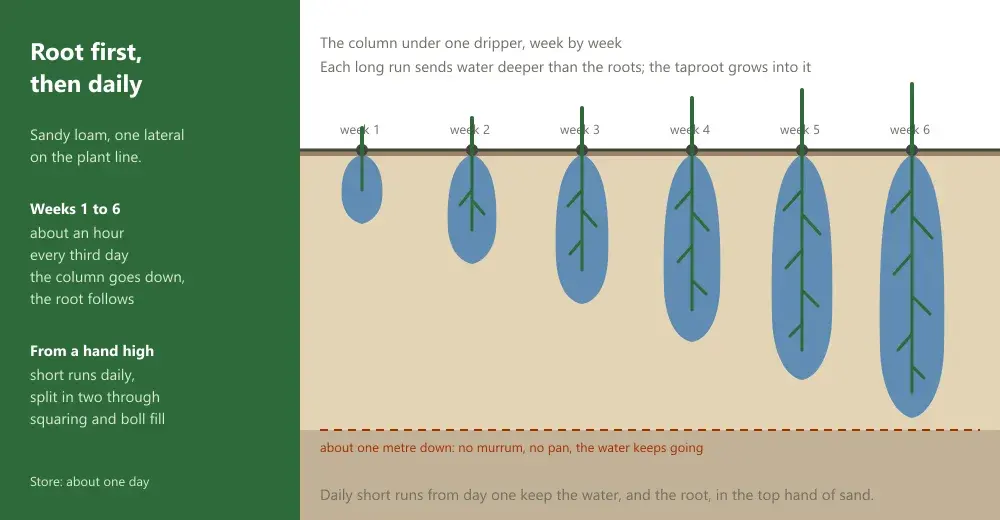
Drip emitter spacing for cotton on sandy loam has to be read from the taproot, because the soil itself holds about a day of water: the 40 cm drippers on every inline pipe we list wet a narrow column that cotton's root can follow a metre down, and the plan is to build that column deep in the opening weeks and then keep the top of it filled with short daily runs.
Drip emitter spacing for cotton on sandy loam is therefore one lateral on the plant line, not beside it, and a season that opens slow and then runs fast.
Sandy loam carries cotton on the lighter stretches of Khammam, Nalgonda and the Guntur uplands, where the crop meets a hot September on a soil that stores almost nothing. This guide covers the column and where the lateral must lie, the root-first opening, the minutes through the season, and the fertigation habit sand charges for.
The column, and the lateral on the line
Under a 4 litre dripper sandy loam wets a column 35 to 50 cm across and far deeper than it is wide; there is no murrum or clay pan to catch it, so an hour's run is half a metre down and still going. Drippers 40 cm apart merge into a narrow strip along the lateral, and the sideways pull ends about 20 cm from the pipe.
On red loam the lateral is laid 10 to 15 cm off the plant line. On sandy loam that offset eats most of the reach, and a seedling 15 cm from a line whose bulb ends at 20 cm lives on the edge of the water. The lateral goes on the plant line here, and sowing follows the pipe: lay, run once to mark the wet spots, and dibble into them.
The cotton crop page says row spacing decides the pipe; on sand it also decides how far from the pipe a plant may sit, which is almost nowhere.
- Column: 35 to 50 cm across, a metre deep after a long run, no pan to stop it.
- Reach: about 20 cm each side of the lateral, so the plant line sits on the pipe.
- Store: about a day in the root zone, so a skipped day is a dry plant.
Drip emitter spacing for cotton on sandy loam, row by row
One lateral per row at the 0.9 to 1.2 metres cotton is sown, which at 0.9 metres is about 4,500 metres of lateral on an acre. The paired layout that saves pipe elsewhere, two rows around one line, works on this soil only when the pair is 40 cm apart or less, so that both rows sit inside the reach.
The 45 cm pair that heavier soils allow leaves each row 2 or 3 cm past the bulb, nothing on paper and a wilting row in May. Tight pairs at 1.6 metres between pairs put about 2,500 metres on the acre, and the choice is made at sowing.
The cotton conversion guide prices both counts against the wall thickness a season in the sun demands. The lateral is 16 mm inline from the drip range, and its 40 cm spacing already suits seed at 30 to 45 cm along the row.
Root first: the opening weeks
Cotton's taproot reaches a metre on any soil that lets it, and sandy loam lets it; the only store the crop will have in September is the depth that root has reached by July. So the opening is the one time the run is long and the interval is not daily.
Short daily runs from day one grow a shallow crop on sandy loam, and that crop reads the first missed day in September as a drought.
From emergence to a hand high, runs of about an hour every third day send the column 60 to 80 cm down, and the root follows the water instead of coiling in a wet top ten centimetres. The cotton drip guide covers the dry commissioning a pre-monsoon sowing forces; on sand that run is also the first deepening run.
The minutes, then the season
A dripper every 40 cm at 4 litres an hour puts 10 litres an hour onto each metre of lateral, and on rows 0.9 metres apart that metre serves 0.9 square metres, so the line applies about 11 mm an hour. Six millimetres is about 32 minutes and four is about 22; on tight pairs at 1.6 metres the rate drops by nearly half and the minutes nearly double.
From a hand high the schedule turns daily, and in the squaring and boll-filling weeks the day's minutes go in as two runs, early morning and late afternoon, because a single 32-minute run on sand sends its second half past the roots.
Cotton in active growth uses about 4 to 6 mm a day, which on one acre is roughly 16,000 to 24,000 litres at the root, or about 18,000 to 27,000 litres from the pump once drip's losses are allowed for; the water requirement calculator gives the figure for your own acreage.
The monsoon changes less than growers expect. The column is empty within a day of the last shower, so the pump restarts the day after rain, not the week after; the red-loam cotton guide makes the same point about a soil that holds two days, and sand holds one.
Fertigation on sand
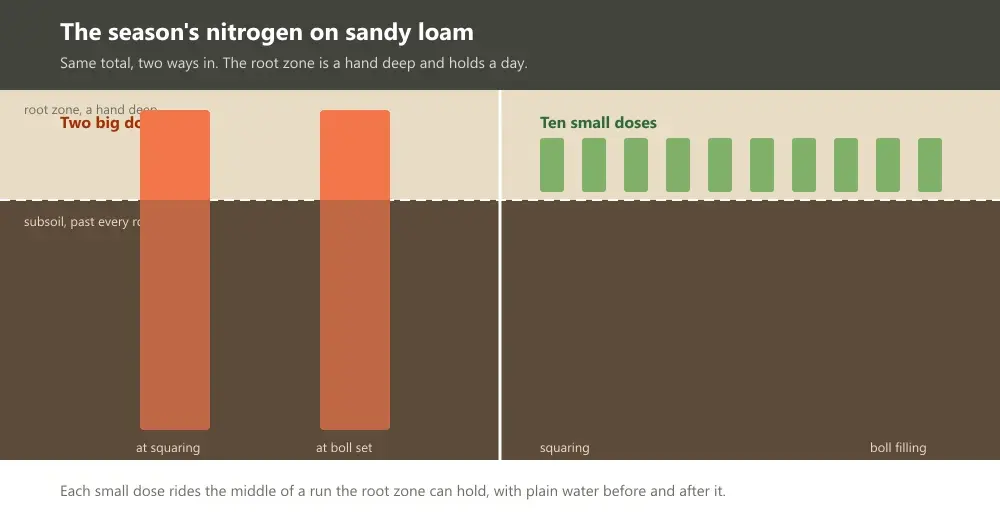
Nitrogen is where sandy loam collects. A urea dose injected at the start of a long run goes down with the water that passes the roots, and the crop that was fertigated generously is the one with pale leaves in August.
The dose goes into the middle of a short run, plain water before and after, and the season's nitrogen is split into eight or ten small doses from squaring to boll filling rather than two large ones. The venturi or dosing unit that injects it is not something we stock.
A blocked dripper on this soil shows within a day as one plant flagging; the blocked-line guide covers flushing, and the filter it depends on is not ours to sell.
- The lateral 15 cm off the plant line: a row on the edge of the bulb, wilting first in May.
- Short daily runs from day one: a shallow root, and the first missed day in September read as drought.
- An hour's run at boll filling: half the water past the roots and the day's nitrogen with it.
- The check: a trowel a hand deep on the plant line the morning after a run; moist is right, wet below and dry on top is a run too long.
The figures are a starting point
The 4 to 6 mm a day and the column widths are published agronomic ranges rather than readings from your field, and sandy loams grade from nearly sand to nearly loam between one bund and the next. On the sandier end the opening runs are shorter and closer together; on the loamier end the red-loam schedule is nearer right. Treat an hour every third day until a hand high, then 32 minutes in two halves, as the first schedule and let the trowel move it.
The same crop on heavier ground is worked in the alluvial cotton guide, and the same soil under beds in the sandy-loam vegetables guide. For the coil count and the shifts sized to your row plan and bore, send us the row spacing, the acreage and the bore yield and we will say how many coils the field takes and how many runs a day the pump must give.
Where these numbers come from
- FAO Irrigation and Drainage Paper 56 (opens in a new tab)
The reference method for crop evapotranspiration and crop coefficients that daily water figures derive from.
- ICAR (opens in a new tab)
Indian Council of Agricultural Research — crop agronomy and regional package-of-practices.
- TNAU Agritech Portal (opens in a new tab)
Crop-wise spacing, water requirement and drip layout references for southern India.
Keep reading
Drip emitter spacing for pomegranate on sandy loam, in short runs
Drip emitter spacing for pomegranate on sandy loam is a ring of narrow columns that empty by evening. The ring per bush, the short runs, fertigation on sand.
GuidesDrip emitter spacing for vegetables on sandy loam, bed by bed
Drip emitter spacing for vegetables on sandy loam decides whether one lateral can serve a two-row bed. The beds that work, the minutes a day, the leaching trap.
GuidesDrip emitter spacing for cotton on alluvial soil: pairs on ridges
Drip emitter spacing for cotton on alluvial soil lets a pair of rows share a lateral on a ridge, as the bulb is wide. The pair, the minutes, the wet-feet rule.