Fixing uneven flow at the far end in a rain pipe system
Uneven flow at the far end of a rain pipe has three usual causes. Here they are in order of likelihood, with a field test and an honest fix for each.
12 October 2026 · 4 min read · REDYPLAST
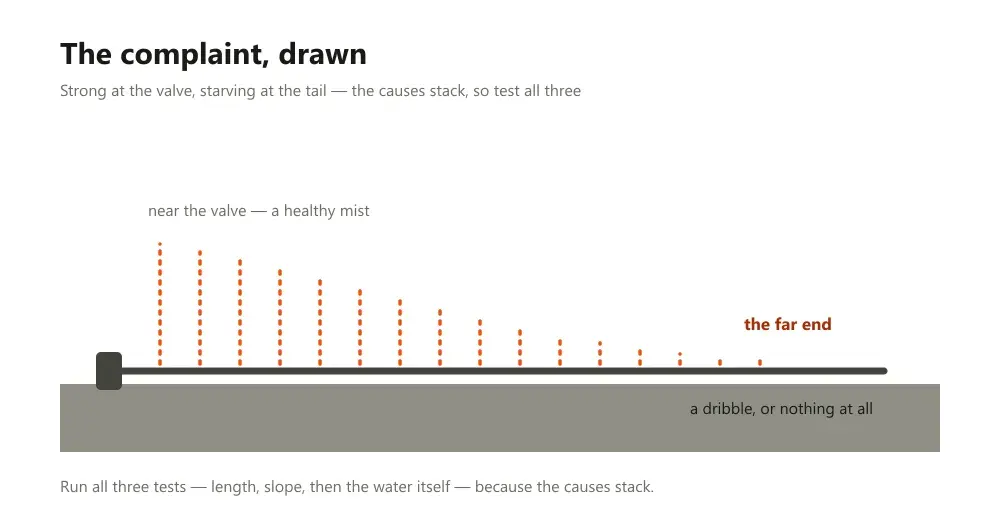
Uneven flow at the far end is the classic rain pipe complaint: strong mist near the valve, a sad dribble at the tail. The causes rank in a usual order — the line is too long for the pressure, the line is climbing, or the water is dirtying the holes — and each has a two-minute field test. Run all three, because the causes stack; a line can be a little long and a little uphill at once.
Before anything: the two-minute checks
Rule out the cheap answers first. Stand at the near end: if the spray is weak there too, the problem is upstream — a valve not fully open, a pump sharing its water, a pump asked for more flow than it has, a main too narrow for the line, a suction problem at the bore. The sharing case hides well: a line that behaves most days and starves only when something else runs is not a pipe problem at all. Fix the source before blaming the line.
Then walk the run. A half-twist, a kink at a corner, or a fold pressed in by a passing wheel chokes everything past it, and the line downstream of the choke mimics a far-end problem exactly. The tell is the suddenness: flow that is fine, fine, fine and then poor from one point onward has a choke at that point, not a length problem.
Cause one: the line outruns the pressure
The most likely answer is the simplest. Every metre of line spends a little pressure moving the water, and every open hole spends some throwing it; a run long enough eventually spends what the pump supplies, and the tail gets what is left — which is not enough. The family's listed working pressure is 1 to 1.5 kg/cm² at the pipe, and no listing states a maximum run, so the limit is yours to find, not look up.
The test: run the line alone, nothing else drawing on the pump, and compare the throw at both ends. A healthy near end with a gradual fade points here — but slope and silt fade the same way, so confirm it: feed the line from its other end for one watering. If the weakness follows the feed to the new far end, it is length; if the same ground stays weak, read the next two sections.
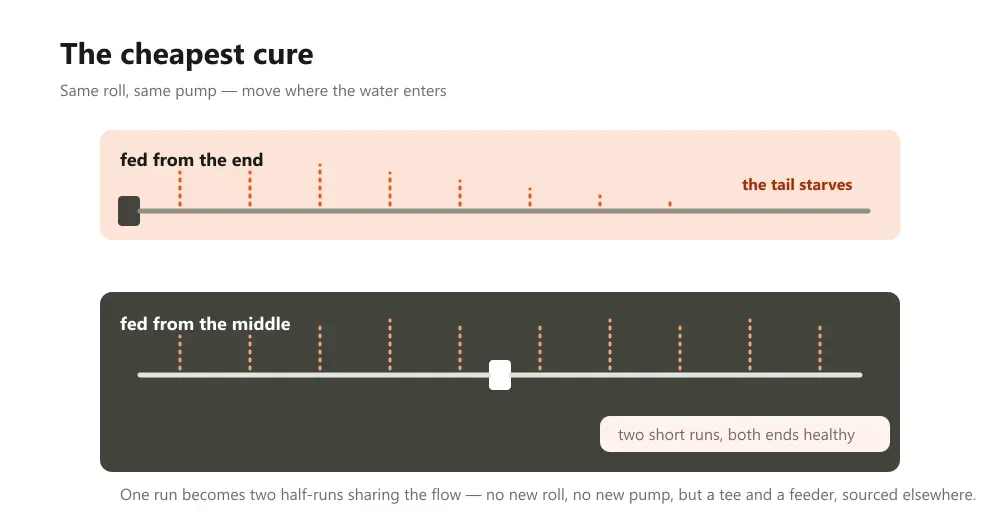
The fix is never to push past the listed 1.5 kg/cm². Run shorter lines fed in turn, or feed the same line from its middle — two half-runs sharing the flow. Cheapest in pipe, not in parts: the middle feed needs a tee and a feeder as wide as the line, turn-taking needs a cock per line — none of which we list. Joining rolls end to end does not work; the groundnut and vegetable guides say test one lateral first — this complaint is what it catches.
Cause two: the line is climbing
Water pays for height before it pays for distance. A line that looks flat but rises gently toward its tail loses pressure to the slope on top of the length, and the far end starves sooner than the same line laid level.
Do not trust your eye here — a rise too gentle to see still costs roughly 0.1 kg/cm² per metre of height, a real bite out of a 1 to 1.5 window. Test it with a clear hose filled with water held at both ends, a line level, or the spirit level in a phone. The fix is layout, not hardware — run the lines across the slope on the level, feed from the uphill side where the field allows it, and keep the climbing runs short.
Cause three: the water, not the pipe
Spray holes are small, and water with silt in it closes them slowly — usually from the tail backwards, because the tail is where the flow slows and the load settles. The listing itself says filtration depends on water quality; a silty bore or an open tank is exactly that case.
The test is the flush: open the far end — untie it — and run the line hard for a minute. If the first water out runs dirty, the line has been collecting what the source carries.
The fix is a flushing habit — at season start, after any work upstream, and regularly on a source that carries silt — plus screening the source itself; we stock no filters or screens, so that part is budgeted elsewhere, as the rain pipe guide says plainly. A settling tank helps with sand, though not with the organic load an open tank grows; draw from above the floor either way.
Repair, or replace
A line with torn or enlarged holes upstream bleeds pressure before the tail ever sees it — common where a roll was dragged or a hole was widened by hand. Be honest about the hardware here: we list no rain-pipe joiners or menders, so a mid-line repair means a coupler sourced elsewhere, or retiring the damaged stretch and keeping the good length for a shorter duty.
That retirement is rarely a loss — a 100 metre roll with a bad stretch past 60 is still a healthy 60 metre line for a smaller block, and most farms have a smaller block waiting.
Replace rather than nurse when the wall itself is tired: multiple splits, holes wearing wide across whole stretches, a line that has lived its summers in the open. A fresh 40 mm roll lists at an MRP of ₹1,320 and a 63 mm at ₹3,780, tax included, on the rain pipe listing — the listing may show a discount off these — and against an afternoon of chasing leaks every watering, the arithmetic usually speaks for itself.
Preventing uneven flow at the far end
Three habits prevent almost every return of the problem. Test one lateral on your own pump before a field is cut into lines — the far-end dribble is cheapest to discover on day one. Flush the tail at season start, after any work upstream, and regularly on silty water. And store the roll well between seasons — drained, coiled loose, off the floor in shade, per the pipe-life guide — because a wall that spent the summer baking returns weaker everywhere, and the tail is where the loss shows first.
If the line still will not behave after the three tests, the problem is usually the match between pump and layout rather than the pipe — send the details and we will look at the whole chain, from bore to far end, before you buy anything.
Keep reading
Rain pipe irrigation benefits, and where they stop
Rain pipe irrigation benefits, priced per roll — why a fine shower on a small pump suits close-sown crops, and the fields where it fails.
GuidesRain pipe for cotton: sizes, prices and pitfalls
Rain pipe for cotton does one job well — the even start — and this guide separates it from the mid-season rescue, with sizes and real prices.
GuidesRain pipe for sugarcane: sizes, prices and pitfalls
Rain pipe for sugarcane has one honest window each cycle — setts to canopy — and this guide covers it: the 75 mm size, prices and pitfalls.