Rain pipe for sugarcane: sizes, prices and pitfalls
Rain pipe for sugarcane has one honest window each cycle — setts to canopy — and this guide covers it: the 75 mm size, prices and pitfalls.
9 October 2026 · 4 min read · REDYPLAST
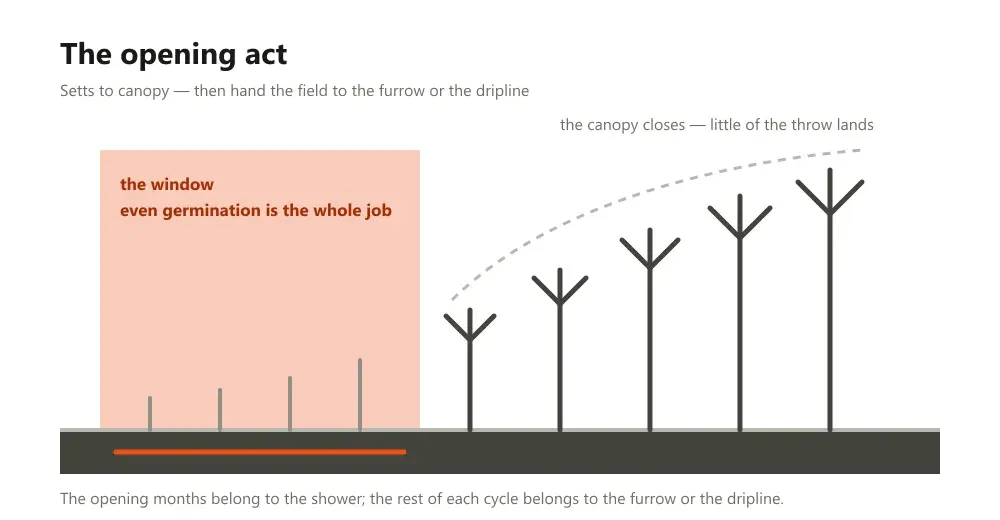
Rain pipe for sugarcane has one honest window per crop cycle, and this guide is built around it: from planting the setts to the month the canopy closes over the rows. Inside that window a gentle overhead shower is exactly what young cane wants; after it, the crop itself blocks the spray, and the job passes to the furrow or the dripline. Here are the sizes that fit, what the rolls cost, and the pitfalls that go with a crop this tall.
The window: setts to canopy
Newly planted setts want the soil around them kept steadily, lightly moist until germination is even — a dry fortnight at this stage is gaps in the stand that no later watering repairs. Light, frequent wetting is the standard early-stage advice behind our sources, and that is precisely the water a rain hose throws.
What "light and frequent" means in practice is short rounds, often, instead of the furrow's heavy turns — enough each time to wet down to the sett, never enough to stand. That rhythm is a discipline the valve makes cheap and the channel makes impossible. Run the rounds early in the morning, while the air is still, and the throw lands where it was aimed.
The ratoons reopen it, though, and that changes the arithmetic. Every ratoon restarts the stand from stubble, and those new shoots want steady early moisture much as the setts did — on their own, usually shorter, clock. A crop cycle of plant cane and two ratoons gives the same rolls three working windows, each briefer than the first, and a purchase that looks thin against a single season looks different across the years one planting actually lives.
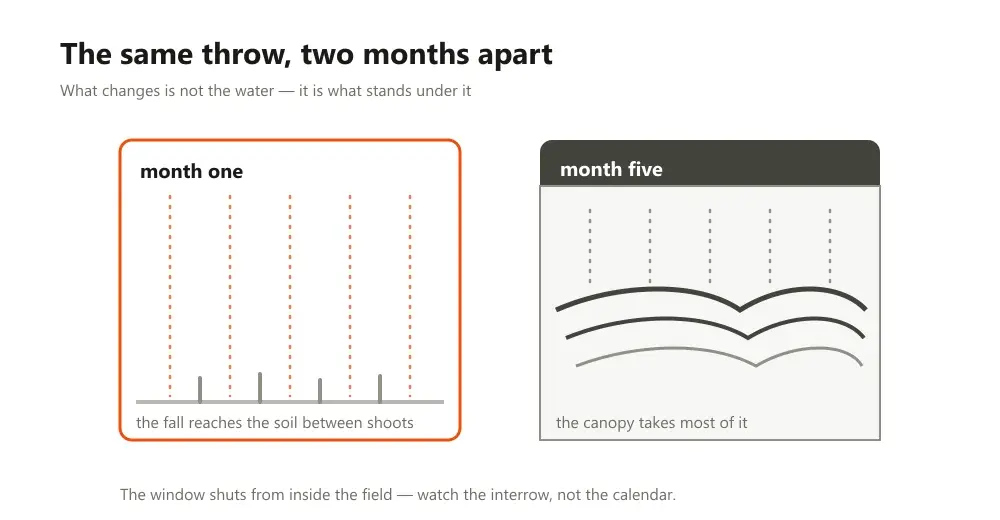
The window closes on its own schedule. As the stand thickens and rises, the leaves take more of every throw, the interrow the spray once reached disappears, and overhead water becomes canopy water. By then the field has moved to the furrow and its lapeta roll, or — for the stand planned that way from the start — to the dripline buried beside the row. Rain pipe is the opening act, never the whole play.
Which rain pipe for sugarcane: the 75 mm
Sugarcane stands first on the 75 mm size's own use list, and that is the size this crop means:
The pressure line is unchanged across the family: 1 to 1.5 kg/cm² at the pipe, listed on every size. No flow figure per roll is published, so the one-lateral test, run on your own pump, is what proves the length — not a chart, and not this page.
- **75 mm × 100 m** is the cane roll — the one the maker's list names for sugarcane outright.
- **63 mm** serves the rotation around the cane: its own list runs cotton, maize, groundnut, chilli, pulses and vegetables, and does not name cane itself — ask before putting it on the cane block.
- The smaller sizes belong to nurseries and vegetable beds — wrong scale for this crop entirely.
Rolls, prices and the honest arithmetic
Now the honesty: covering a full acre with lines at the house planning width of roughly seven metres means nine or ten lines — 570 to 640 metres of hose, six or seven rolls. At 75 mm that is ₹26,460 to ₹30,870 for the hose; at 63 mm, ₹22,680 to ₹26,460. All of it serves a window of roughly three to four months per cycle.
From the rain pipe listing, MRP with 5% tax inside:
Bought for cane alone, that is a hard sum against the furrow guide's own rolls — its 4 inch, 150 metre tarpaulin is ₹7,920 with 18% inside, and carries the whole season. The purchase makes sense in three cases: the block small enough that one or two rolls cover it; the stand kept through its ratoons, where the same rolls earn three windows; or the farm whose rotation — maize after cane, vegetables between — keeps the rolls working all year on the 63 mm's own crop list. Name your case before ordering.
- 75 mm × 100 m: ₹4,410 a roll.
- 63 mm × 100 m: ₹3,780 a roll.
Pitfalls with a crop this tall
- **Staying past closure.** The commonest mistake is the calendar's: the shower that worked in month two is still running in month five, wetting leaves while little reaches the soil. The tell is simple — walk the interrow during a round, and if your feet stay dry while the leaves drip, the water stopped farming weeks ago.
- **Trash underfoot on ratoons.** A ratoon field is carpeted in dry leaf exactly when the new shoots want their showers. Clear the lanes the lines lie in — cane trash is as hard on a thin wall as any litter a field produces.
- **Laying across the rows.** Run lines along the interrow, never across the rows — the lanes are the only ground that stays open to lay, lift and walk as the stand rises.
- **Skipping the length test.** One lateral, run on your own pump, before the rest are cut — the far-end dribble is cheaper to discover on day one than mid-germination.
- **Most of the year idle.** A cane-only roll waits out far more months than it works. Drained, loosely coiled, off the floor and shaded — [the pipe-life guide](/blog/making-your-pipe-last) carries the roll from one planting to the next.
Buying it for a cane farm
Decide the rotation question first, because it decides everything else: a farm where the rolls serve maize, vegetables or pulses after cane buys with confidence; a cane-only farm should price the window honestly against the furrow kit most cane farms already run. Where neighbours' planting dates genuinely stagger, a shared set of rolls serving more than one farm's window is a possibility worth arranging — a possibility, not a plan to assume. The sugarcane crop page keeps the agronomy beside the parts, and the water calculator gives the young stand's rough daily budget.
Rain-pipe joiners, cocks and end closures are not parts we list — plan those separately when the layout needs them. For a block that does not fit the tidy cases, send the measurements and we will size the rolls against your pump, your rows and your real window.
Where these numbers come from
- ICAR (opens in a new tab)
Indian Council of Agricultural Research — crop agronomy and regional package-of-practices.
- TNAU Agritech Portal (opens in a new tab)
Crop-wise spacing, water requirement and drip layout references for southern India.
Keep reading
Rain pipe for vegetables: sizes, prices and pitfalls
Where rain pipe for vegetables earns its keep — the leafy, close-sown blocks and the replant rhythm — with sizes, roll prices and pitfalls.
GuidesRain pipe for chilli: sizes, prices and pitfalls
Where rain pipe for chilli genuinely fits — the nursery and the unconverted field — with the right sizes, real roll prices and the pitfalls.
GuidesRain pipe for groundnut: sizes, prices and pitfalls
Which rain pipe for groundnut — 40, 63 or 75 mm — with real roll prices, the layout that suits the pod zone, and the pitfalls that waste a roll.