Rain pipe for cotton: sizes, prices and pitfalls
Rain pipe for cotton does one job well — the even start — and this guide separates it from the mid-season rescue, with sizes and real prices.
12 October 2026 · 4 min read · REDYPLAST
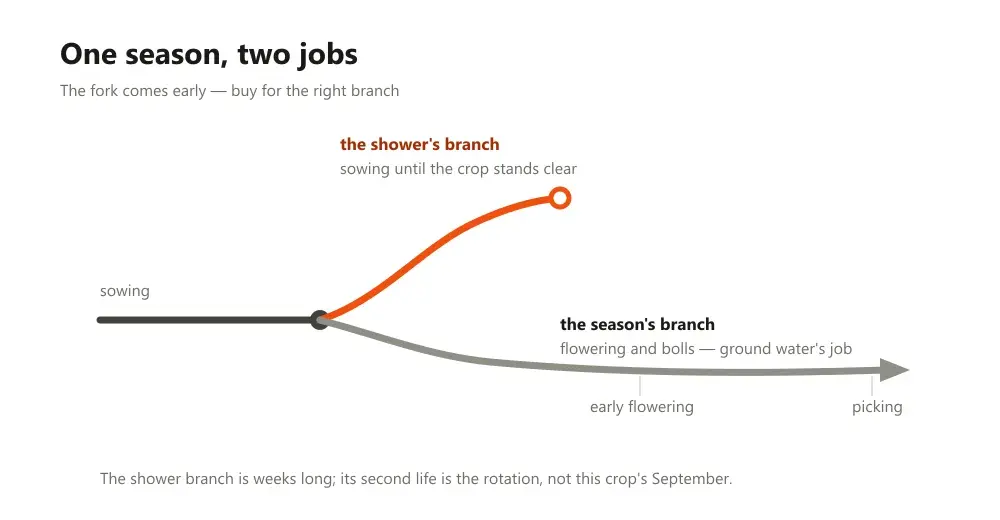
Rain pipe for cotton does one job genuinely well, and this guide keeps it separate from the job it does not: the shower belongs to the start of the season — germination and the young stand — while the mid-season rescue watering belongs to a different, cheaper roll entirely. Mixing them up is how the wrong pipe gets bought; here are both jobs, with the sizes and the real prices.
The job it does: the even start
Cotton here is mostly sown to meet the monsoon, and the gamble at sowing is evenness: seed that waits dry for a late rain comes up in patches, and gaps get filled late or carried all season. Where a bore exists, one light watering at sowing — and light, frequent rounds until the crop stands clear — narrows that gamble, and a shower delivers the watering evenly across the whole width: a low-pressure spray, 1 to 1.5 kg/cm² listed, far softer than a flood.
A crusted surface is hard on young cotton, so on soils that seal, keep the first rounds especially light — gentleness at this stage is what the method is for.
The placement is partly the maker's and partly ours: "small cotton plots" sits on the 40 mm roll's use list in exactly those words, while the start-of-season framing is this page's own judgement. The early-morning round, run while the air is still, is the whole routine — and once the crop stands clear of the spray, the shower's cotton work is done for the year.
The job it does not: the rescue
The waterings that save a cotton season later — at flowering and boll fill — are a different problem. By then the crop is tall, the canopy takes the throw, and wet leaves are a risk the crop does not need; the cotton lapeta guide covers that rescue honestly, with rolls that start at ₹720 and wait in the shed for the dry fortnight that calls them.
We would not buy rain pipe for that job — by September the canopy takes the spray before the soil sees it. And for the field watered every year rather than rescued in bad ones, the answer is not a shower at all: drip pays back faster on cotton than on any other field crop, which is also what our own planning tool recommends for this crop.
Which rain pipe for cotton: 63 and 40
The listed working pressure is the family's usual 1 to 1.5 kg/cm², and no flow figure per roll is published — so the one-lateral test on your own pump decides the length before the rest of the rolls are cut.
- **63 mm × 100 m** carries cotton by name — first on its own use list, ahead of maize, groundnut, chilli, pulses and vegetables. That list is the point: it is the rotation's roll, not just cotton's.
- **40 mm × 100 m** names small cotton plots on its list, in those words.
- **75 mm** does not list cotton; its list is cane, banana, turmeric, fodder and the large groundnut and maize fields. The garden sizes do not list cotton either.
Prices, and the arithmetic that decides the buy
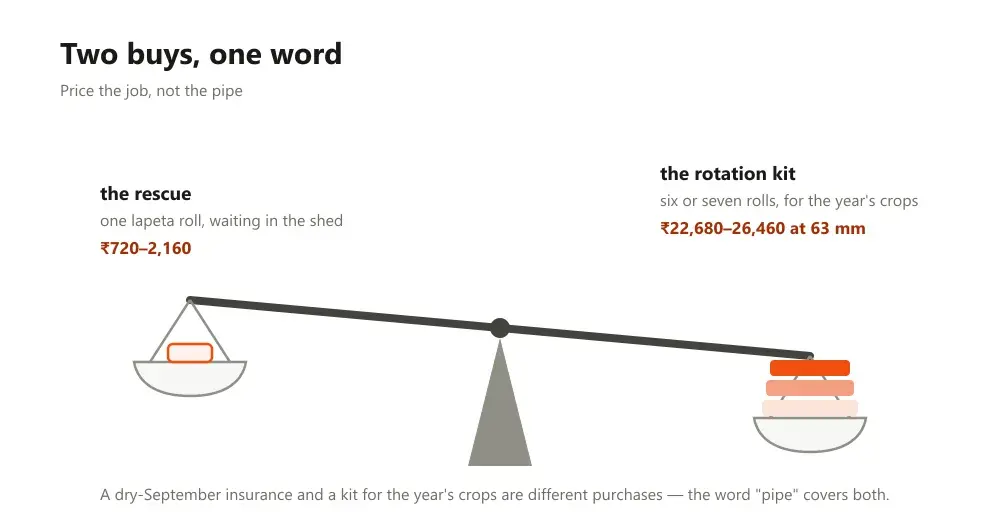
At the house planning width of roughly seven metres — the estimator's one spacing figure, calibrated on the 40 mm — an acre takes nine or ten lines, six or seven rolls. That is ₹7,920 to ₹9,240 at 40 mm; at 63 mm it would be ₹22,680 to ₹26,460 if its reach is no further, and no listing states it. (The estimator plans cotton as drip; it will not rerun this count.)
If its reach is no further, then, the 63 mm costs roughly ₹14,760 to ₹17,220 more per acre, and it earns that only one way: as the rotation's roll, serving the other crops on its list all year while cotton takes a few weeks. A farm wanting only dry-spell insurance is better served by the lapeta guide's ₹720 to ₹2,160 rescue rolls and the shed they wait in — a rescue tool is judged by the years it waits, not the days it works.
From the rain pipe listing, MRP with 5% inside:
- 63 mm × 100 m: ₹3,780 a roll.
- 40 mm × 100 m: ₹1,320 a roll.
Pitfalls with cotton in particular
- **A shorter window than it looks.** Cotton rises fast once it establishes; by early flowering the rows have closed over the throw's useful reach. The shower's season is weeks, not months — plan its second life on the rotation before buying.
- **Owning it for the wrong job.** A common mistake is buying a shower in June for a September rescue the canopy will not let it deliver. Name the job first; the rescue has [a cheaper pipe of its own](/blog/lapeta-pipe-for-cotton).
- **Wind on a young stand.** The sparser the stand, the more the wind moves the spray. Early-morning rounds, while the air is still, put the water on the rows instead of the neighbour's bund.
- **Cutting before testing.** One lateral, run on your own pump, before the field is cut into lines — the far-end dribble is a day-one discovery or a season-long one.
- **The long wait.** Between its cotton weeks and its rotation work, the roll is in storage: drained, coiled loose, off the floor in shade — [the pipe-life guide](/blog/making-your-pipe-last) is short and exact about it.
Buying it for a cotton farm
Name the job out loud before the millimetre: an even start plus a working rotation buys the 63 mm with confidence; a small plot's start alone buys the 40 — often just two rolls, ₹2,640, laid for a month and then moved to the next plot or season; insurance against a dry September buys the other guide's lapeta roll instead. The cotton crop page keeps the agronomy beside the parts, and the water calculator gives the field's peak daily litres — that is boll-week demand for sizing the rescue, not seedling watering.
Rain-pipe joiners, cocks and end closures are not parts we list — source them separately when a layout needs them. For a farm that straddles the cases, send the measurements and we will put honest sizes against your pump, your rotation and your real risk.
Where these numbers come from
- ICAR (opens in a new tab)
Indian Council of Agricultural Research — crop agronomy and regional package-of-practices.
- TNAU Agritech Portal (opens in a new tab)
Crop-wise spacing, water requirement and drip layout references for southern India.
Keep reading
Rain pipe for sugarcane: sizes, prices and pitfalls
Rain pipe for sugarcane has one honest window each cycle — setts to canopy — and this guide covers it: the 75 mm size, prices and pitfalls.
GuidesRain pipe for vegetables: sizes, prices and pitfalls
Where rain pipe for vegetables earns its keep — the leafy, close-sown blocks and the replant rhythm — with sizes, roll prices and pitfalls.
GuidesRain pipe for chilli: sizes, prices and pitfalls
Where rain pipe for chilli genuinely fits — the nursery and the unconverted field — with the right sizes, real roll prices and the pitfalls.